# Patients Can Now Connect Their athenahealth Records to Claude
> athenahealth launched a connector that lets Claude Pro and Max subscribers in the US bring their own lab results, medications and visit history into Claude. Here's how setup works, what you can ask, and which privacy rules cover your records once they're in Claude.
By AI for Mortals Staff · November 2, 2026 · 5 min
Canonical: https://www.aiformortals.co/blog/athenahealth-claude-records
athenahealth, whose software many US doctors' offices use to keep patient records, [launched a connection to Claude](https://www.athenahealth.com/about/press-releases/patients-connect-health-records) on November 2. If your doctor's office runs on athenahealth, you can now ask Claude about your own lab results, medications and past visits, with Claude reading the records themselves.
It's open to Claude Pro and Max subscribers in the US, and athenahealth says its software serves [more than 20% of the US population](https://www.athenahealth.com/about/who-we-are).
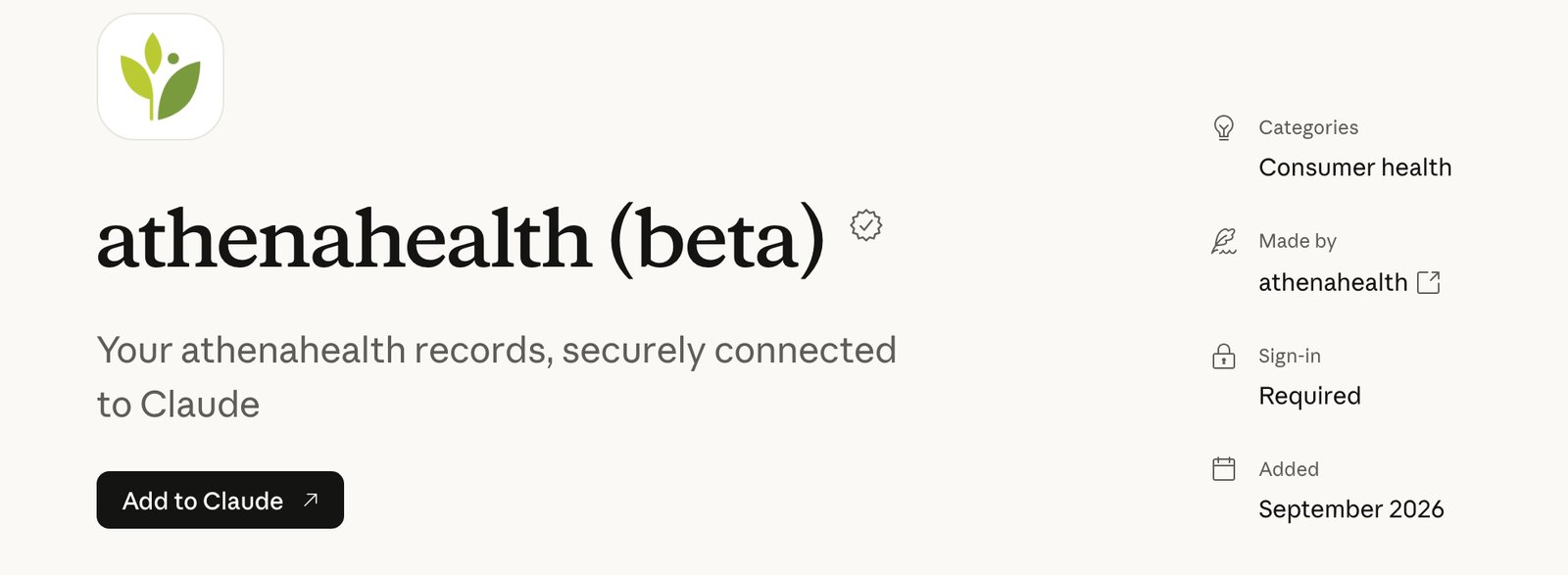
The athenahealth connector is listed as a beta in Claude's directory. From Claude's connector directory
## How to connect your athenahealth records to Claude
You need two things: a Claude Pro or Max plan in the US, and an account on athenahealth's patient portal, the login your doctor's office gave you for checking results and messages.
Anthropic [renamed its Max plans](https://www.aiformortals.co/blog/claude-ultra-plan) last week: the $100 plan is still called Max, and the $200 plan is now Ultra. athenahealth's announcement names Pro and Max and doesn't say whether Ultra subscribers can use the connector.
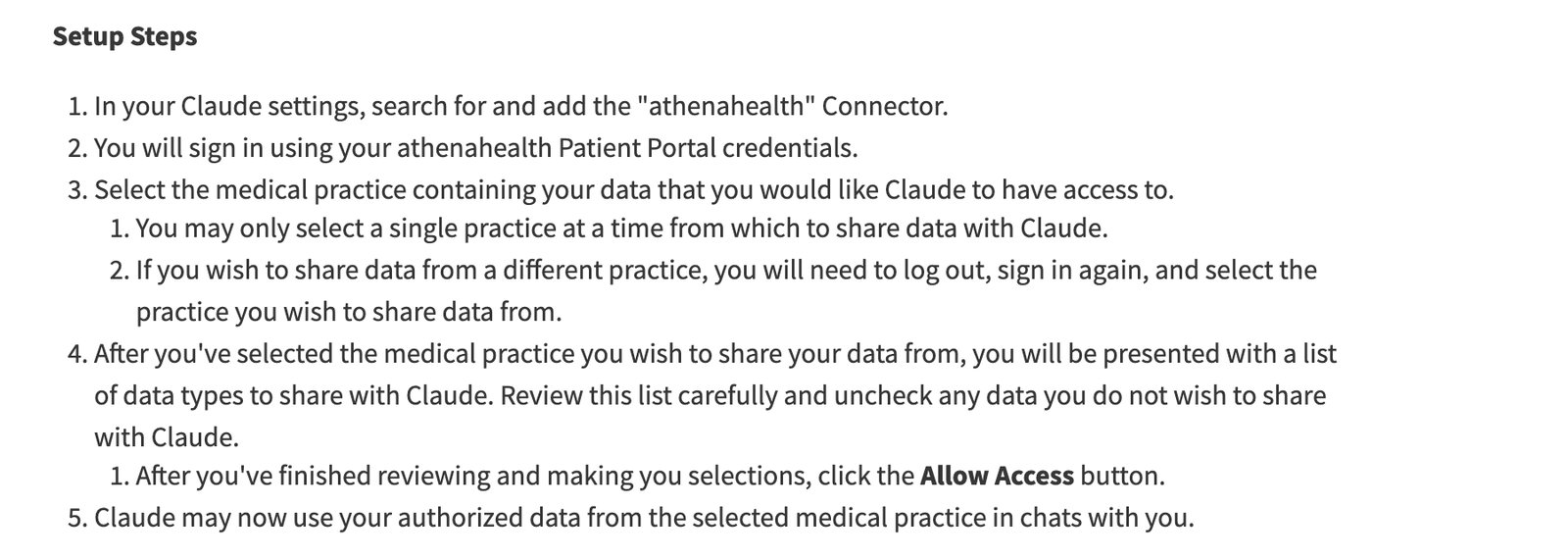
[athenahealth's setup guide](https://docs.athenahealth.com/api/guides/athenapatient-mcp) walks through it in four steps:
1. In Claude's settings, search for the **athenahealth** connector and add it.
2. Sign in with your athenahealth patient portal login.
3. Pick the doctor's office whose records you want Claude to see.
4. Uncheck any kind of record you'd rather keep out of Claude, then click **Allow Access**.
athenahealth's own setup steps, including the one-practice-at-a-time rule. From athenahealth's developer docs
You can only share one practice at a time. If you see doctors at two offices that both use athenahealth, you have to sign out, sign back in and pick the other office to switch.
As for what Claude gets from that sign-in, athenahealth says your login [isn't shared with Claude](https://www.fiercehealthcare.com/ai-and-machine-learning/athenahealth-launches-tool-bring-patient-health-records-anthropics-claude) and the connection is encrypted. You can take back access at any time, and you can see or disconnect every app linked to Claude under **Settings → Connectors**, next to ones like [Google Docs, Sheets and Slides](https://www.aiformortals.co/blog/claude-google-workspace).
## What you can ask Claude about your medical records
Once you allow access, Claude can draw on your lab results, vitals, medications, health conditions, immunizations, visit history, diagnostic reports, allergies, procedures and care plans, [according to athenahealth's announcement](https://www.athenahealth.com/about/press-releases/patients-connect-health-records).
athenahealth's guide gives three sample questions: one that pulls a fact from your record ("What are my current medications?"), one that makes a chart ("Can you create a graph of my recent blood pressure values?") and one that asks what LDL and HDL are, after fresh lab work before a checkup.
Here are a few more to paste in once you're connected:
> Make a table of my lab results from the past two years. Mark anything that was flagged as high or low, with the date.
> I have a checkup next week. Based on my recent visits and current medications, write a short list of questions I should ask my doctor.
> Summarize my last three visits in plain language: why I went, what was done, and any follow-up I was told to do.
Claude's directory listing for the connector also suggests asking Claude to review what happened at a recent visit.
## Where athenahealth draws the line on medical advice
athenahealth [told ZDNET](https://www.zdnet.com/health/athenahealth-claude-ai-medical-partnership/) the connection doesn't give medical advice, and that questions about a diagnosis, a treatment or changes to your care should still go to your doctor.
The listing in Claude's directory says the same thing: Claude helps you understand your existing records, doesn't diagnose conditions or make clinical decisions, and "always points you back to your care team for medical advice."
So the questions that work best are the ones about what your records say. What a result means for your own treatment is still a conversation for your appointment.
## How this differs from HealthEx, Claude's other way to link records
Claude already had one way in for health records. Since January, Claude Pro and Max subscribers in the US could [link their records](https://www.anthropic.com/news/healthcare-life-sciences) through HealthEx, a service that gathers records from different doctors, along with Function, a lab-testing service, and Apple Health and Android Health Connect.
The two work differently. [HealthEx asks you](https://claude.com/resources/tutorials/using-the-healthex-connector-in-claude) to verify your identity with CLEAR, using biometrics and a government ID, and then pulls records from many providers into one place. athenahealth's connector comes straight from the records company, uses the portal login you already have, and covers one practice at a time.
## Why HIPAA stops covering your records once they're in Claude
HIPAA, the US law that protects your records at your doctor's office, usually [doesn't cover records you share](https://www.forbes.com/sites/jessepines/2026/10/03/heres-how-anthropic-is-aiming-to-transform-healthcare/) with a consumer app like Claude. That holds whichever route you use, athenahealth or HealthEx.
Once your records are in Claude, what protects them is Anthropic's own policies. Anthropic says it [doesn't train its models on users' health data](https://www.anthropic.com/news/healthcare-life-sciences), and its rules are written in its [Consumer Health Data Privacy Policy](https://anthropic.com/legal/consumer-health-data-privacy-policy).
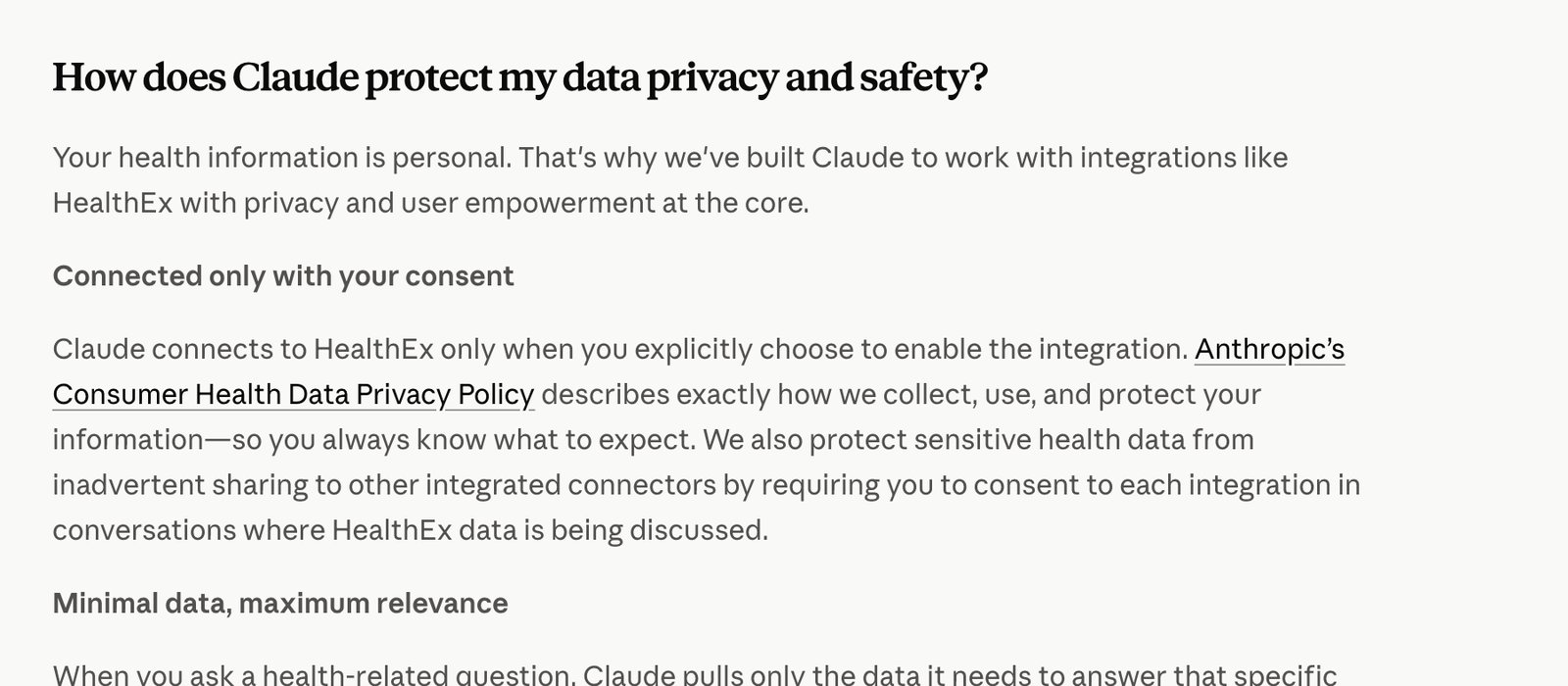
Anthropic's privacy promises for health records, written for its HealthEx connection. From Claude's HealthEx guide
Anthropic's guide for HealthEx goes further. It says chats that use HealthEx are never used for training, Claude pulls only the parts of your record a question needs, and Claude's memory doesn't carry your health data into future conversations. athenahealth's announcement doesn't say whether the training and memory rules in Anthropic's HealthEx guide apply to its connector too.
It's the same question to ask about any personal account you link to an AI app, like the bank accounts behind ChatGPT's [Finances dashboard](https://www.aiformortals.co/blog/chatgpt-finances-free), which opened to free users last month.
## Sources
- [athenahealth: athenahealth launches new solution to let patients connect their health records to Anthropic's Claude](https://www.athenahealth.com/about/press-releases/patients-connect-health-records)
- [athenahealth: athenaPatient MCP setup guide](https://docs.athenahealth.com/api/guides/athenapatient-mcp)
- [Claude: athenahealth (beta) connector listing](https://claude.com/marketplace/connectors/athenahealth)
- [Anthropic: Advancing Claude in healthcare and the life sciences](https://www.anthropic.com/news/healthcare-life-sciences)
- [Claude: Using the HealthEx connector in Claude](https://claude.com/resources/tutorials/using-the-healthex-connector-in-claude)
- [ZDNET: Athenahealth patients can ask Claude about their medical records now](https://www.zdnet.com/health/athenahealth-claude-ai-medical-partnership/)
- [Fierce Healthcare: athenahealth launches tool to bring patient health records to Anthropic's Claude](https://www.fiercehealthcare.com/ai-and-machine-learning/athenahealth-launches-tool-bring-patient-health-records-anthropics-claude)
- [Forbes: Here's how Anthropic is aiming to transform healthcare](https://www.forbes.com/sites/jessepines/2026/10/03/heres-how-anthropic-is-aiming-to-transform-healthcare/)