# Which AI to Use for Which Writing Job at Work
> ChatGPT, Claude and Gemini each win different writing jobs. Here's which to open for cold emails, landing pages and ads, plus the check to run before anything ships.
By AI for Mortals Staff · November 23, 2026 · 9 min
Canonical: https://www.aiformortals.co/blog/best-ai-for-copywriting
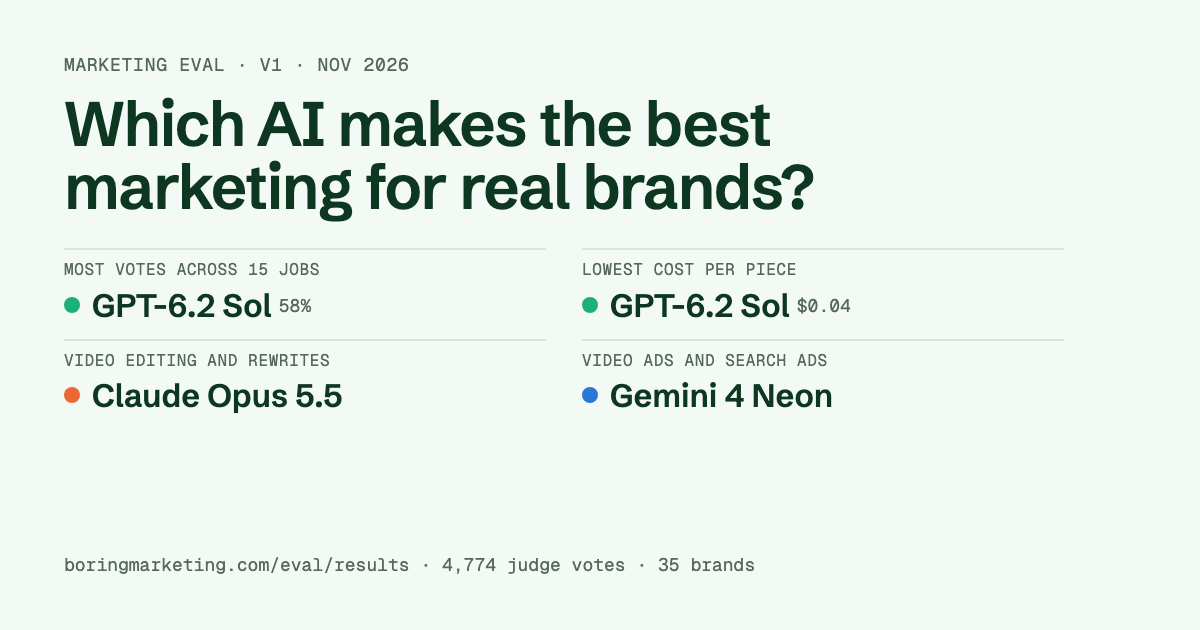
The best AI for copywriting depends on what you're writing. A new blind test put the top model from ChatGPT, Claude and Gemini on 15 marketing jobs, and each one won different jobs: GPT-6.2 Sol took cold emails and campaign plans, Claude Opus 5.5 took landing pages and headlines, and Gemini 4 Neon took video ads and Google search ads.
So we ran our own version on a small business, with three jobs most people write at work: a cold email, a landing page and a Facebook ad. Some of the big test held up and some of it flipped, and one result held in both tests: the model that stayed closest to the facts.
Below is the cheat sheet, what our test found, and the two prompts that catch made-up claims before a customer sees them.
## The cheat sheet: which AI to use for each writing job
The test was [published by the marketing agency Boring Marketing](https://boringmarketing.com/eval/results) on November 19. Each model wrote for 35 real brands, including Figma, Notion, Zapier and WHOOP, from the same fact sheet per brand, all at their highest reasoning setting.
The judges were AI models too, 4,774 votes in all. Each pair of drafts was judged blind, in both orders, by a model from the lab that wasn't in the pair, so no model ever scored its own lab's work.
The test's headline results: Sol won the most votes overall, but each model owned different jobs. Source: Boring Marketing's results page
Here's the pick for each writing job, and the share of its head-to-head votes the winner took. ChatGPT means GPT-6.2 Sol, Claude means Opus 5.5 and Gemini means 4 Neon:
| Job | Use | Votes won |
|---|---|---|
| Cold emails | ChatGPT | 92% |
| Campaign plans | ChatGPT | 91% |
| Long sales pages | ChatGPT | 78% |
| Welcome emails | ChatGPT | 69% |
| Instagram posts | ChatGPT | 67% |
| Landing pages | Claude | 62% |
| Facebook ads | Claude | 64% |
| Headlines | Claude | 59% |
| Rewriting a flop | Claude | 66% |
| Google search ads | Gemini | 70% |
| Video ads | Gemini | 75% |
| YouTube titles | Gemini | 61% |
The runners-up can be close or far behind. On cold emails Claude took 52% and Gemini 6%, and on landing pages ChatGPT took 56% and Gemini 31%.
Two things to know before you lean on it. Overall, the three models came out statistically tied: their ranges overlap, so any of them could rank first. And some rows rest on small samples, like cold emails, which were written for 4 software brands and judged in 72 votes.
The table is a good place to start, then. Our own test below shows how much a single brief can move it.
## Use ChatGPT (GPT-6.2 Sol) for cold emails and anything that must stick to the facts
Sol won the jobs where the hard part is deciding what to say: cold emails, campaign plans, long sales pages and positioning. Its winning cold emails opened on one problem the reader would recognize and ended with an easy question to answer.
It was also the cheapest model in the test, at about 4 cents a piece through the API.
The bigger reason to make it your default: Sol was the only model whose every claim about a brand was backed by the brand's facts, 100% of the time. Claude's were backed 79% of the time and Gemini's 90%.
Keep Sol away from anything visual. When each model edited the same footage into a short video ad, Sol's edits won 23% of the votes.
## Use Claude (Opus 5.5) for landing pages, headlines and rewrites
Opus won the pieces people judge in a second: the first screen of a landing page, headlines, Meta ads and rewrites of posts that flopped. Its rewrite of a Zapier post that flopped on X beat the real post in all 4 of its votes, by opening on the problem the reader feels before naming any product.
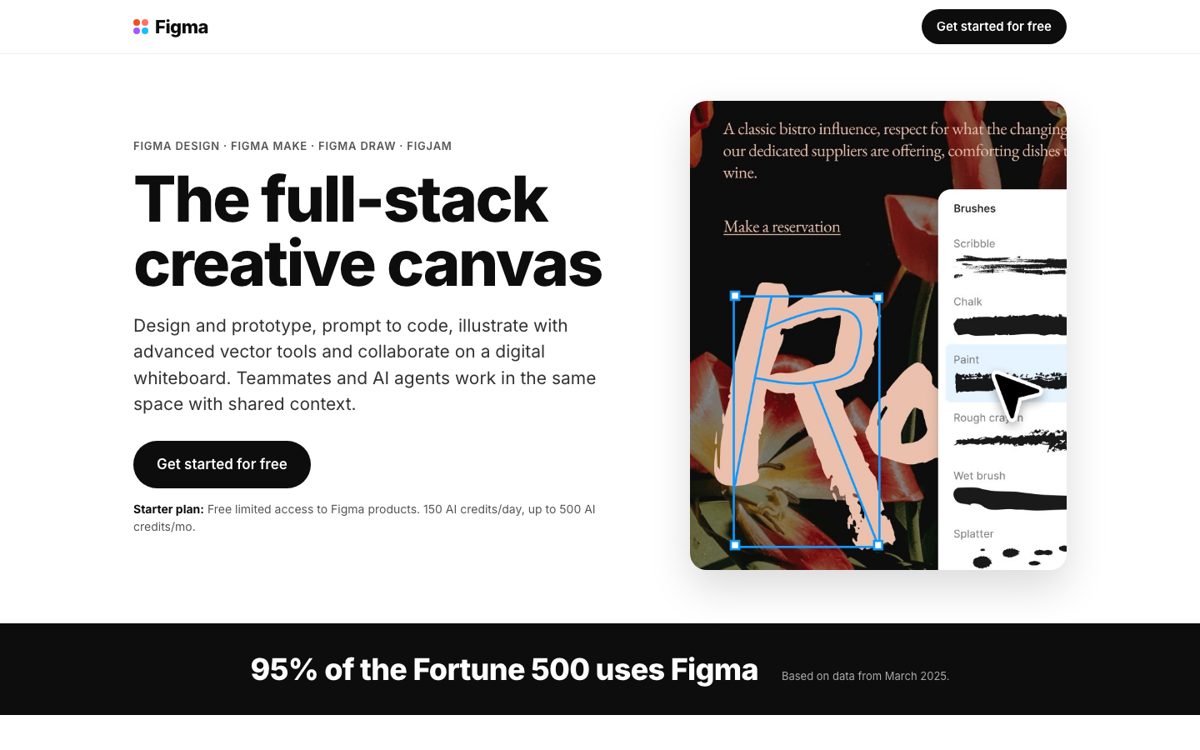
Opus's landing page for Figma, made for the test (not by or for Figma). It won 75% of its votes on that page. Source: Boring Marketing's results page
When judges from two labs outside the race, Kimi and Qwen, judged the same copy again, they put Opus first on copywriting, 66% to Sol's 42%.
Opus has one habit to watch: it adds details that weren't in the facts you gave it. Most were true, like the fact that a Solo Stove fire pit burns wood, and a few were wrong, like calling a feature free when it comes with a grant. If you use Claude for writing a lot, it also helps to [teach it your writing style](/blog/teach-claude-your-writing-style) first.
## Use Gemini (4 Neon) for video ads and Google search ads, then cut the copy
Gemini finished last overall but won the ad jobs: video ad briefs (75%), Google search ads (70%) and YouTube titles and thumbnails (61%).
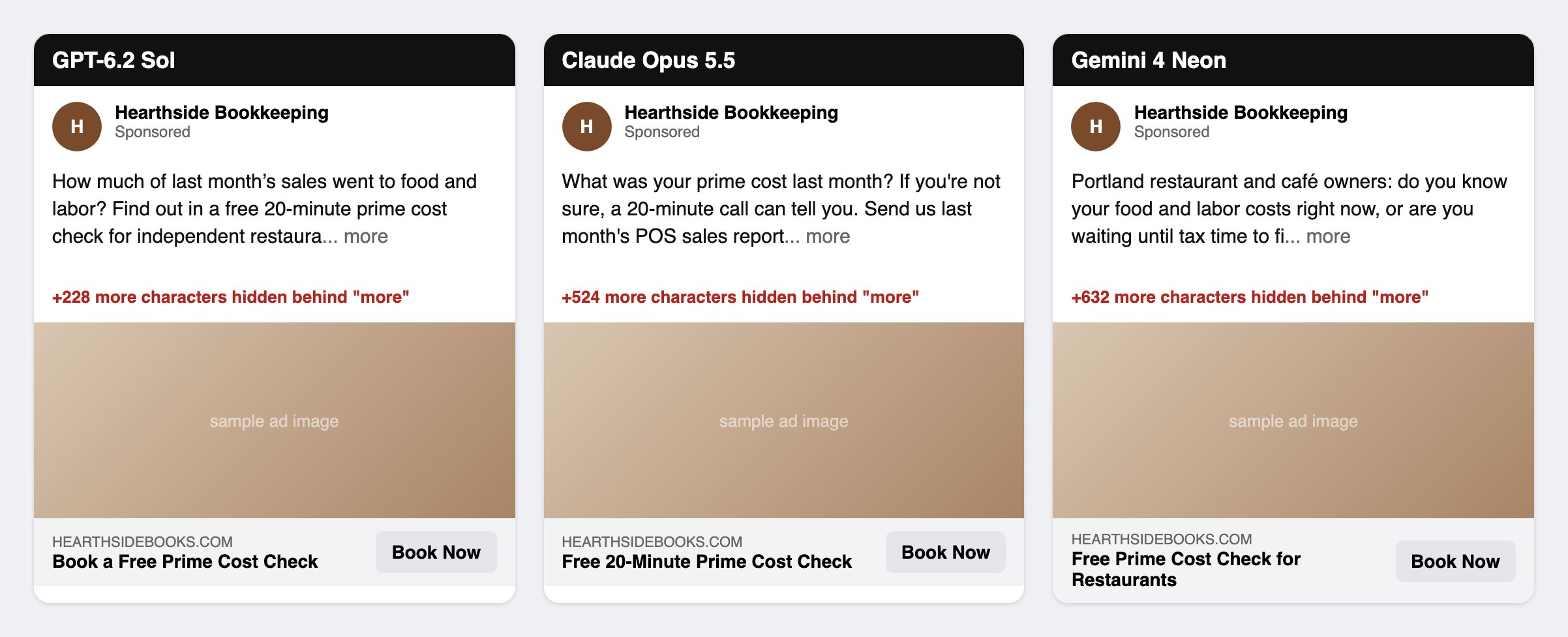
It also writes long. Its ad text was the longest in almost every matchup, while Facebook and Instagram show only about the first 125 characters before "more." When the test scored the words alone with length held equal, Gemini dropped from first to last.
So use Gemini to make the ad, then trim the text (the prompt is below). Skip it for emails and plans, where it won 6% of the cold email votes and 9% of the campaign plan votes.
## We gave all three the same cold email, landing page and ad
We made up a small business with a one-page fact sheet: Hearthside Bookkeeping, a Portland firm run by a former restaurant manager, Maya Ortiz, that does monthly books for independent restaurants. Its offer is a free 20-minute "prime cost check." The sheet had prices, the founder's background, 23 local clients, one real-sounding customer quote, and the two things the firm doesn't do.
Each model wrote three pieces, twice: a cold email to a restaurant owner opening a second location, the first screen of a landing page, and a Facebook and Instagram ad. We ran Sol through Codex and Opus through Claude Code at high effort, and Neon through Google's API at high thinking, with the same prompt each time and no rules about sticking to the facts.
Then we judged the 18 drafts the way the big test did: blind pairs, both orders, by the model from the third lab. That's 36 votes.
| Job | Won our votes | Won the big test |
|---|---|---|
| Cold email | Claude, 6 of 8 | ChatGPT, 92% |
| Landing page | Gemini, 7 of 8 | Claude, 62% |
| Facebook ad | Claude, 8 of 8 | Claude, 64% |
Across all 24 of its votes, Claude won 16, Gemini 15 and ChatGPT 5. On made-up claims the order flipped: ChatGPT had none in its 6 drafts, while Claude and Gemini each had at least one in 3 of their 6.
Sol lost the cold email, the job it won with 92% in the big test. Its emails were the shortest and left out the proof: neither mentioned the 23 local clients, and the judges kept picking the drafts that did. One judge said the winning email "earns far more trust" from a busy owner by adding local proof.
Gemini won the landing page with a headline that put the payoff and "free in 20 minutes" up front, followed by three bullets of proof.
Opus swept the ad. Both of its ads opened on a question an owner could answer from last month's numbers and put the free 20-minute check on screen before the cutoff.
Each model's real ad text from our first run, shown as the feed would cut it at 125 characters (our mock-up of the card). Gemini's ads ran about twice as long as Opus's.
The made-up claims matched the big test exactly. Sol made no claim the sheet didn't back in any of its six drafts.
Opus called the free check "a 20-minute call" in two drafts, though the sheet never says how it happens, and quoted "$600 a month" for two locations, though the base price only covers a restaurant doing up to $150,000 a month in sales. Gemini promised an "exact" prime cost number, said the report lands "in your inbox," and called Maya someone "who knows hospitality margins firsthand." None of those were in the facts.
On speed, Opus wrote each piece in 3 to 18 seconds, Sol in 9 to 15, and Gemini in 20 to 37.
## How to pick the best AI for copywriting on your own work
Our test was one made-up business and 36 votes, while the big one covered 35 brands and 4,774. The big table is the better guide on average. Ours shows how much one brief can move it: what the judges wanted here was proof, and the model that packed the most proof into each piece won.
Three habits held up in both tests:
- **Give every model the same fact sheet.** Your offer, prices, real numbers, real reviews, and what you don't do. The more real facts a model has, the less it fills in on its own.
- **For anything that matters, run it through two models and compare.** A cold email campaign or a landing page is worth the extra minute. Start with the table's pick and use the other as a challenger.
- **Ask for the proof you want in the piece.** If Sol is your default, tell it to include your strongest proof point, since its drafts in our test were the leanest.
Then check the draft before it goes out.
## Check every draft with a second AI before it ships
The big test's fix for invented details was a fact check by a model from a different lab. We ran it on all 18 of our drafts with both other models as checkers.
Two checkers caught more than one. Sol flagged Opus's "20-minute call" both times, while Gemini caught it once and missed it once. Sol was also the strictest, flagging a few lines that were fine, so read the list it gives you and decide.
Start by keeping the writer on your facts. Paste this before the job:
```
You're writing [the piece] for [business]. Use only the facts below. Don't add numbers, prices, offers, features, customers, quotes, reviews, awards or dates that aren't in them, and keep every fact exact. If you need a fact that isn't here, write [NEED: the fact] instead of guessing.
Facts:
[paste your fact sheet, website copy and real reviews]
```
The [NEED] line is the useful part: the model flags each missing fact, so you can fill it in yourself.
Then open a different chatbot, from a different company than the one that wrote the draft, and paste this. If Claude wrote it, check it in ChatGPT.
```
Below are the only facts known about [business], then a draft. List every claim about the business or its products that these facts don't support, quoted exactly. If there are none, say "none".
Facts:
[your fact sheet]
Draft:
[the draft]
```
If the answer isn't "none," fix those lines before anyone sees the draft.
For Gemini's long ads, this trim worked on our test. It took Gemini's 757-character ad down to about 430 and put the hook and the offer in the first 124 characters:
```
Here's the primary text for a Facebook and Instagram ad. The feed shows about the first 125 characters before "more". Rewrite it so the hook and the offer land in those 125 characters, then cut the rest to two short lines. Keep every fact exact.
[paste the ad text]
```
## Where to find each model on your plan
- **ChatGPT:** GPT-6.2 Sol runs the Chat tab on Plus, Pro, Business and Enterprise since November 23 ([what changed](/blog/gpt-6-2-sol-chat)). Free and Go plans don't have it.
- **Claude:** Opus 5.5 is in the model menu on Claude Pro and up.
- **Gemini:** Neon is the top model on Google AI Pro and also comes with Ultra. Our [guide to the Gemini models](/blog/best-gemini-model-neon-hydrogen-carbon) covers which plan gets what.
The big test ran every model at its high reasoning setting. If your app offers a longer-thinking option, use it for anything you'll send to a customer.
If you only pay for one, the table still tells you where it's weak, and the fact check works with a free account at a second company. For a wider look at the three on everyday work, see our [ChatGPT vs Claude vs Gemini comparison](/blog/claude-vs-chatgpt-vs-gemini) and [the best AI for writing](/blog/best-ai-for-writing) in general.
## What none of them can do yet
The brands' own best work still won. Against a brand's proven winning post, the AI version won 19% of votes, and against the brand's flops it still won only 32%.
Judges aren't customers either. The AI judges favored ads with more words, while the brands' real winners averaged 24 words against 34 for their flops.
So treat any of these models as a fast first draft, keep your own best work next to it, and let real results decide what runs. Pat put three of the same top models on one build in this video:
Pat gives Opus 5.5, Fable 5.1 and GPT-6 the same app to build and compares the raw results.
## Sources
- [Boring Marketing: Which AI makes the best marketing for real brands? (results, method and every job)](https://boringmarketing.com/eval/results) (November 19, 2026)
- [OpenAI: ChatGPT release notes (GPT-6.2 Sol in the Chat tab)](https://help.openai.com/en/articles/6825453-chatgpt-release-notes)
- [Gemini Help: About Gemini models (which plan gets which model)](https://support.google.com/gemini/answer/18648722)
- [Gemini on X: Gemini 4 Neon for Google AI Pro and Ultra](https://x.com/GeminiApp/status/2123168704662012079) (November 18, 2026)
- AI for Mortals test: 18 drafts from a made-up business's fact sheet (GPT-6.2 Sol via Codex, Claude Opus 5.5 via Claude Code, Gemini 4 Neon via the Gemini API), 36 blind cross-lab votes and 36 cross-lab fact checks, November 23, 2026