# We Let Claude Direct a 15-Second Video Ad. Here's What It Cost
> We wrote the script. Claude cast it, shot it, checked every take and cut the ad for $7.71 in video generation and 28 minutes of work.
By AI for Mortals Staff · November 24, 2026 · 10 min
Canonical: https://www.aiformortals.co/blog/claude-video-generation-ad
Claude can now direct the AI models that make video. To test Claude video generation on a real job, we wrote a 15-second ad for a made-up bike shop and handed Claude the script, a mood board written in words, a $15 budget and access to Google's image and video models.
Claude cast the two actors, locked the look in still images, shot every scene, checked each take, retook what was wrong and cut the finished ad with music and an end card. We gave notes like a client would and never touched a frame ourselves.
The generation bill came to **$7.71**. Here's the ad, what each step cost, and what Claude couldn't fix.
The finished 15-second ad. Every shot, voice and the guitar bed was generated; Claude planned it, checked it and cut it together (sound on).
## Can Claude generate video?
Not directly. Claude writes, plans and looks at images, but the pictures and clips come from video models such as Google's Gemini Omni, Kling, Seedance or Veo. What changed this year is that Claude can drive those models for you through connectors, so you talk to Claude and it does the production work.
That's how a tech publication made its Black Friday ad on Monday: an 80s-style infomercial with a made-up pitchman. Its head of marketing wrote the script, briefed Claude with it and a mood board, and let Claude run production in the AI canvas app Flora. It cost about $43 in Flora usage plus the Claude tokens, took two days alongside other work, and got more than 21,000 views on X in its first day.
Every All Access is now only $388 for a year. It comes with over $8,000 in AI credits from @OpenAI, @AnthropicAI, @NotionHQ, @Google, and more.
We wanted to know what the same approach takes on a smaller, plainer job, the kind of short promo a marketer or a small-business owner gets asked for with no budget or crew.
## How we set up the test
We wrote the script ourselves, since a hook is the part you shouldn't hand off. It had three five-second beats for Northside Bike Repair, a one-room shop whose pitch is "drop it off, grab a coffee, it's fixed in 20 minutes":
- A commuter on a wet sidewalk stares at a flat front tire. Narrator: "Flat tire on the way to work?"
- In the shop, the mechanic spins the wheel on the repair stand and tells the camera: "Drop it off. Grab a coffee."
- The commuter rides off down a sunny street with a coffee in the handlebar holder. Narrator: "Northside Bike Repair. Fixed in twenty minutes."
The mood board was a paragraph: warm 35mm film, soft morning light, teal and orange, real people instead of models, friendly and never slick. The rules were a $15 cap on generation spend, stills before any video, and a 15-second 720p file with sound at the end.
Claude ran as Claude Fable 5.2 on high effort in Claude Code, the same model the infomercial was directed with. Instead of Flora, we gave it a small script that calls Google's Gemini 3.1 Flash Image for stills and Gemini Omni 1.2 Flash for video, and logs the real cost of every call. Claude could look at any still, pull frames out of a clip to check it, and send a clip to Gemini to listen to it, since Claude can't hear audio.
## Round 1: Claude cast the ad and locked the look in stills
Before making any video, Claude wrote a shot list and a plan for keeping the two people and the bike the same across shots. Its approach was to make one approved photo of each actor and one of the bike, feed those photos into every later image, and then start each video clip from an approved still so the model can't invent a new face.
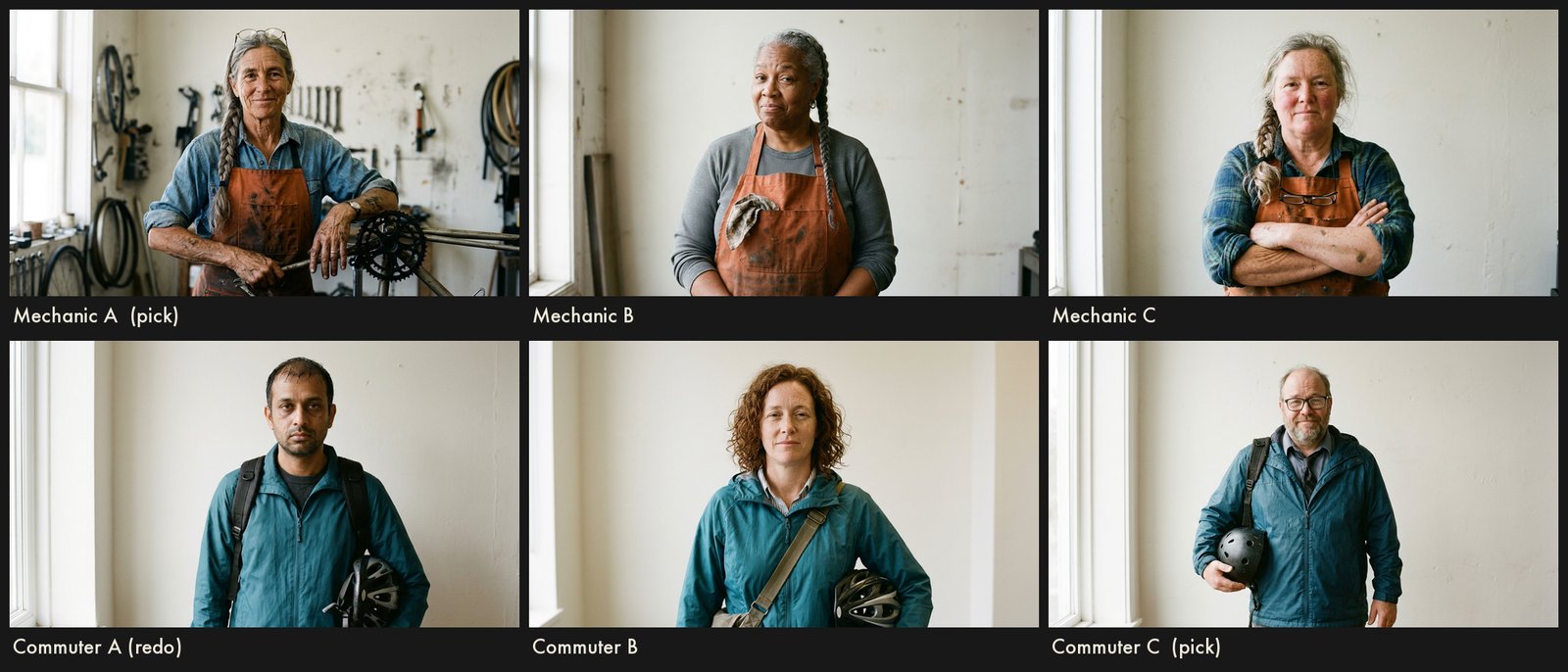
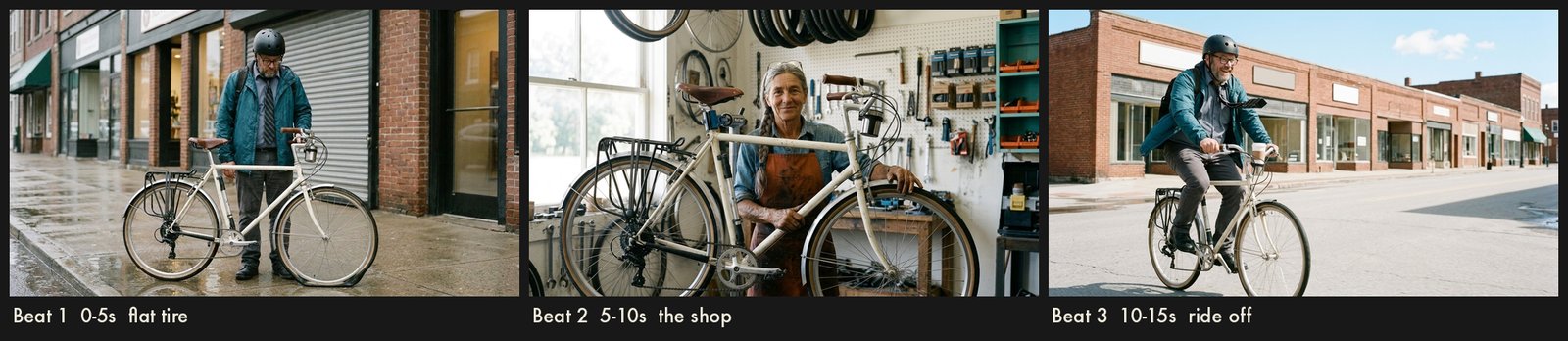
It then made a casting slate of three mechanics and three commuters, looked at each one, threw out a commuter who "read as a model" and redid him, and made a picture for each beat of the script.
Claude's casting slate. It picked mechanic A and commuter C and explained why: the braid, the apron, the glasses and the beard give the video model strong details to hold onto from shot to shot.The approved still for each beat. The first try at beat 1 had a fully inflated tire, so Claude edited only the tire.
That round took about six minutes and cost **$1.43** for 16 stills. Each still came to about 9 cents, a third more than the 6.7 cents Google lists per image, because the model's thinking and the reference photos are billed too.
Claude also sent back a list of what worried it about the video stage. The list included the narrator coming back as two different voices, the model putting the narrator's words in the commuter's mouth, the flat tire reinflating once things moved, and the coffee cup falling out of the holder. Most of those turned out to be real problems.
## Round 2: our blunt notes, and what Claude did with them
We answered like a client. "He looks bored, not annoyed. I want a man whose morning just got ruined, and it should actually be raining." "She should be dry and a little deadpan, not a greeting-card smile." "The coffee must be in the holder, not in his hand." "If the voice sounds like a cheesy radio ad, that's a retake."
Claude edited the approved stills first (rain added, a scowl on him, the smile off her), then started the video. Its notes on every take were specific:
| Take | Cost | Claude's call |
|---|---|---|
| Shot 1, take 1 | $0.42 | Rejected: good sigh, but no rain falling |
| Shot 1, take 2 | $0.43 | Kept, with rain added in the edit |
| Shot 2, take 1 | $0.43 | Rejected: line ran past 5 seconds, ended on a smile |
| Shot 2, take 2 | $0.42 | Kept: deadpan to the last frame |
| Shot 3, take 1 | $0.43 | Kept on the first try |
| Narrator, 3 takes | $1.69 | Kept take 2, dropped an "announcer" take |
| Guitar bed | $1.05 | Kept, used as audio only |
The rejected shop take shows how close a failed take can look to a good one. Her line ran past the five seconds the shot had, and she broke into a warm smile at the end, the exact thing we'd asked her not to do.
A take Claude rejected: the line runs long and she smiles at the end. The retake fixed both for 42 cents.
Two of Claude's fixes were things we wouldn't have thought to ask for. To keep one narrator voice across shots 1 and 3, it generated both narrator lines in a single clip, cut them apart and laid them over the two shots, which it had generated without sound. And when two takes in a row wouldn't show real falling rain, it kept the better performance and built a rain layer in the edit, then rebuilt that layer when Gemini said the first version looked "added".
The round took about 17 minutes and cost **$5.14**. Video cost exactly Google's listed 7 cents a second.
## Claude can't hear the ad
Claude flagged this one itself, at the top of its report: "I cannot hear." Every judgment about the voices and the music came from asking Gemini to listen, and Gemini was an unreliable judge of tone. Asked the same question twice about the mechanic's line, it scored it 3 and then 7 on a 10-point "radio announcer" scale.
So Claude could prove the words were right, the timing fit and both narrator lines were one voice. Whether the narrator sounds warm and dry or like a radio ad is a call you have to make with your own ears. It left us a second cut with the other narrator take, in case we didn't like the first.
## Round 3: fixing what a viewer would notice
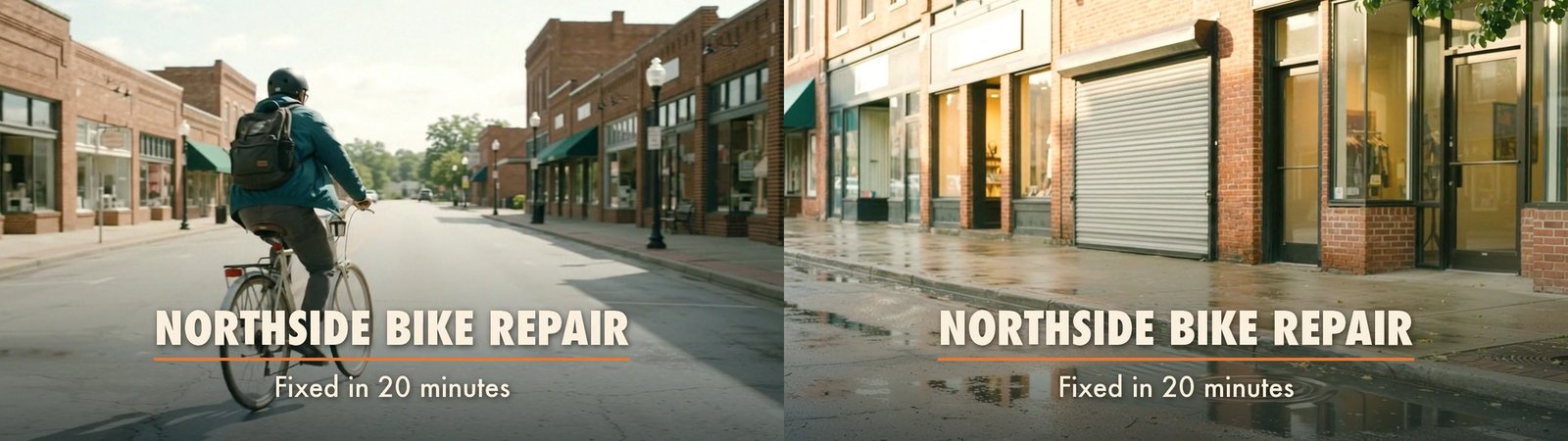
We had two notes left, and both were things a viewer would spot in a second. The end card's text sat on top of the rider's back wheel as it faded in, and the last shot was plainly a different street from the first.
Claude built a new first frame for shot 3 out of the shot 1 frame itself, so the green awning, the shutter and the brick pier are the same ones, now in warm sun on wet pavement. Its first reshoot followed him down the road and drifted onto a new street again, so it rejected that take. The second holds the camera on the block while he rides through and out of frame, and the end card fades in over the empty street.
The end card before our note (left) and after (right). The reshoot uses the same block as the opening shot and lets the rider leave the frame before the title appears.
Claude also caught its own reviewer making a mistake. Gemini said the commuter was holding the coffee, so Claude enlarged the handlebars in six frames, found the cup in the holder the whole time and his hand resting beside it, and wrote that down instead of reshooting.
That round took about 5 minutes and cost **$1.14**. Claude was upfront about the trade: he now rides out of frame instead of away down the street, and a window and a tree branch late in the shot don't quite match the opening.
## What it cost and how long it took
| Step | Cost | Time |
|---|---|---|
| Round 1: stills | $1.43 | 6 min |
| Round 2: video | $5.14 | 17 min |
| Round 3: fixes | $1.14 | 5 min |
| **Total** | **$7.71** | **28 min** |
That's what Google billed for the images and video. The Claude side ran on a Claude subscription, so it cost us nothing extra, but Claude Code reports what the same work would cost at API prices: about $9.79 in Fable 5.2 tokens, more than the video itself. Fable read millions of tokens of its own notes, prompts and image checks over the three rounds, and that adds up fast if you're paying per token.
For comparison, the 39-second infomercial cost about $43 in Flora, and its maker estimates a real shoot would have run $15,000 at the very least.
## What broke, and what Claude couldn't fix
- **Rain.** The video model kept dropping the falling rain even when the start frame had it. The rain you see in shot 1 is partly an effect Claude added in the edit.
- **Small continuity slips.** In the shop, the front tire doesn't look flat, and a window and a branch at the end of the last shot don't match the first. The bike's rear fender is shorter in one shot.
- **Voice quality.** Claude can't hear, and the AI listener it relied on gave the same line different scores. A person has to sign off on every voice.
- **Rain to sunshine in ten seconds.** That was our script, and it's the joke, but Gemini's review flagged it as abrupt, and some viewers will too.
None of these would stop a small business from posting the ad. All of them are things a human director would catch in a few minutes of watching.
## How to make an AI video ad yourself
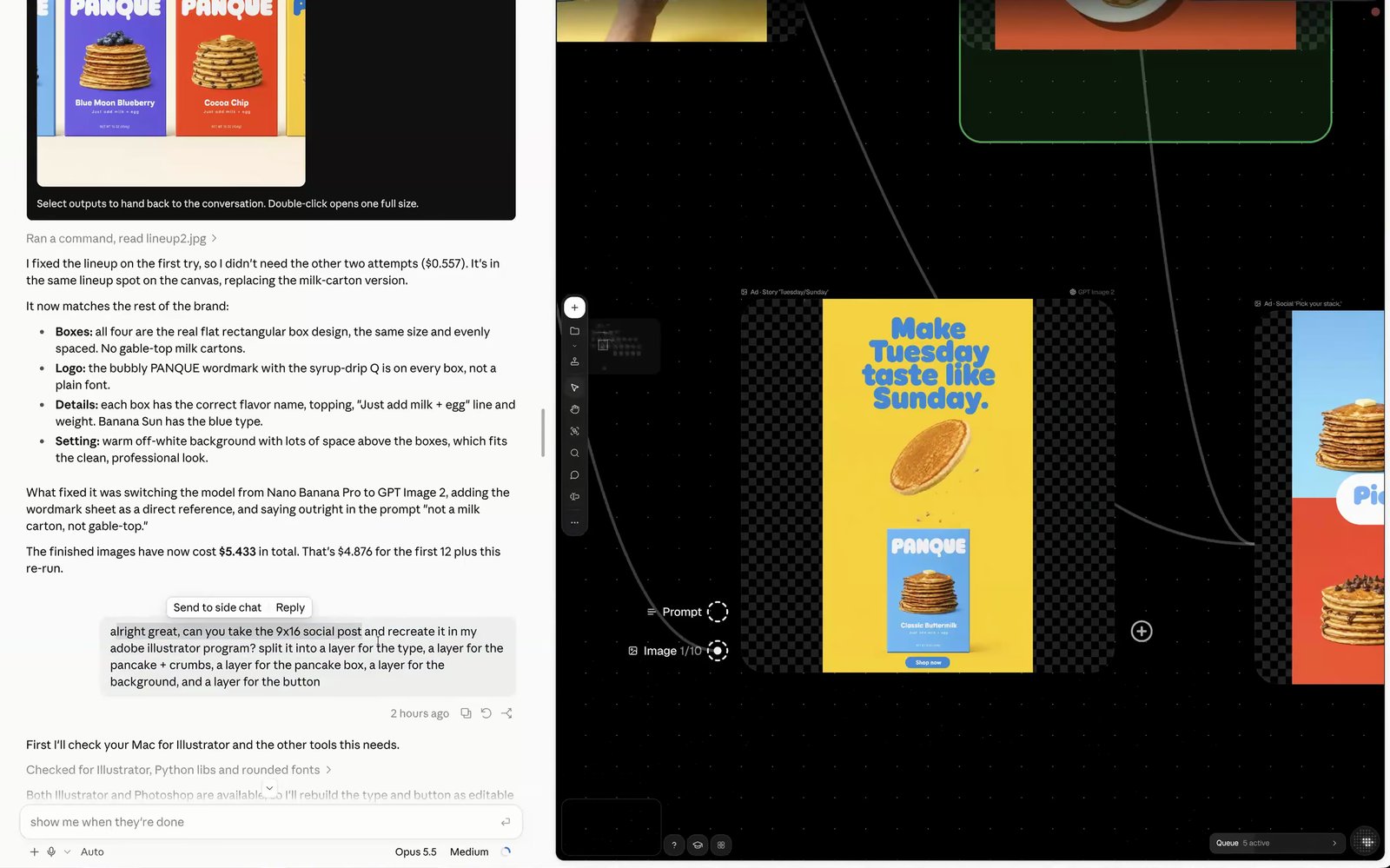
You don't need Claude Code or our script to try this. The easiest no-code route is Flora's connector, which lets the regular Claude app make images and video on a Flora canvas.
Claude working in a chat on the left while its images land as nodes on the Flora canvas on the right (Flora).
1. Make a Flora account. The free plan includes about $2.50 of image generations but no video; video starts on the Starter plan at $18 a month, and each plan's price is also its monthly usage budget.
2. In Claude, open **Customize → Connectors → Add custom connector**, name it Flora and paste `https://agents.flora.ai/mcp`. Click **Connect** and sign in to Flora.
3. In a new chat, turn Flora on from the **+** menu, then paste your script, your mood board and a budget.
4. Approve the casting and the stills before any video gets made. Flora's own guide says a clip costs 30 to 90 times as much as the still it starts from.
5. Give notes in plain words, and listen to every voice yourself.
Flora asks the agent to quote a price before it spends, and its list puts most stills at about 5 cents and five-second clips at roughly 30 cents to $10 depending on the model. In Claude Code, the install is one line:
```
claude mcp add --transport http flora https://agents.flora.ai/mcp
```
If you'd rather see more of what these video models can do first, our [guide to the best AI video generators](https://www.aiformortals.co/blog/ai-video-generators-guide) compares them by job, and our [Gemini Omni 1.2 Flash test](https://www.aiformortals.co/blog/gemini-omni-flash-1-2-tested) covers the model we used here. For editing your own footage with Claude instead of generating it, see [how Claude Opus 5.5 does most of a Premiere Pro edit](https://www.aiformortals.co/blog/opus-5-5-edits-my-videos-premiere) and [HyperFrames, HeyGen's free tool for making videos with Claude](https://www.aiformortals.co/blog/hyperframes-studio).
## Prompts to copy for an AI commercial
The brief we gave Claude, trimmed so you can fill it in:
```
You're the director and the whole production crew. I'm the client. I wrote the script; you make the ad.
The business: [what it is, and its one-line pitch]
Script ([length] seconds):
- [0-5s: what we see, and any line of dialogue or voiceover]
- [5-10s: ...]
- [10-15s: ..., plus the end card text]
Mood board: [the look in a few lines: film or digital, light, colors, real people or polished, funny or serious, music or none]
Rules:
- Hard cap of $[budget] on generation. Check the running cost and tell me.
- Lock the look in stills before you make any video.
- Round 1 only: write a shot list, make a casting slate with 3 options per role, and one still per beat. Tell me your picks and what worries you about the video stage. Then stop and wait for my notes.
```
The notes we sent for round 2, which worked because each one names a specific thing to change:
```
Notes from the client:
- Cast: [your picks].
- Beat 1: [what's wrong, in plain words: "he looks bored, not annoyed"].
- Beat 2: [the expression or action you want instead].
- Beat 3: [the prop or detail that must be right].
- Keep one narrator voice for every voiceover line. If it sounds like a cheesy radio ad, that's a retake.
Now make the video. Check every take yourself, retake what's broken, and cut the final file with sound. Then list every take you made, what you kept and why, what broke, the cost per shot and the total.
```
Ask for that last list every time. It's what tells you where the money went and which problems are still in the cut.
How to make product ads with Seedance 2.0, a step-by-step beginner's guide (AI for Mortals on YouTube).
## Sources
- [Flora MCP](https://flora.ai/mcp) and [MCP docs](https://docs.flora.ai/mcp) (Flora)
- [Connect Flora to Claude](https://docs.flora.ai/mcp/install/claude) and [Claude Code](https://docs.flora.ai/mcp/install/claude-code) (Flora docs)
- [Plans and pricing](https://docs.flora.ai/plans-and-billing/pricing) and [model pricing](https://docs.flora.ai/plans-and-billing/model-pricing) (Flora docs)
- [flora-script-to-video skill](https://github.com/florafauna-ai/flora-mcp-skills/tree/main/skills/flora-script-to-video) (Flora on GitHub)
- [Every on X: the Black Friday infomercial](https://x.com/every/status/2124872865648419256) (Nov 23, 2026)
- [Gemini API pricing](https://ai.google.dev/gemini-api/docs/pricing) (Google, Omni 1.2 Flash and Gemini 3.1 Flash Image)
- [Introducing Gemini Omni 1.2 Flash](https://blog.google/innovation-and-ai/technology/developers-tools/introducing-gemini-omni-1-2-flash/) (Google)