# We Had Claude Write a Style Guide to Sound Like Pat. Here's What Happened
> We had Claude turn 12 of Pat's video intros into a style guide, then judged 64 drafts blind against what he really said.
By AI for Mortals Staff · November 16, 2026 · 10 min
Canonical: https://www.aiformortals.co/blog/claude-writing-skills
Most Claude writing skills start the same way: a style guide that Claude writes for you after reading your old work. You paste in a stack of your posts, ask it to describe how you write, and save the result as a skill it follows from then on.
A test making the rounds this week says that shortcut can backfire. Across 185 published posts, a style guide written by Claude lost to properly tested skills on 80 to 95 percent of held-out posts, and Claude Opus 5.5 with no skill at all beat Opus with the Claude-written guide 61 percent of the time.
We wanted to know if that holds for someone who doesn't write like Claude, so we ran our own version on Pat's own words. Here is the short answer.
- **For Pat's voice, the Claude-written style guide helped a lot.** A blind judge picked it over plain Claude in all 32 head-to-heads.
- **It also turned him into a caricature in places,** repeating a line from one old video, "the benchmarks can be a little deceiving," in video after video.
- **One round of corrections made it better again.** The corrected guide beat the original 23 to 9, though it picked up new tics of its own.
- **Pasting in three of Pat's real intros did as well as Claude's 3,300-word guide.**
## The results: a style guide beat plain Claude 32 to 0
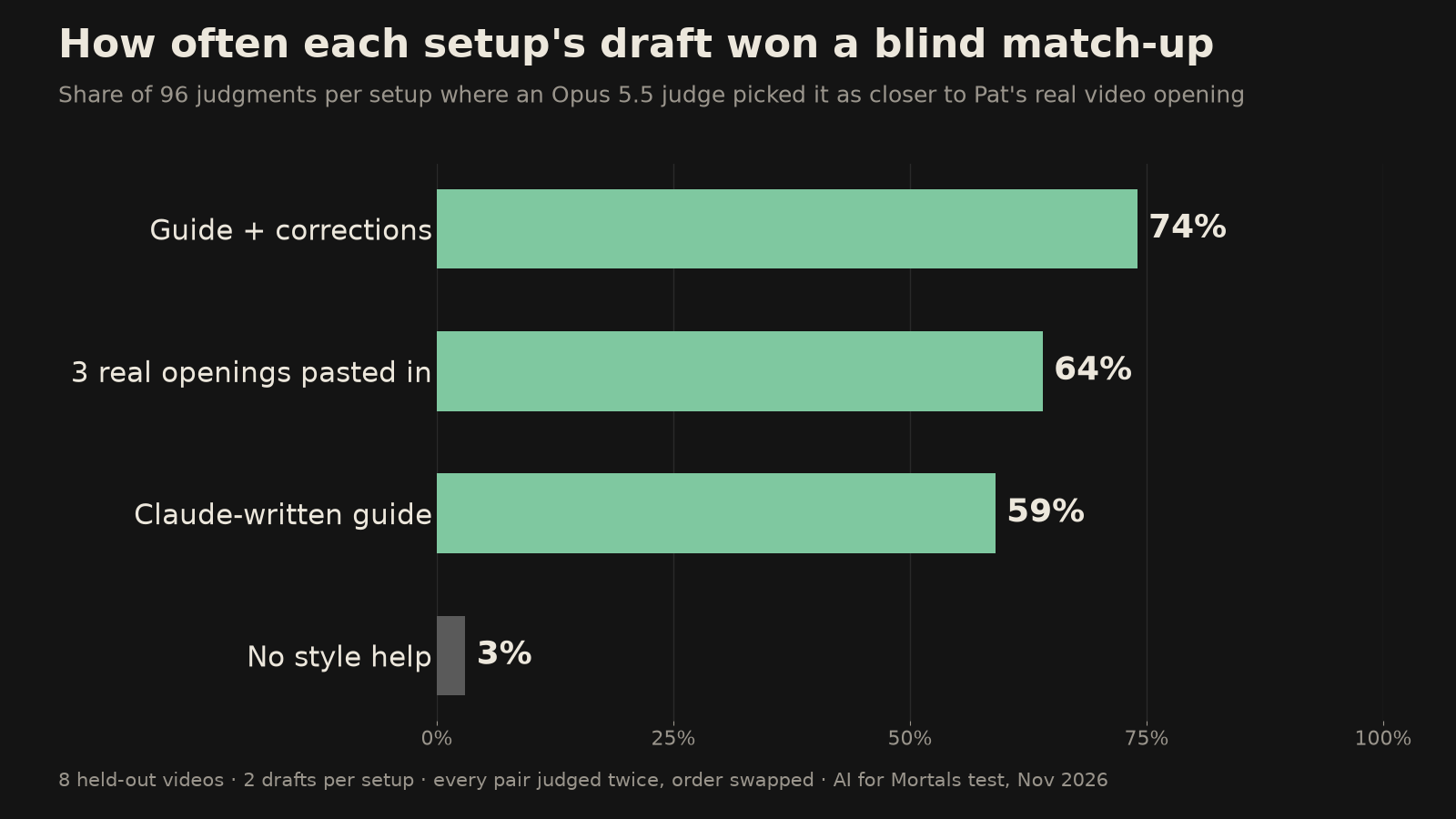
How often each setup's draft was picked as closer to Pat's real opening, across all 96 judgments it appeared in. Our test, Opus 5.5 as writer and judge.
Every draft was written by Claude Opus 5.5 from the same style-free brief, then compared with what Pat actually said on camera. The judge saw two drafts at a time and picked the one that sounded more like him.
Here is how the head-to-heads went.
- **Claude-written guide vs no style help:** the guide won 32 to 0.
- **Guide plus one round of corrections vs the original guide:** corrections won 23 to 9.
- **Three real openings pasted in vs the guide:** a 16 to 16 tie.
- **Guide plus corrections vs three real openings:** 19 to 13 for the corrected guide.
- **No style help vs anything:** it won 3 of 96 match-ups.
We ran a second judge, GPT-6 Astra, on a third of those match-ups to make sure the result wasn't one model's taste. It agreed with the Opus judge 81 percent of the time and landed in the same place: the guide beat plain Claude 16 to 0, and corrections beat the original guide 11 to 5. It liked the three pasted examples a bit more than Opus did, picking them over the guide 11 to 5.
## How we tested Claude writing skills on Pat's own words
Pat's blog posts are drafted with AI help, so they'd make a poor test of his voice. His YouTube videos are different: he talks to camera, unscripted, and the transcripts are his own words.
So we took the opening 420 or so words of 20 recent videos and split them in two.
- **12 openings to learn from.** Claude read these to write the style guide, and we used six of them to collect corrections.
- **8 openings held back as the exam.** Claude never saw these. Their drafts are what got judged.
For each held-back video, Opus 5.5 turned the opening into a brief: every fact, claim and step in order, in flat neutral language, with no phrasing, jokes or hooks. That way the drafts all had the same content, and the only difference between them was the style setup.
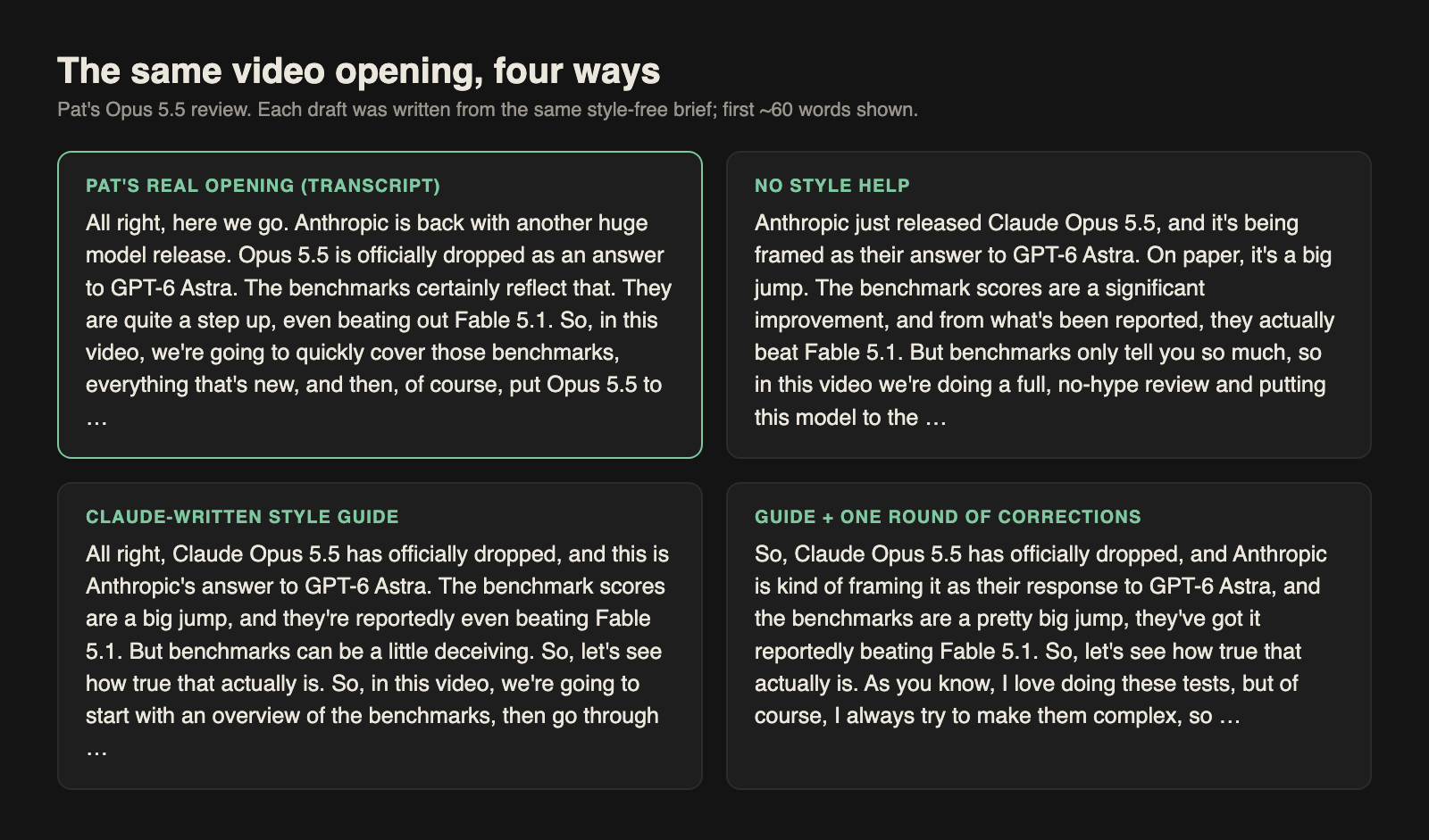
Pat's [Opus 5.5 review](https://www.aiformortals.co/blog/opus-5-5) is one of the eight held-back videos. Its first minute is the "real" side of the comparison below.
We then wrote two drafts of every held-back opening four ways, all with Opus 5.5 at medium effort.
1. **No style help.** Just the task and the brief.
2. **Claude-written style guide.** We gave Opus the 12 openings and asked it to write a SKILL.md capturing how Pat writes and talks. It came back with 3,294 words.
3. **Guide plus one round of corrections.** We used the guide to draft six of the learning videos, had Opus list how each draft differed from what Pat really said, then asked Claude to rewrite the guide to fix those problems.
4. **Three real openings pasted in.** No guide, just three of Pat's actual intros and the line "Match how I sound."
Judging used the method in our [AI evals checklist test](https://www.aiformortals.co/blog/ai-evals-checklist): an AI judge, a yes-or-no question, and the real thing as the answer key. Each pair was judged twice with the drafts swapped, because AI judges tend to favor whichever one they read first. The Opus judge gave the same verdict both ways 89 percent of the time.
That came to 290 Opus runs on a Claude subscription. At API prices it would have been about $12.65, and the style guide itself cost about 25 cents to write.
## Where Claude's style guide turned Pat into a caricature
The first minute of Pat's Opus 5.5 review, four ways. We fixed two caption errors in the transcript ("Opus 55" and "GBT6").
Plain Claude writes a clean, organized script: "Here's the plan. First, we'll go through the benchmarks." Pat doesn't talk like that. He opens with "All right, here we go," strings clauses together with "so" and "and then, of course," and gets on with it.
The guide fixed most of that. It caught his "All right" and "So, in this video" openings, his habit of naming his subscription tier and effort level, and his skeptical "let's see how true that actually is."
It also read like a list of Pat's greatest hits, and Claude used them on cue. Pat said "the benchmarks can be a little deceiving" in one of the 12 learning videos. The guide quoted it four times as a signature line, and six of the 16 guide drafts used it. He said it in none of the eight held-back openings.
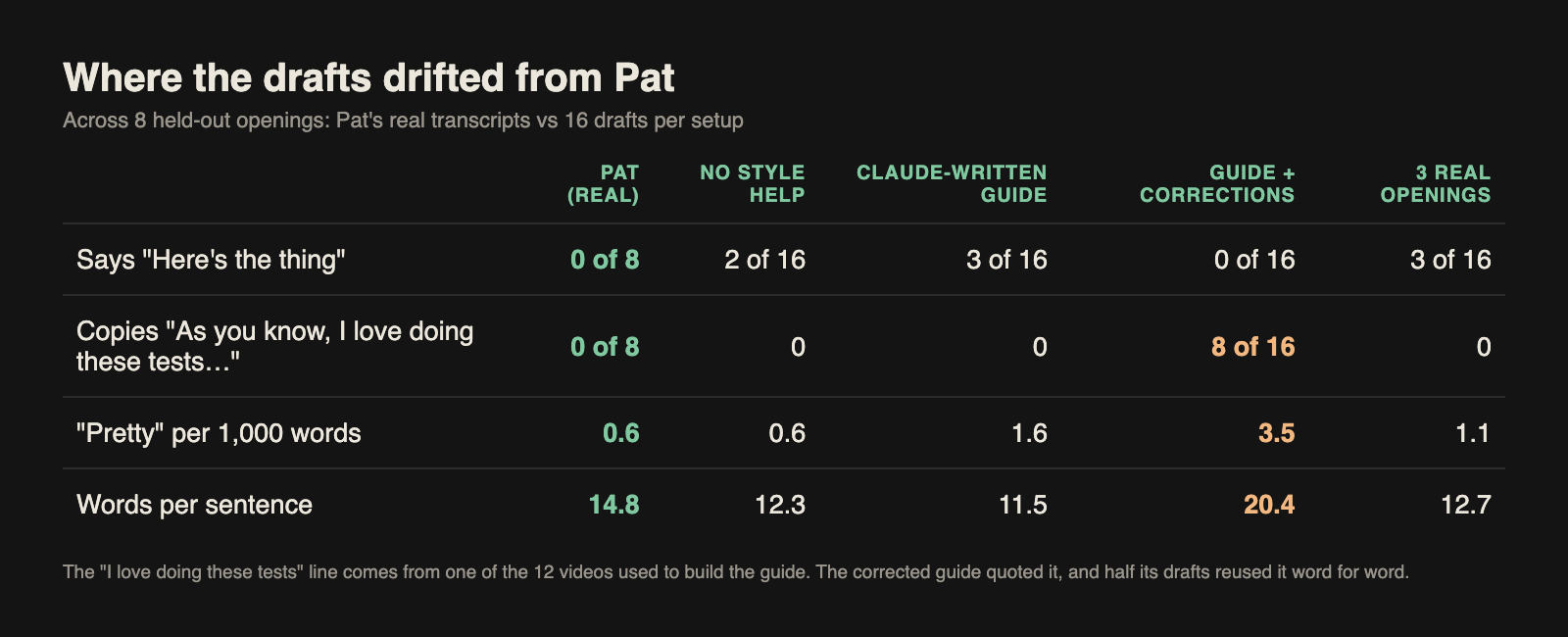
When the guide's drafts lost, the judge's notes tended to say the same thing: "too polished and scripted," with "rhetorical setups" and "a tidy First/Second/Third structure." Three of the guide's drafts added "here's the thing," which Pat didn't say in any of the eight real openings. Two of plain Claude's drafts did too, so that one is Claude's own habit more than the guide's.
## One round of corrections helped, and overcorrected
The six correction notes were blunt. One listed the hype lines the draft had added, from "Pretty freaking cool" to "Nothing fancy," and said: "The presenter never editorializes like this."
Claude's rewritten guide took that to heart. It warned that "the most common failure is writing something too clean, too hyped, and too structured," and its drafts won 72 percent of their match-ups against the original guide.
But the fix created new habits that weren't Pat's either.
Where the drafts drifted. YouTube transcripts are punctuated by software, so treat words per sentence as a rough guide.
The corrected guide called "pretty" one of Pat's "signature softeners," so its drafts used the word almost six times as often as he does. It told Claude to talk in long, run-on sentences, and the drafts' sentences ran more than a third longer than his.
It also quoted a real line from one of the learning videos: "As you know, I love doing these tests, but of course, I always try to make them complex." Half of the corrected drafts dropped that exact sentence into videos where Pat never said it.
The judge still preferred those drafts, probably because a real Pat sentence sounds like Pat. A reader who watches every video would notice the same line turning up week after week.
## Three real examples worked as well as a 3,300-word guide
The cheapest setup did surprisingly well. Pasting three of Pat's real intros into the prompt tied the full Claude-written guide 16 to 16 with the Opus judge, and beat it 11 to 5 with GPT-6 Astra.
The examples also cost less to run. A draft with the three examples cost about 6 cents, against about 9 cents with the long guide, since the guide is longer than the examples.
Anthropic's own prompting docs recommend [3 to 5 examples](https://platform.claude.com/docs/en/build-with-claude/prompt-engineering/multishot-prompting) when you want a consistent format or tone, and that advice held up here. If you only try one thing, try this.
## Why a style guide can make Claude's writing sound less like you
Our result and this week's test point in different directions, and we think the reason is the writer.
Pat talks loosely, in long spoken runs, and plain Claude writes tidy, organized prose. That gap is wide, so almost any style help moves the drafts closer to him, even a guide that overdoes his habits.
The writer in the other test publishes polished essays, and Opus 5.5 already writes close to that. When the default is close, a guide's main effect is to add the quirks it lists, and the drafts drift away from the real person. That's our best guess at why no skill won there.
So whether a Claude-written guide helps depends on how far your voice is from Claude's. The only way to know is to test it on your own writing, with the prompts below.
## How to build Claude skills for writing that sound like you
This is the same loop we ran, cut down to something you can do in one Claude chat. You need 12 to 20 pieces of one kind of writing: newsletters, blog posts, or meeting transcripts if you talk more than you write. Stick to one format, since a guide built from your emails will pull your long posts toward email.
Hold back three pieces you'll use as the test. Don't paste those into the guide step.
**Step 1: turn each test piece into a brief.** This strips out your style and keeps the substance, so a draft can only sound like you if the skill makes it.
```
Turn the piece below into a content brief that keeps all of the substance and none of the style.
List, as plain bullet points in order: what it's about, every fact, number, name, claim, example and step, so a writer could cover exactly the same ground. Keep exact quotes only if someone else is quoted.
Don't copy my phrasing, hooks, jokes, catchphrases or sentence rhythm. Write the bullets in flat, neutral language. Output only the brief.
[PASTE ONE OF YOUR TEST PIECES]
```
**Step 2: have Claude write your style guide.** Paste in your other pieces, not the test ones. We added the last paragraph after our first guide overdid Pat's habits.
```
Below are [NUMBER] pieces I wrote. Read them and write a writing-style skill (a SKILL.md file) that captures how I write, so that when I give you a brief, you can draft a new piece that sounds like me.
Cover voice, tone, structure, sentence patterns and what I avoid.
Say how often I do each thing, not just that I do it. Don't quote whole sentences from my pieces for you to reuse, and don't tell yourself to use every habit in every piece.
[PASTE YOUR PIECES, EACH WITH ITS TITLE]
```
**Step 3: draft each test piece from its brief two ways,** once with the guide pasted in and once with no guide. Then judge them blind in a fresh chat, twice per pair with the order swapped.
```
REAL is something I actually wrote. DRAFT X and DRAFT Y were written by AI from a brief of the same piece, so ignore content.
Which draft sounds more like the writer of REAL: voice, phrasing, rhythm and habits?
Reply with "X" or "Y", then list every way each draft doesn't sound like REAL. Quote the drafts.
REAL:
[PASTE THE REAL PIECE]
DRAFT X:
[PASTE ONE DRAFT]
DRAFT Y:
[PASTE THE OTHER DRAFT]
```
If the no-guide draft keeps winning, Claude already writes close to you, and the guide is getting in the way. Delete it, or go straight to the examples prompt at the end of this section.
**Step 4: feed the judge's notes back into the guide.** Your own edits work even better here. Whenever you fix a draft by hand, note what you changed and why.
```
Here is my writing skill. I used it to draft pieces I'd already written, and below are notes on where the drafts didn't sound like me.
Rewrite the skill so the next drafts fix these problems. Keep it shorter than the current version. Don't add any new rule that isn't backed by the notes, and don't quote whole sentences from my pieces.
[PASTE YOUR SKILL]
[PASTE THE JUDGE'S NOTES OR YOUR OWN EDIT NOTES]
```
Then run Step 3 again with the new guide. If you want to automate this loop over many rounds, tools such as [DSPy's GEPA optimizer](https://dspy.ai/api/optimizers/GEPA/overview/) do it for you, but you'll need to be comfortable with Python.
**The quick version: skip the guide and use examples.** In our test this did as well as the full guide.
```
Write [WHAT YOU NEED] from the brief below. Here are three pieces I wrote. Match how I sound, but don't reuse their sentences or stories.
[PASTE PIECE 1]
[PASTE PIECE 2]
[PASTE PIECE 3]
BRIEF:
[PASTE YOUR NOTES, OUTLINE AND FACTS]
```
Either way, write from a real brief with your own ideas in it. Give Claude a one-line topic and it will fill the gaps with plausible things you never said, in a voice that sounds just enough like you to be convincing.
## How to add your writing skill to Claude
Once a guide wins your blind test, save it so you don't have to paste it every time. There are two easy places.
- **As a skill.** In the Claude app, turn on Code execution and file creation under Settings > Capabilities, then upload your skill as a ZIP file in Customize > Skills. Claude [loads it when a request matches](https://support.claude.com/en/articles/12512180-using-skills-in-claude), and it works on Free, Pro, Max, Ultra, Team and Enterprise plans.
- **In a Project.** Put the guide, or your three examples, in a Project's instructions and do your writing inside that Project.
Our [best Claude skills test](https://www.aiformortals.co/blog/best-claude-skills) walks through installing a skill if you haven't done it before. If you'd rather build the guide from the edits you make each week, our guide to [teaching Claude your writing style from your edits](https://www.aiformortals.co/blog/teach-claude-your-writing-style) sets up a system that does that.
## What this test didn't cover
- **One voice, one format.** We tested Pat's spoken video intros, not written posts. Someone whose writing is already close to Claude's could get the opposite result, as the other test did.
- **An AI judge, not Pat.** Both judges compared drafts with the real transcript, and they agreed 81 percent of the time. Neither one is Pat reading the drafts himself.
- **Short pieces.** Each opening was about 430 words. Habits like a repeated line show up more over a long piece, and across many weeks of posts.
- **One round of corrections.** Longer tuning, over several rounds, might keep improving the guide or might pile on more quirks. We didn't test it.
- **One writer model.** Every draft came from Opus 5.5. A guide tuned for one model may not work as well with another.
## Sources
- [Claude Help Center: Use skills in Claude](https://support.claude.com/en/articles/12512180-using-skills-in-claude)
- [Claude Help Center: What are skills?](https://support.claude.com/en/articles/12512176-what-are-skills)
- [Claude Code docs: Extend Claude with skills](https://code.claude.com/docs/en/skills)
- [Anthropic: Equipping agents for the real world with Agent Skills](https://www.anthropic.com/engineering/equipping-agents-for-the-real-world-with-agent-skills)
- [Anthropic docs: Use examples (multishot prompting)](https://platform.claude.com/docs/en/build-with-claude/prompt-engineering/multishot-prompting)
- [Zheng et al., Judging LLM-as-a-Judge with MT-Bench and Chatbot Arena (arXiv, 2023)](https://arxiv.org/abs/2306.05685)
- [DSPy: GEPA optimizer overview](https://dspy.ai/api/optimizers/GEPA/overview/)