# GPT-6.2 Astra and Sol: What's New, and What We Got When We Tested Them
> We gave OpenAI's two new models and the two they replace the same five office jobs. All four got the facts right; slides, length and price told them apart.
By AI for Mortals Staff · November 17, 2026 · 9 min
Canonical: https://www.aiformortals.co/blog/gpt-6-2-astra-sol
GPT-6.2 Astra and GPT-6.2 Sol came out on November 17. Astra is OpenAI's new top model for hard projects, and Sol is the faster, cheaper one for everyday work.
Both replace models you may already use in ChatGPT: GPT-6 Astra and GPT-6.1 Sol. OpenAI says the new pair does better work with fewer words, so you get more done before you hit your plan's limits.
Some of you have been asking very politely. Some of you have just been asking. GPT-6.2 Astra and Sol are now available. Super efficient and built to perform where it counts—the real world.
So we gave all four models the five office jobs we use for every new release: a messy email thread, a 48-page report, a contact list full of duplicates, a 10-slide deck and a small budget calculator.
Every model got every job right. The upgrades showed up in the slides, in tighter writing and in the price.
## GPT-6.2 Astra and Sol: the short answer
- **Facts and accuracy:** a four-way tie. All four answered the report questions correctly, cleaned the contact list perfectly and built a working budget calculator.
- **Slides:** the clearest upgrade. GPT-6.2 Astra wrote headlines that say the point of each slide, and both new models picked their own look instead of the near-identical template the old models shared.
- **Writing:** the new models' report answers were 20% to 25% shorter than the old ones, with nothing missing.
- **Speed and usage:** about the same as before on our jobs. We didn't see the big token savings OpenAI describes.
- **Cost:** GPT-6.2 Astra ran our set for about 13% less than GPT-6 Astra at API prices. GPT-6.2 Sol did the same work for about a quarter of Astra's price.
- **Who should switch:** if you pay for ChatGPT, use GPT-6.2 Sol as your everyday model and save Astra for decks, designed documents and hard projects.
## What's new in GPT-6.2 Astra and Sol
OpenAI's launch art for GPT-6.2 Astra and Sol. Source: OpenAI
OpenAI's launch post leans on office work. It says GPT-6.2 Astra makes slides, spreadsheets and documents that "read less like AI" and stick closer to the templates you give it, down to the font size.
On its own GDPval v2 test of consulting, finance and design assignments, OpenAI says Astra scored 6.2 points higher than GPT-6 Astra while writing 22% fewer words. Sol gained 5.3 points over GPT-6.1 Sol.
Sol gets one striking claim. On LifeVal, OpenAI's test of everyday jobs like shortlisting schools or planning meals, OpenAI says GPT-6.2 Sol beat GPT-6 Astra at about a seventh of the cost.
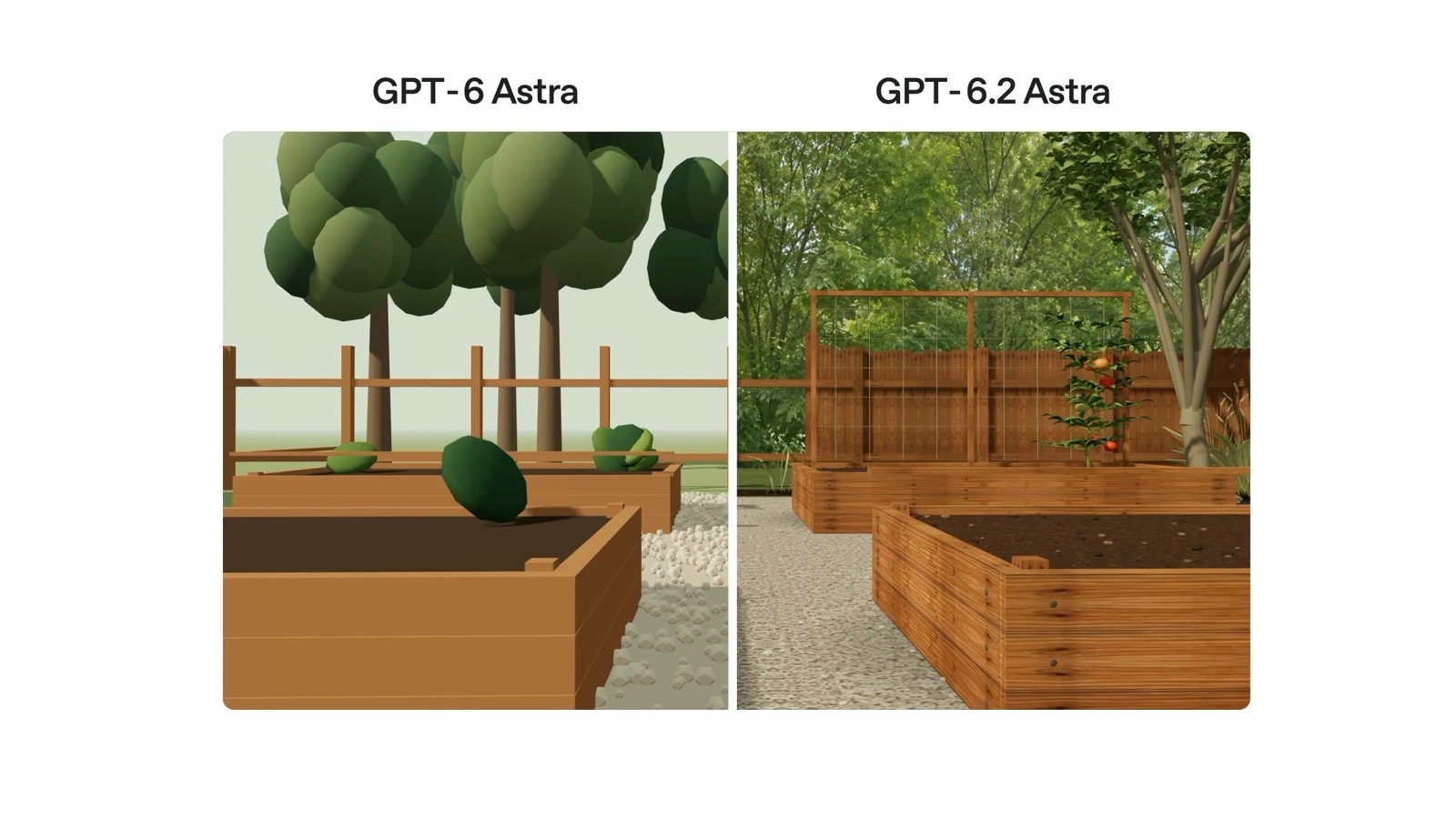
Astra also builds better-looking web pages and 3D scenes. In a blind test where people pick between two interactive scenes made from the same prompt, Astra ranked first, ahead of Claude Fable 5.2, with Sol close behind.
The same garden-planning prompt, built by GPT-6 Astra (left) and GPT-6.2 Astra (right). Source: OpenAI
Two changes matter if you use AI at work.
**Tighter security limits.** Both models are stricter about hacking-related requests, and OpenAI admits that also blocks some legitimate security testing.
**Missing-file blind spot.** In OpenAI's own safety tests, both models were more likely to skip telling you when something blocked their work, like a file that wasn't there or a search tool that didn't respond. OpenAI says it added instructions in Codex to cut this down. In ChatGPT, it's worth ending a big request with "Tell me anything you couldn't open or check."
## Who gets GPT-6.2, and what it costs
GPT-6.2 Astra and Sol are available now on the Plus, Pro, Enterprise and Edu plans, in ChatGPT Work and in Codex. Enterprise and Edu users get them once their workspace admin turns them on. OpenAI's post doesn't mention the Free plan.
Pro 500 subscribers can use Ultrafast mode with both models. Pro 200 subscribers get Ultrafast for the first time, starting with Sol. Our [ChatGPT pricing guide](/blog/chatgpt-pricing) breaks down what each plan costs.
For developers, here are the API prices per million tokens:
| | GPT-6.2 Astra | GPT-6 Astra |
|---|---|---|
| Input | $8 | $10 |
| Cached input | $0.40 | $1 |
| Output | $40 | $50 |
| | GPT-6.2 Sol | GPT-6.1 Sol |
|---|---|---|
| Input | $2 | $2 |
| Cached input | $0.10 | $0.10 |
| Output | $10 | $10 |
Astra got a 20% price cut, and repeated input (like the same long document sent twice) got 60% cheaper. Sol's prices didn't change, so any savings there have to come from the model using fewer words.
For how these compare with Claude, Gemini and others on the same build, see our [AI model cost comparison](/blog/ai-model-cost-comparison).
## The five office jobs we gave GPT-6.2 Astra and Sol
We ran every job through Codex, signed in with a ChatGPT subscription, with reasoning set to high. Each model got the same prompt once: GPT-6.2 Astra against GPT-6 Astra, and GPT-6.2 Sol against GPT-6.1 Sol.
Codex can write and run small bits of code while it works, which the regular ChatGPT chat window does too. The prompts are below so you can run them yourself. If you haven't used Codex, our [plain-English Codex guide](/blog/what-is-chatgpt-codex) shows how to run your first task.
### A messy email thread: all four got the details right
Six emails between a clinic and a workshop trainer, with the date, start time, budget and travel cap all changing along the way, plus a question about laptops and a request to keep patient data out.
```
Here's a messy email thread. Write the reply Dana asked for, addressed to everyone on the thread. Keep it short and friendly, and include a short agenda for the workshop.
[paste the whole thread here]
```
All four confirmed Friday, November 20, 8:30 to noon, $2,800 with travel capped at $150. All four told Priya that laptops were optional for her six staff on clinic desktops, and all four promised no patient data.
The differences were small. GPT-6.2 Sol dropped the times from its agenda and gave three topic lines instead, which makes it less useful as an agenda.
GPT-6.2 Astra added a promise nobody asked for ("I'll bring printed exercises"). It's harmless here, but read any reply before you send it, because a model will happily commit you to things.
### A 48-page report: five for five, in fewer words
We pasted in NIST's AI Risk Management Framework and asked for a 150-word summary plus five questions. One is a trap: it asks what penalties the framework sets, and it sets none.
```
Below is a long document. First, summarize it in about 150 words for a busy manager. Then answer these five questions, quoting the document where you can:
1. What are the framework's core functions, and which one is described as cross-cutting?
2. List the characteristics of trustworthy AI the framework names.
3. How many categories does each core function have?
4. Is the framework mandatory, and what penalties does it set for organizations that don't follow it?
5. What does MANAGE 4.1 ask organizations to do?
[paste the document here]
```
All four answered every question correctly and caught the trap. We checked every quote against the report, and each one is real.
This is where the new models' shorter writing showed. GPT-6.2 Astra's full answer ran 327 words, against 437 for GPT-6 Astra. GPT-6.2 Sol wrote 358 words, against 454 for GPT-6.1 Sol.
The new versions cut the extra tables and repeated explanations and kept every fact. If you skim AI answers on your phone, that adds up.
### A contact list full of duplicates: perfect across the board
A 172-row contact list with duplicates, blank rows, mixed date formats, messy phone numbers, and six pairs of different people who share a name.
```
Clean up this contact list. Two rows are the same person only when the email address matches (ignoring capitals and stray spaces); two people can share a name. Drop blank rows. Merge duplicate people into one row each, and when the copies disagree on the signup date, keep the earliest. Format names as First Last in normal capitalization, emails in lowercase with no spaces, phone numbers as (555) 555-5555, states as two-letter codes, and dates as YYYY-MM-DD (dates with slashes are month/day/year). Return the cleaned CSV in a code block, then say how many rows are left, how many duplicate rows you removed, and list any people who share a name but are different people.
[paste the CSV here]
```
We checked every row against the correct answer. All four returned exactly 146 people with zero mistakes, removed the 26 duplicates and 3 blank rows, and named all six name-twins.
All four did it the same way: they wrote a short script to clean the list instead of retyping it. Each took about four minutes. If you hand ChatGPT a spreadsheet, that's the behavior you want, because scripts don't get tired on row 140.
### A 10-slide deck: the clearest upgrade
One page of rough notes from a support team's quarter, turned into a 10-slide all-hands deck.
```
Turn these notes into a 10-slide presentation for a Monday all-hands. Make it a single self-contained HTML file: each slide is a 16:9 section (1280x720) stacked vertically, clean modern design, readable from the back of a room, no external libraries or images. Use only the numbers in the notes. Return only the HTML in one code block.
[paste your notes here]
```
All four decks had 10 slides and every number right. The design is where they split.
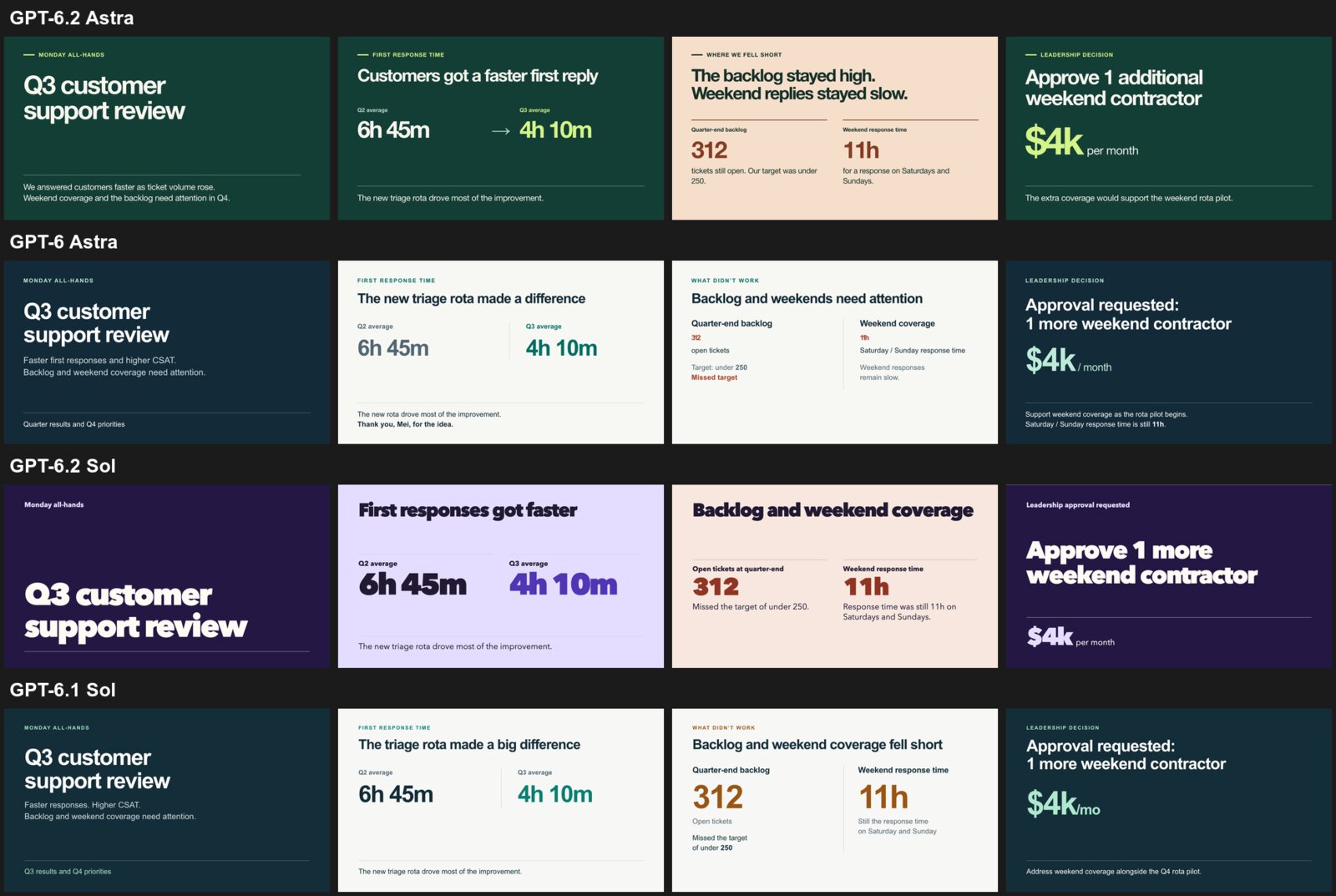
Four slides from each deck: the title, the response-time slide, the problem slide and the request to leadership. Same notes, same prompt. Our test.
GPT-6.2 Astra wrote a headline that states the point of each slide ("Customers got a faster first reply," "Approve 1 additional weekend contractor"), which is exactly what OpenAI says it trained for. It also varied the background color from slide to slide so the deck has some rhythm.
GPT-6.2 Sol went its own way with a heavy, poster-style purple design. It's the boldest of the four, though its title slide skips the one-line summary the others included.
The two older models made almost the same deck: same navy-and-white layout, same section labels, nearly the same headlines. GPT-6 Astra also shrank the two numbers that mattered most on its problem slide, the 312-ticket backlog and the 11-hour weekend wait, into tiny red text.
If you make slides in ChatGPT, this is the reason to switch.
### A budget calculator: all four passed every test
A one-page budget tool: take-home pay, expenses by category, a savings goal, and a warning when you're short.
```
Build a monthly budget calculator as a single self-contained HTML file (no external libraries). I want to enter my monthly take-home pay, add and remove expenses (name, amount, and a category picked from Housing, Food, Transport, Bills, Fun, Other), and set a savings goal as a percent of my pay. Show total spending, what's left over, how much of my pay I'm actually saving as a percent, a per-category breakdown, and a clear warning when I'm short of my savings goal or spending more than I earn. Everything updates as I type. Keep my budget if I close the tab and come back. Handle bad input (empty, negative, letters) gracefully: treat it as 0 and don't show NaN. Make it look good on a phone and a laptop. Return only the HTML in one code block.
```
We ran each calculator through 12 automatic checks: the math, the warnings, overspending, typing letters into a money box, removing a row, closing and reopening the tab, and fitting on a phone. All four passed all 12.
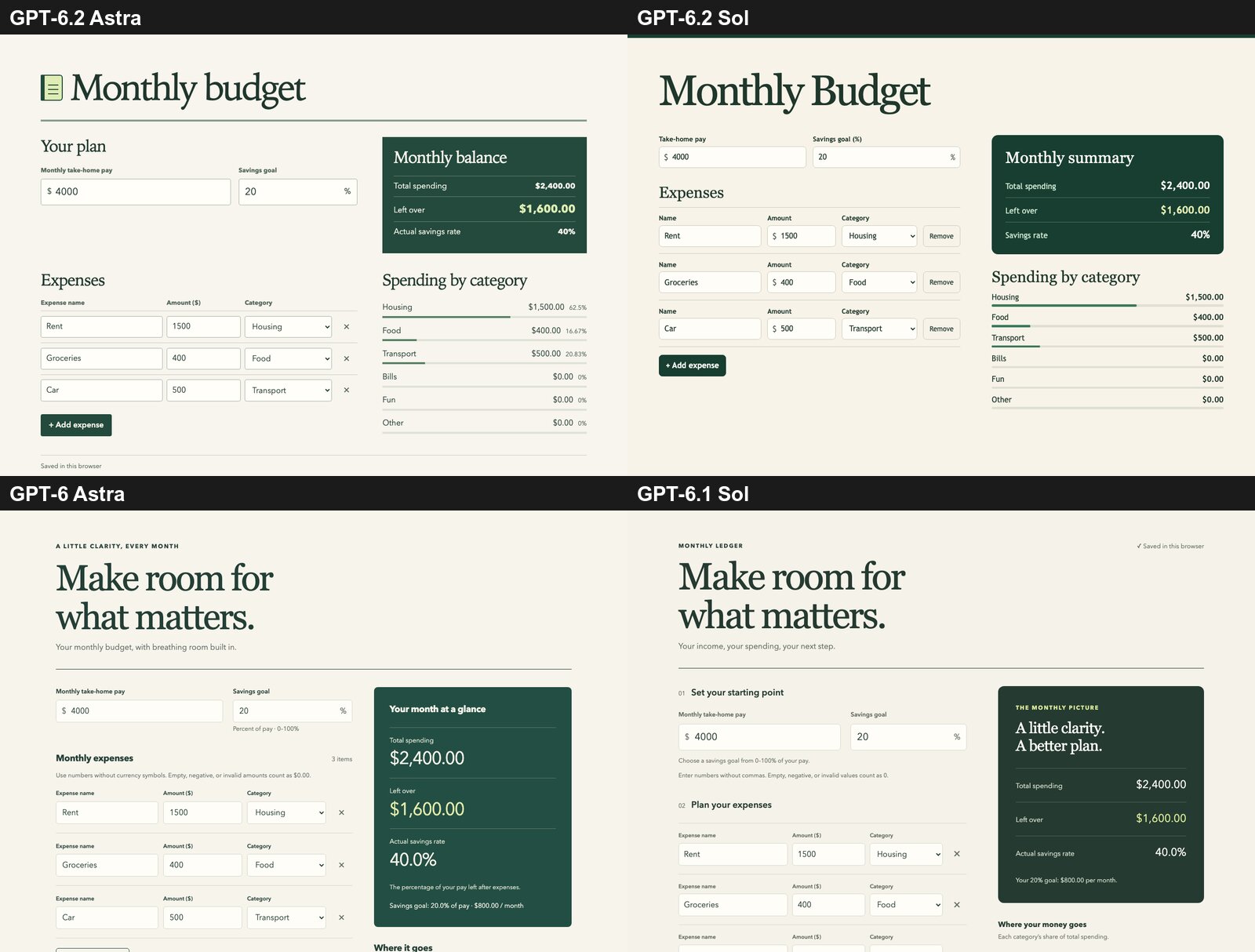
The four budget calculators with the same numbers typed in. Top row: GPT-6.2 Astra and GPT-6.2 Sol. Bottom row: GPT-6 Astra and GPT-6.1 Sol. Our test.
They also look alike, with the same cream-and-green style. The one real difference was effort: GPT-6.2 Astra took 3 minutes 17 seconds and checked its own page several times before answering, while GPT-6 Astra answered in under 2 minutes.
The extra checking didn't catch anything the old model missed this time. On a bigger build, that habit is the one you want.
## Speed, tokens and cost: GPT-6.2 vs the models they replace
Here's the whole five-job set, added up. Cost is what the same tokens would cost at API prices. On a ChatGPT plan you pay your monthly fee instead, and the token count is roughly what counts against your limits.
| | GPT-6.2 Astra | GPT-6 Astra |
|---|---|---|
| Jobs right | 5 of 5 | 5 of 5 |
| Total time | 9 min 12 s | 8 min 15 s |
| Output tokens | 25,011 | 22,038 |
| API cost | $1.83 | $2.10 |
| | GPT-6.2 Sol | GPT-6.1 Sol |
|---|---|---|
| Jobs right | 5 of 5 | 5 of 5 |
| Total time | 9 min 15 s | 9 min 41 s |
| Output tokens | 25,750 | 25,663 |
| API cost | $0.51 | $0.56 |
The totals include Codex's own setup instructions, which are the same for every model.
On these jobs, the new models didn't write less overall. Their answers were shorter, but GPT-6.2 Astra spent extra effort testing its budget calculator, and that cancelled out the savings.
OpenAI's efficiency numbers come from long, multistep professional assignments, and our jobs are short. The new Astra still came out cheaper, because its prices dropped 20%.
## What people are saying about GPT-6.2
The models are only hours old, so early reactions are thin and mostly from people who use AI for coding.
People at OpenAI are calling GPT-6.2 Sol their go-to model for day-to-day work, and the company says many of its employees already use it as their default. Arena, the public leaderboard where people vote between models, added both and hasn't posted scores yet.
Not everyone is happy. At least one well-known early tester said his runs went badly enough that he won't publish a full review, without saying what went wrong.
In the weeks before launch, a lot of the talk in OpenAI's Codex community was about the wait. Some people said they'd moved to Gemini 4 Hydrogen in the meantime and found it less lazy than GPT-6.1 Sol.
Pat's first look at GPT-6 Astra, the model GPT-6.2 Astra replaces (AI for Mortals on YouTube).
## GPT-6.2 Sol vs Astra: which should you use?
**Use GPT-6.2 Sol for almost everything.** It matched Astra on every fact in our test, and it costs about a quarter as much on the API. On a ChatGPT plan, that should mean more messages before you hit your limit.
**Switch to GPT-6.2 Astra for anything people will look at.** Decks, designed documents, web pages and 3D scenes are where it pulled ahead, and where OpenAI's own examples are strongest.
**If you're on GPT-6 Astra today, switch.** The new one is cheaper and at least as good on everything we tried.
For a wider view of which model wins which job across OpenAI, Anthropic and Google, see our [best AI model by job](/blog/best-ai-model) roundup. Our recent test of [Qwen4-Max against Claude Opus 5.5](/blog/qwen-4-max-vs-claude-opus) used the same five jobs, so you can compare the results directly.
## How to test GPT-6.2 on your own work
The quickest way to know if an upgrade matters for you is to rerun something you did last week. Pick a real task, run it on the old and the new model, and compare them side by side.
```
I'm comparing AI models. Here's a task I did last week with another model, plus the result I got. Do the same task from scratch. Then, in three short bullets, tell me anything in the task you couldn't open, check or were unsure about.
Task: [paste the original prompt and any files]
Earlier result (for my comparison only, don't copy it): [paste it]
```
The last line matters more with these models than usual, given OpenAI's note that they sometimes skip mentioning what blocked them.
## Sources
- [OpenAI: Introducing GPT-6.2 Astra and Sol](https://openai.com/index/introducing-gpt-6-2-astra-sol)
- [OpenAI: GPT-6.2 Astra and Sol system card](https://deploymentsafety.openai.com/gpt-6-2-astra-sol)
- [OpenAI on X: the launch announcement and plan availability](https://x.com/OpenAI/status/2122750124543926515)
- [OpenAI: LifeVal](https://openai.com/index/lifeval/)
- [OpenAI API docs: keeping prompt prefixes unchanged (preserved reasoning)](https://developers.openai.com/api/docs/guides/preserved-reasoning)
- [OpenRouter: GPT-6.2 Astra and GPT-6 Astra listings (previous prices)](https://openrouter.ai/openai/gpt-6.2-astra)
- [NIST: AI Risk Management Framework (AI RMF 1.0), the report we tested with](https://nvlpubs.nist.gov/nistpubs/ai/NIST.AI.100-1.pdf)