# GPT-6.2 Sol and Astra vs Claude: A Trip, a Memo and a Messy Spreadsheet
> We gave OpenAI's new models and Claude Opus 5.5 and Sonnet 5.5 three everyday jobs with traps built in, then checked every number.
By AI for Mortals Staff · November 17, 2026 · 9 min
Canonical: https://www.aiformortals.co/blog/gpt-6-sol-vs-claude
GPT-6 Sol just got its first big upgrade. OpenAI released GPT-6.2 Sol and GPT-6.2 Astra on November 17, and the obvious question for anyone who pays for an AI is whether either one beats Claude at ordinary work.
Sol is the one OpenAI pitches for everyday tasks, and Astra is for your hardest projects. We already compared both with the models they replace in our [GPT-6.2 Astra and Sol first look](/blog/gpt-6-2-astra-sol).
This time we put them against Claude Opus 5.5 and Claude Sonnet 5.5 on three jobs a regular person actually does: planning a trip, writing a long memo from messy notes, and cleaning up a spreadsheet. Each job had a trap we could check.
OpenAI's launch video for GPT-6.2 Astra and Sol (OpenAI on YouTube).
## GPT-6 Sol vs Claude: the short answer
- **Accuracy was a four-way tie.** All four models caught every contradiction in the memo notes and got every spreadsheet total right to the cent. Every trip budget added up.
- **The GPT models were better travel agents.** Astra and Sol looked things up and linked real booking and accessibility pages. Sonnet planned from memory even with web search turned on.
- **The memos split by style.** Astra and Sol wrote tidy prose close to the 700 words we asked for. Opus and Sonnet ran longer but added cost tables and a checklist of what to confirm.
- **Claude was much faster on the spreadsheet.** Opus and Sonnet finished in about a minute. Sol took almost eight.
- **Who should use what:** if you already pay for ChatGPT, GPT-6.2 Sol is good enough for all three jobs. Nothing here is a reason to leave Claude, and Claude still wrote the more useful memo.
## How we tested GPT-6.2 Sol and Astra against Claude
We ran Sol and Astra through Codex and the two Claude models through Claude Code, each signed in with a regular subscription and set to high effort. Every model got the same prompt once.
Both apps can search the web and run small bits of code, much like the ChatGPT and Claude chat windows. We left that on for every model on the trip, because live opening hours matter there.
If you haven't used either app, our [plain-English Codex guide](/blog/what-is-chatgpt-codex) shows how to run a first task. The prompts are below so you can try them in whichever chat you use.
## Trip planning: GPT-6.2 checked the web, and Sonnet didn't
The job was a long weekend in Lisbon for two, with rules that are easy to break: a €1,200 budget, a vegetarian partner with a bad knee, one day trip, one museum, one fado night and a Monday evening flight.
```
Plan a 3-day trip to Lisbon for me and my partner. We land Friday, March 12, 2027 at 2:00 pm and our flight home leaves Monday, March 15 at 6:10 pm. Budget: 1,200 euros total for the two of us, not counting flights or the hotel (already booked in Chiado). My partner is vegetarian and has a bad knee, so no long walks or steep hikes. We'd like one day trip out of the city, at least one great museum, and one fado night. Give us an hour-by-hour plan for each day and a cost table that adds up, and tell us anything we should book ahead.
```
The hidden trap is Monday. Several of Lisbon's big sights close that day, including [Jerónimos Monastery](https://mosteirojeronimos.torrebelem.gov.pt/en/visitar). All four models kept Monday to places that are open, like the Gulbenkian museum or the Lisboa Story Centre, and all four had you at the airport about three hours before the flight.
We added up every cost table by hand. All four were correct, with planned spending between €723 (Sonnet) and €1,054 (Opus).
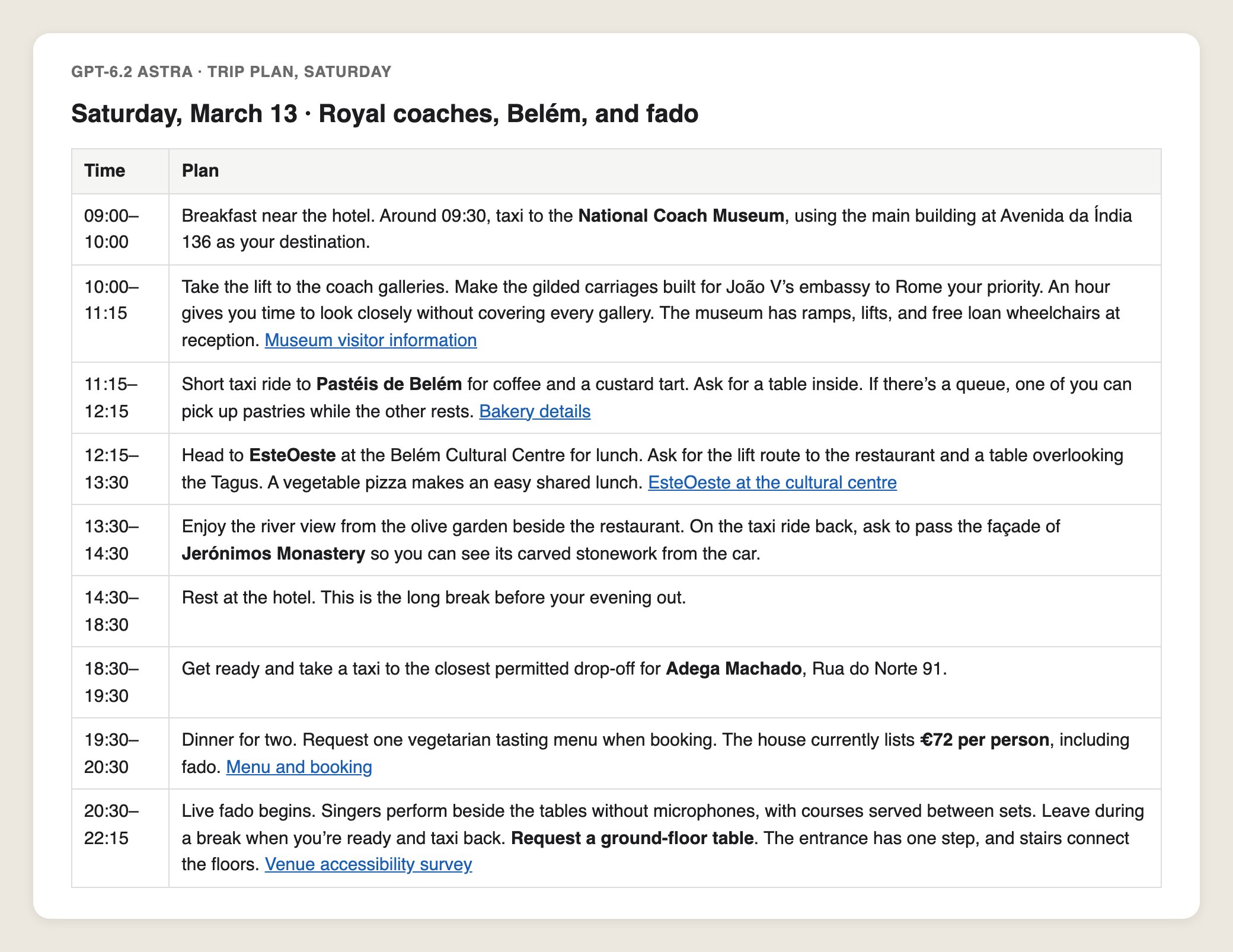
The real difference was homework. GPT-6.2 Astra and Sol searched the web on their own and linked the actual pages: a fado house's current tasting-menu price, a museum's lift and wheelchair information, and an airport page on how early to arrive.
Part of GPT-6.2 Astra's Saturday plan. It flagged the step at the fado house's entrance and linked an accessibility survey of the venue. Our test.
Astra was the most careful about the knee. It put a taxi on every leg, warned that one vegan restaurant's dining room is down a flight of stairs and suggested ordering in instead.
Opus also searched and listed 11 sources, mostly travel blogs. Its plan was the most ambitious: Pena Palace in Sintra, Cabo da Roca and Cascais in one day. It used shuttles and taxis, but Pena Palace has plenty of stairs, which is a stretch for a bad knee.
Sonnet, even with search turned on, didn't look anything up. It said so plainly at the top and told you to confirm every price and opening time. The plan is sensible, but you'd do the checking yourself.
If trips are your main use, the GPT-6.2 models saved the most legwork. For more ways to plan with AI, see our guide to [ChatGPT for planning trips, meals and your week](/blog/chatgpt-planning).
## Claude vs ChatGPT for writing: a 700-word memo with three traps
We wrote a page of messy notes about whether a small company should move offices: ops notes, a tour write-up, a landlord email, a rent quote, a finance table and a pasted leadership chat. Then we hid three contradictions in them.
- The lease ends June 30 in one note and March 31 in the landlord's email.
- The new office's rent is $14,200 a month in the quote and $12,400 in the finance table.
- One note says 42 staff, another says "all 38 of us."
```
Here are our notes about whether to move offices. Write a memo of about 700 words to the leadership team for the November 10 meeting. Lay out the two options, the costs and the timing, and give a clear recommendation. Use only facts from the notes.
[paste your notes here]
```
We didn't ask anyone to look for contradictions. All four found all three anyway, and none of them quietly picked one number and moved on. We also checked every sum the models did themselves, from the $90,400 cash needed to Opus's three-year totals, and found no errors.
The lease date was the one that mattered most, and all four worked out why. If the lease ends March 31, notice is due December 31, the same day the new landlord's free-rent offer runs out.
Early testers have said Astra's longer writing loses the thread. We didn't see that at this length. Both GPT memos stayed on point, in clean paragraphs, at 645 words (Astra) and 687 words (Sol).
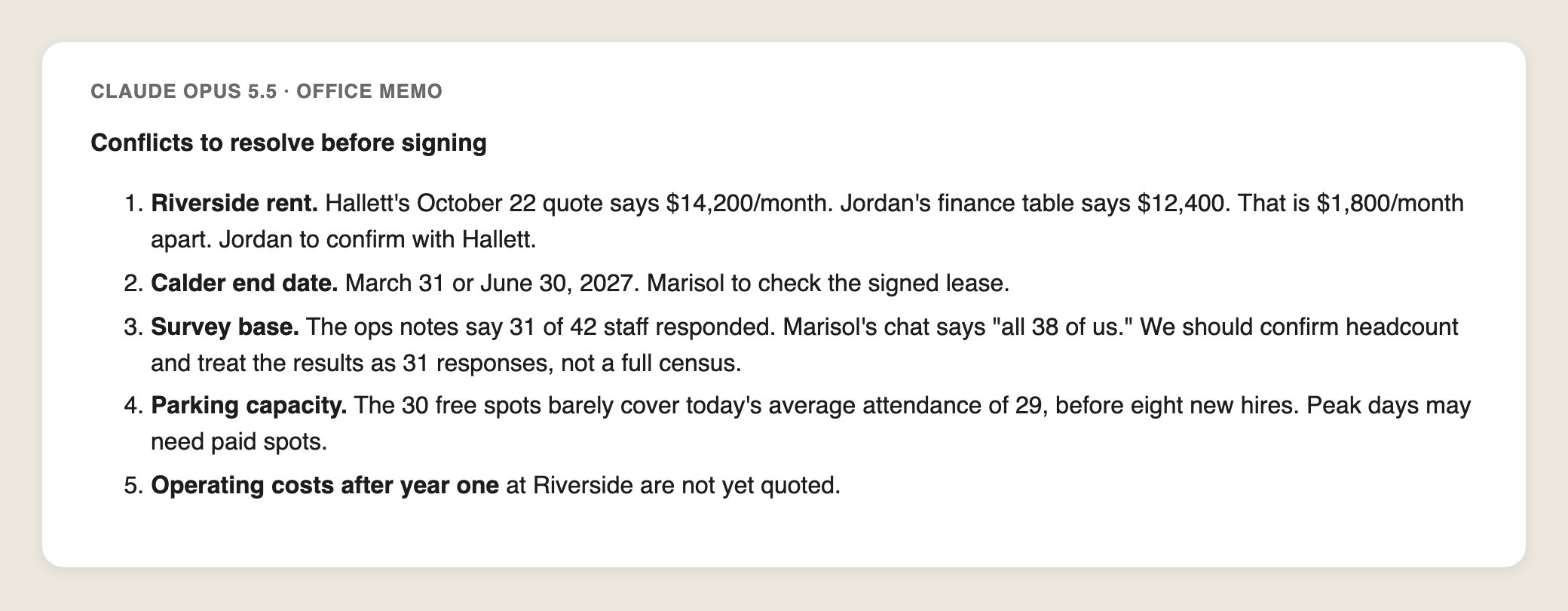
The Claude memos were longer, at 828 words for Opus and 716 for Sonnet, plus notes on how they handled the conflicts. The extra length bought things you'd use in the meeting: cost tables for each option and a numbered list of what to confirm before signing.
The checklist at the end of Claude Opus 5.5's memo. It also noticed that 30 free parking spots barely cover today's attendance, before eight new hires. Our test.
Opus and Sonnet also pointed out that November 10 had already passed when they wrote the memo, so the deadlines were closer than the notes suggested. The GPT models gave a more cautious recommendation (move, but only if the dates work out), while the Claude memos said to move and listed what to fix first.
If you want a memo you can send almost as written, the GPT pair was closer. If you want one that does more of your thinking, Claude's was more useful.
## A messy spreadsheet: every number right, at very different speeds
The last job was a three-month expense export of 132 rows with everything wrong with it: five date formats, amounts written as "$1,200.00", "1,200.00 USD" and "(286.45)", misspelled categories like "Travle" and "Sofware", nine duplicated rows, blank lines and a stray SUBTOTAL row.
```
This is our expense export for July to September 2026 and it's a mess. Clean it up and tell me: total spending, spending by category (Travel, Software, Meals, Office, Marketing), spending by month, and our top 3 vendors by total spend. Refunds count as negative spending. Rows that appear twice exactly are export glitches, so count them once. Give me the numbers in tables, then list anything in the file you weren't sure how to handle.
[paste your CSV here]
```
We built the file ourselves, so we knew the right answers. All four models matched them exactly: $55,461.79 in total, the same five category totals, the same three months, and Amazon, Marriott and Starbucks as the top vendors.
All four also ignored the SUBTOTAL row, which didn't match anything. Each one wrote a short cleanup script instead of retyping rows, which is what you want, because scripts don't make typos on row 120.
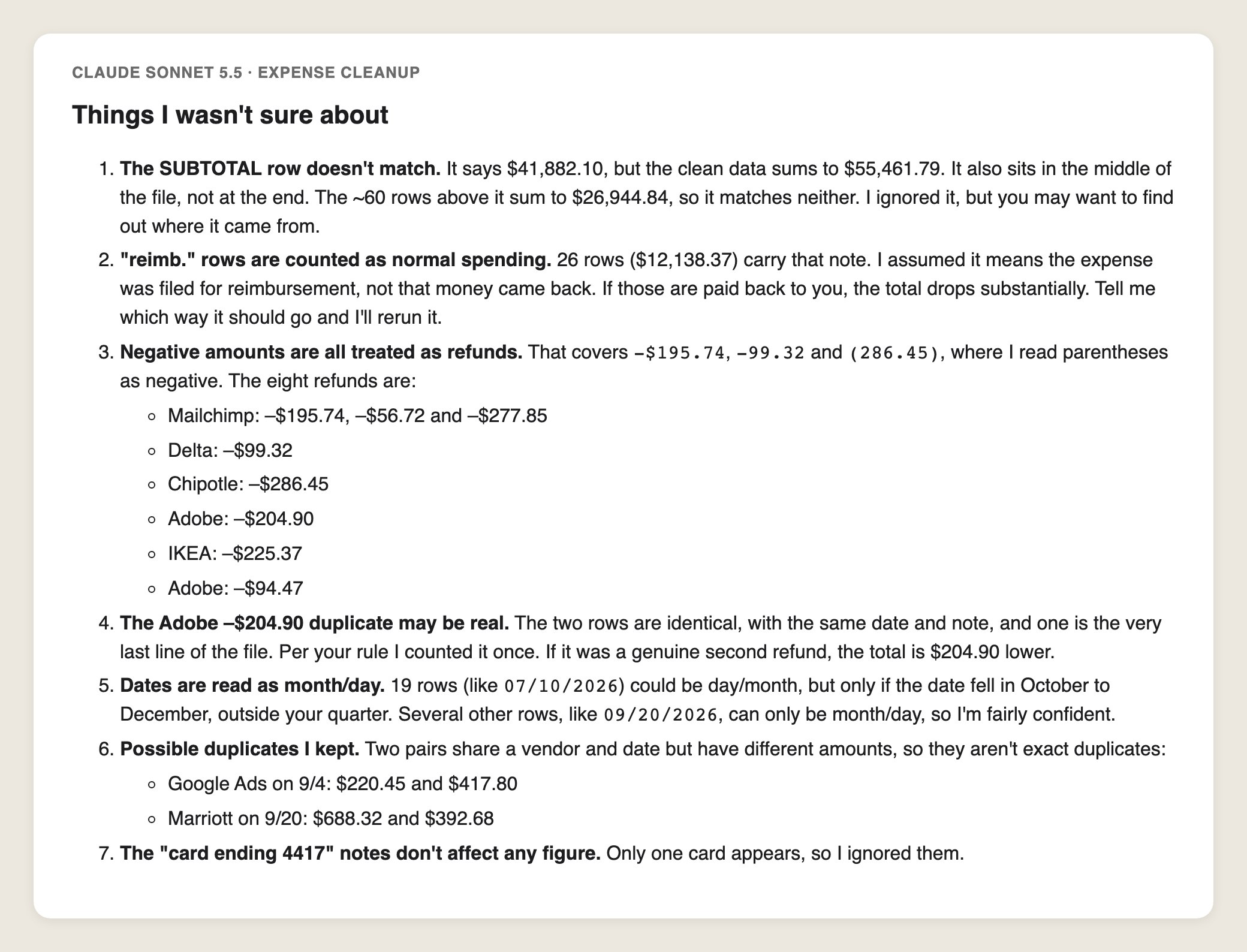
Claude Sonnet 5.5's list of judgment calls. Both Claude models asked what "reimb." meant and pointed out that one of the duplicate rows was a refund. Our test.
The Claude answers flagged more of the judgment calls a bookkeeper would ask about. The biggest gap was speed: Sonnet finished in 59 seconds and Opus in 67, while Astra took almost 2 minutes and Sol took 7 minutes 43 seconds.
For more on doing spreadsheet work with AI, see how we used [Claude Sheets on real work](/blog/ai-spreadsheet-generator-claude-sheets).
## GPT-6 Sol vs Opus 5.5: how long each one took
Here's the time each model took on each job, from sending the prompt to the finished answer.
- **GPT-6.2 Astra:** trip 2 min 54 s, memo 44 s, spreadsheet 1 min 53 s
- **GPT-6.2 Sol:** trip 4 min 52 s, memo 1 min 2 s, spreadsheet 7 min 43 s
- **Claude Opus 5.5:** trip 3 min 36 s, memo 1 min 24 s, spreadsheet 1 min 7 s
- **Claude Sonnet 5.5:** trip 2 min 59 s, memo 53 s, spreadsheet 59 s
Sol was the slowest on two of the three jobs. That's surprising for the model OpenAI pitches as its efficient everyday option. It got there in the end every time, but expect to wait on number-heavy jobs.
This is one run per model, so treat the times as a rough guide. Our [AI model cost comparison](/blog/ai-model-cost-comparison) covers what the same work costs on each company's models.
## What early testers are saying about GPT-6.2
Early hands-on reviews line up with what we saw. Testers who spent two weeks with the models found Astra good at clearly defined jobs you can check, and Sol gave a near-perfect trip plan. Most still reached for Claude or Gemini for open-ended writing and building.
One review found that Astra missed a factual contradiction in a long manuscript that Claude Fable 5.2 caught. On our shorter memo, every model caught all three.
In the launch threads on Reddit and Hacker News, most of the excitement is about price next to Claude. A few people say they'll switch because their Claude limits run out too fast, while others say the GPT models still need more babysitting than Opus 5.5.
Arena's first impressions of GPT-6.2 Astra and Sol against Claude Fable 5.2 (Arena on YouTube).
## Which one should you use?
**If you pay for ChatGPT, use GPT-6.2 Sol for everyday jobs.** It was as accurate as everything else on all three tasks and did the most real research for the trip. Just give it time on spreadsheets.
**Switch to Astra when the answer has to be checked against the real world.** It was the most careful trip planner and noticed details like a step at a restaurant door.
**If you pay for Claude, there's no reason to switch.** Opus 5.5 and Sonnet 5.5 matched the GPT models on accuracy, wrote the more useful memo and cleaned the spreadsheet several times faster. If you ask Claude for travel plans, tell it to search the web, or it may not.
Our [Claude vs ChatGPT comparison](/blog/claude-vs-chatgpt) covers the plans and prices side by side, and our [best AI model by job](/blog/best-ai-model) roundup shows which model wins which kind of build.
Pat's head-to-head of Opus 5.5, Fable 5.1 and GPT-6 on the same app build (AI for Mortals on YouTube).
## Run the same test on your own work
The fastest way to choose is to give both chats one real job from last week and compare. This prompt works in ChatGPT and Claude, and the last line catches the quiet guesses.
```
Here's a task I need done. Do it from scratch, and look up anything that could have changed recently, like prices or opening hours. When you're done, list in three short bullets anything you couldn't check, any facts in my notes that disagree with each other, and any guesses you made.
Task: [paste the prompt and any notes or files]
```
Run it in both and read the three bullets first. That's usually where the difference between two good answers shows up.
## Sources
- [OpenAI: Introducing GPT-6.2 Astra and Sol](https://openai.com/index/introducing-gpt-6-2-astra-sol)
- [OpenAI: LifeVal, its test of everyday tasks](https://openai.com/index/lifeval/)
- [OpenAI on X: the GPT-6.2 launch announcement](https://x.com/OpenAI/status/2122750124543926515)
- [r/codex: the GPT-6.2 Astra and Sol launch thread](https://www.reddit.com/r/codex/comments/1xyr1qj/introducing_gpt62_astra_and_sol/)
- [Jerónimos Monastery: opening days and tickets](https://mosteirojeronimos.torrebelem.gov.pt/en/visitar)
- [Gulbenkian Museum: opening hours](https://gulbenkian.pt/en/informacoes-uteis/horarios/)