# We Tried Claude Fable 5.2 on Six Everyday Work Jobs. Sonnet Kept Up.
> We gave Fable 5.2, Opus 5.5 and Sonnet 5.5 the same six office jobs, and Sonnet matched Fable on every one for about a fifth of the cost.
By AI for Mortals Staff · November 11, 2026 · 9 min
Canonical: https://www.aiformortals.co/blog/how-to-use-claude-fable
If you're working out how to use Claude Fable 5.2 for your day job, know this first. On ordinary office work, the cheapest model we tested did just as well.
Fable 5.2 came out on November 9 and went straight to the top of the AI leaderboards. Pro subscribers can try it inside their plan until November 16.
We wanted to know what that power does for the work most people hand to Claude. So we gave Fable 5.2, Opus 5.5 and Sonnet 5.5 the same six jobs: a long client email, a meeting write-up, a messy spreadsheet question, a project plan, a policy rewrite and a bank reconciliation.
All three models got all six jobs right. Fable cost about five times as much as Sonnet to get there.
## How to use Claude Fable: the short answer
- **Emails, summaries, rewrites and spreadsheet questions:** stay on Sonnet 5.5 or Opus 5.5. They matched Fable on every job we gave them.
- **When an exact length matters:** Fable was the most precise. It stayed inside our word limits every time, and Opus went over every time.
- **Big, long jobs you leave running:** this is where Fable earns its price, in our earlier tests and in Anthropic's own numbers.
- **On Pro this week:** spend the free Fable time on one big project, and keep the small stuff on your usual model.
## How we tested Fable 5.2 on everyday work
We wrote six jobs that look like a normal week at a small business. Each one had a trap built in, with an answer we could check: a fact that had to stay out of the email, a decision that got reversed halfway through a meeting, duplicate rows in a spreadsheet.
Each model ran each job twice, 36 runs in all. We used Claude Code with its tools switched off, so every model answered from the prompt alone, the way it would in a chat.
All three ran at medium effort, the level Anthropic recommends for chat and everyday knowledge work. Claude Code also reports what each run would cost at API prices, which is how we compared cost.
Every prompt below is the one we used. Paste it into Claude and swap in your own notes or files.
## Claude Fable vs Sonnet (and Opus) on six everyday jobs
### A long email to a stressed client: a three-way tie
We gave each model a freelancer's rough notes about a website launch that slipped a week. The notes covered a new launch date, a checkout waiting on the client, a $450 extra charge to approve by Friday, and one private line: the designer had been out sick, and that wasn't the client's business.
```
Write the email to my client from my notes below. It can be as long as it needs to be to cover everything she needs to know and do, but she'll read it on her phone. Sign it from Jess at Bright Pixel Studio.
[paste your notes here]
```
All six emails covered every item, kept every date right and left the sick days out. All six admitted the new date missed Black Friday and offered the free "coming soon" page from the notes.
The differences were small. Fable added a note for the sender pointing out that it had written the review call as already booked. In one run Opus added a line the notes didn't contain, and it flagged that itself.
Fable cost 7 cents per email, Opus 3 cents and Sonnet under 2 cents.
### A meeting write-up: all caught the reversals, Fable hit the length
Next came a transcript of a 1,000-word planning call for a food pantry fundraiser. The group picked a venue, then dropped it when someone said it was closed for renovation. The budget was stated as $3,000, then corrected to $3,500, and one person volunteered for the raffle and then handed it off.
```
Here's the transcript of our planning call. Write it up for the board: a summary of about 100 words, then the decisions we made, then a table of action items (who, what, by when), then the open questions we still need to settle.
[paste your transcript here]
```
All six write-ups had the right venue, the corrected budget and the raffle under the right person. All six listed press as unassigned, which is where the meeting left it.
Fable wrote summaries of 97 and 99 words. Sonnet wrote 102 and 103, and Opus wrote 118 both times.
Fable was also the only one to give the event's year. The call was in December, so an April date means next April, and Fable wrote 2027.
### A messy spreadsheet question: the same right answers everywhere
We pasted in an online candle shop's order export: 138 rows, six of them duplicated, regions spelled four ways ("West", "west", "W.") and dates in three formats. Then we asked four plain questions about the third quarter.
```
Here's our online shop's order export. For Q3 (July through September 2026), tell me:
1. Total revenue from paid orders
2. Which region grew the most from July to September, in dollars
3. Our best-selling product by units
4. How many Q3 orders were refunded
Show how you got each answer in a sentence or two.
[paste your spreadsheet here]
```
Every answer was right in all six runs: $5,536 in paid revenue, South up $352, the cedar candle ahead of the gift box by a single unit, and five refunds.
All three found the duplicate rows on their own and counted each order once. Leaving them in would have made revenue $6,063 and handed the growth crown to the wrong region.
This was the slowest job. Fable took about a minute and cost 34 cents, against 36 seconds and 8 cents for Sonnet.
### A project plan with tight rules: six identical schedules
The plan had eight tasks with handoffs, a photographer out for three days, Thanksgiving off, and a legal reviewer who only works Tuesdays and Thursdays. It fit only by using every working day before the deadline.
```
Make a schedule for this project that meets every constraint. Give it as a CSV in a code block with the columns task,owner,start_date,end_date (dates as YYYY-MM-DD; if a task skips days, start_date is its first working day and end_date its last). Then list the two or three biggest risks to the deadline in plain language.
[paste your tasks, people and calendar here]
```
We checked every schedule with a script for durations, handoffs, days off and double-booking. All six passed with the same dates, and five were identical. One Opus run gave the testing to a different person on the same days.
All three also named the same risks: no spare day anywhere, and one Thursday as the only slot for legal review.
### Rewriting a dense policy: Fable kept to the word limit
We asked for a 284-word expense policy, written in legalese, to be rewritten for new staff in under 150 words. It had seven rules and one easy-to-miss exception: alcohol is reimbursed at client meals, up to $20 a person.
```
Rewrite this expense policy for new employees so anyone can understand it in one read. Keep every rule, number and exception, add nothing new, and keep it under 150 words.
[paste your policy here]
```
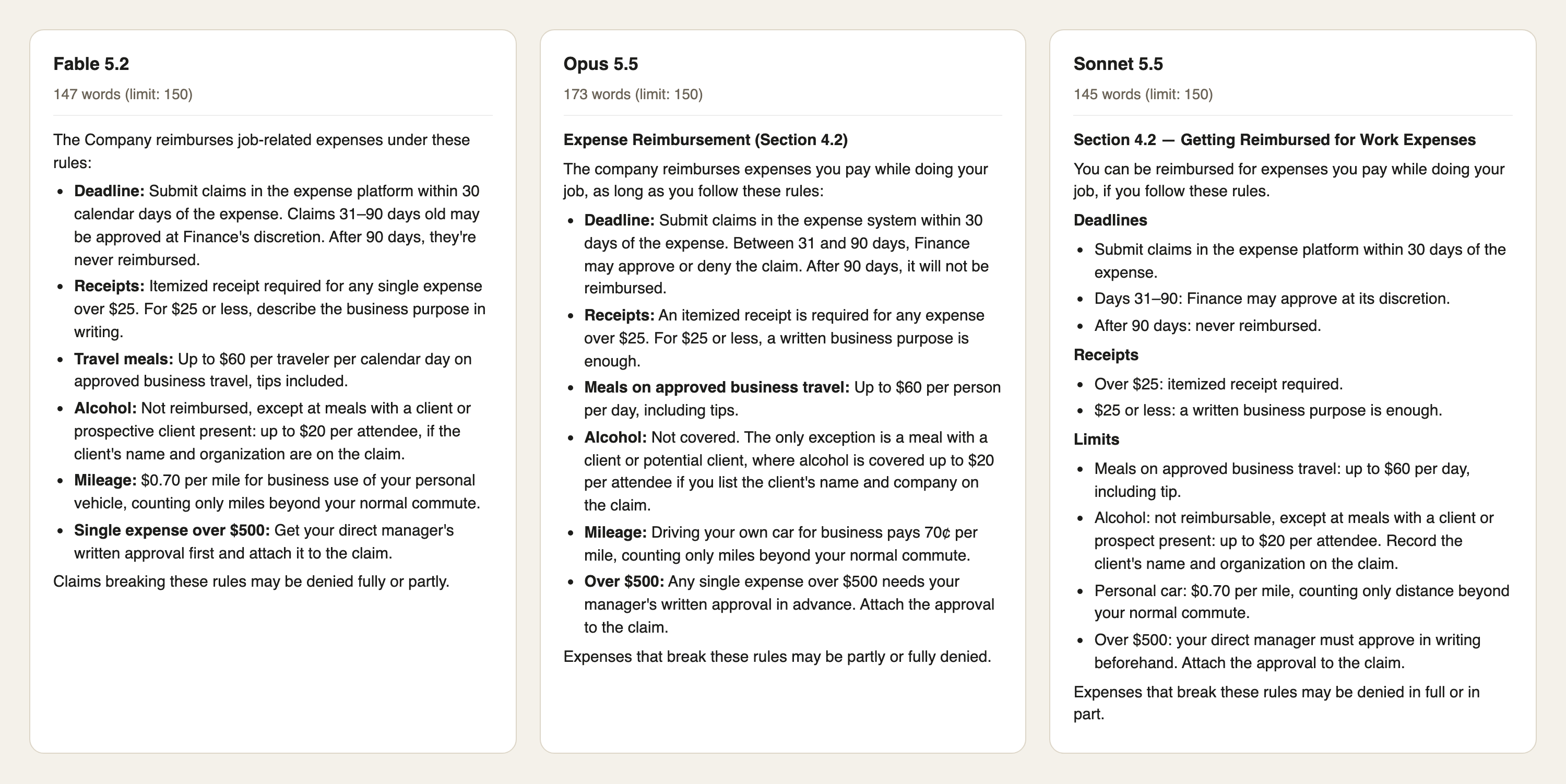
All six rewrites kept every number and the client-dinner exception. Only Fable stayed within 150 words both times, at 147 and 150.
Sonnet came in at 145, then 162. Opus wrote 173, then 162.
The three first-run rewrites, rendered from the models' raw answers. Word counts are ours.
This was also the biggest price gap of the test. Sonnet answered in 4 seconds for under a cent, and Fable thought for 30 seconds and cost 14 cents, about 24 times as much, for a 150-word rewrite.
### Matching bank deposits to invoices: every model caught every trap
For the hardest job, we gave each model 37 unpaid invoices and 23 bank deposits and asked what was still owed. Three deposits each paid two invoices with no reference, two clients paid exactly half, one overpaid by $100, and one deposit quoted another client's invoice number.
```
Below are our unpaid invoices from August and September and our bank deposits from October. Match the deposits to the invoices. Then tell me which invoices are still unpaid or only partly paid and how much is still owed on each, the total still outstanding, and anything odd I should look into.
[paste your invoice list and your deposits here]
```
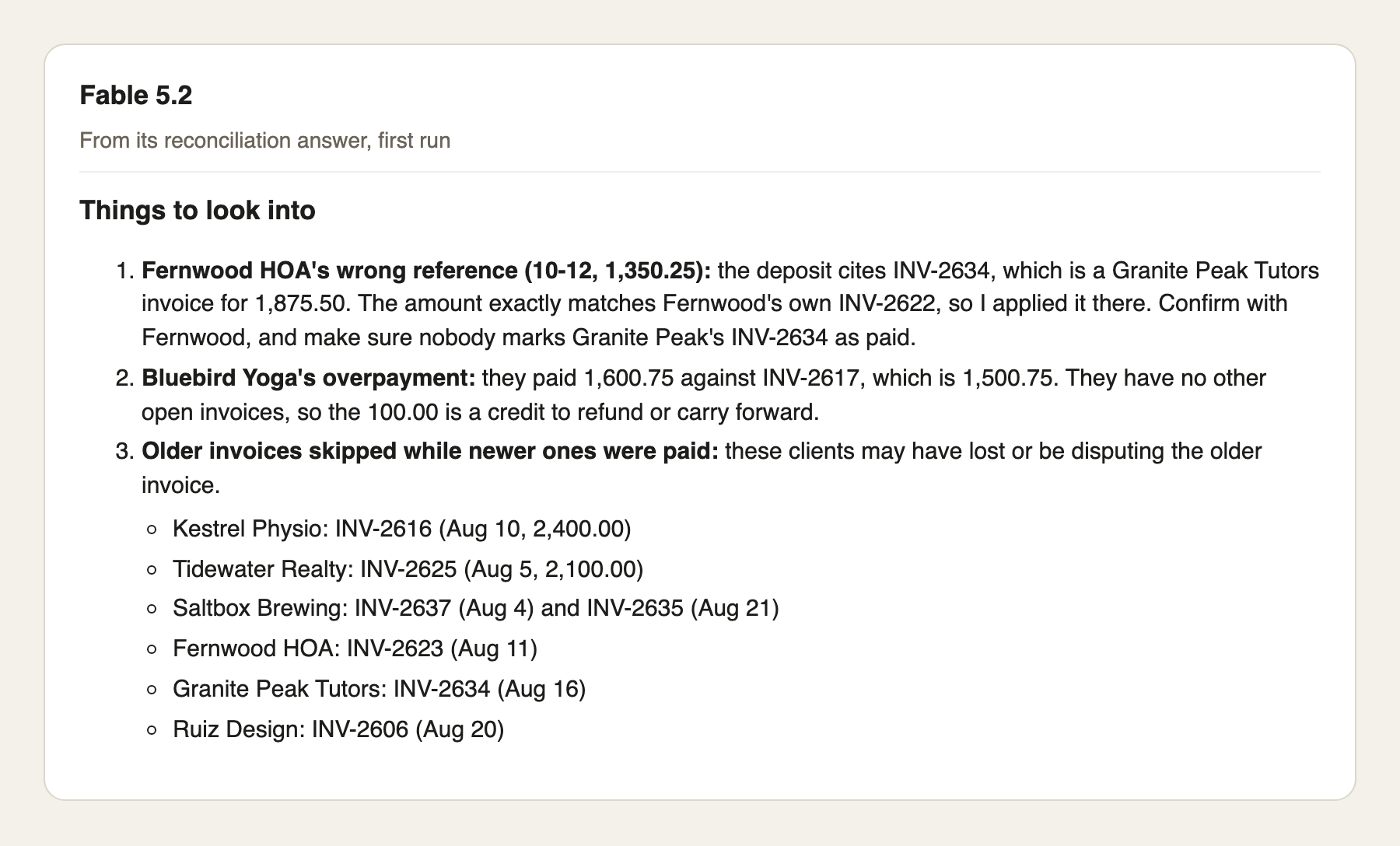
All six answers found the same 13 open invoices and the same total, $15,166.25. All six caught the wrong invoice number, kept the other client's invoice on the unpaid list, and flagged the $100 overpayment.
Part of Fable 5.2's reconciliation answer. Sonnet 5.5 and Opus 5.5 flagged the same problems.
Fable cost 23 cents per run here. Sonnet cost 5 cents and finished in 25 seconds, against Fable's 43.
## What Fable 5.2 cost next to Sonnet and Opus
Through the API, Fable 5.2 costs $8 per million tokens you send and $40 per million it writes back. Opus 5.5 costs $4 and $20, and Sonnet 5.5 costs $2 and $10.
Fable 5.2 is now available in the Claude Platform and Claude Code. It’s up to 30% faster than Fable 5.1, and costs $8/$40 per 1M tokens, down from $10/$50.
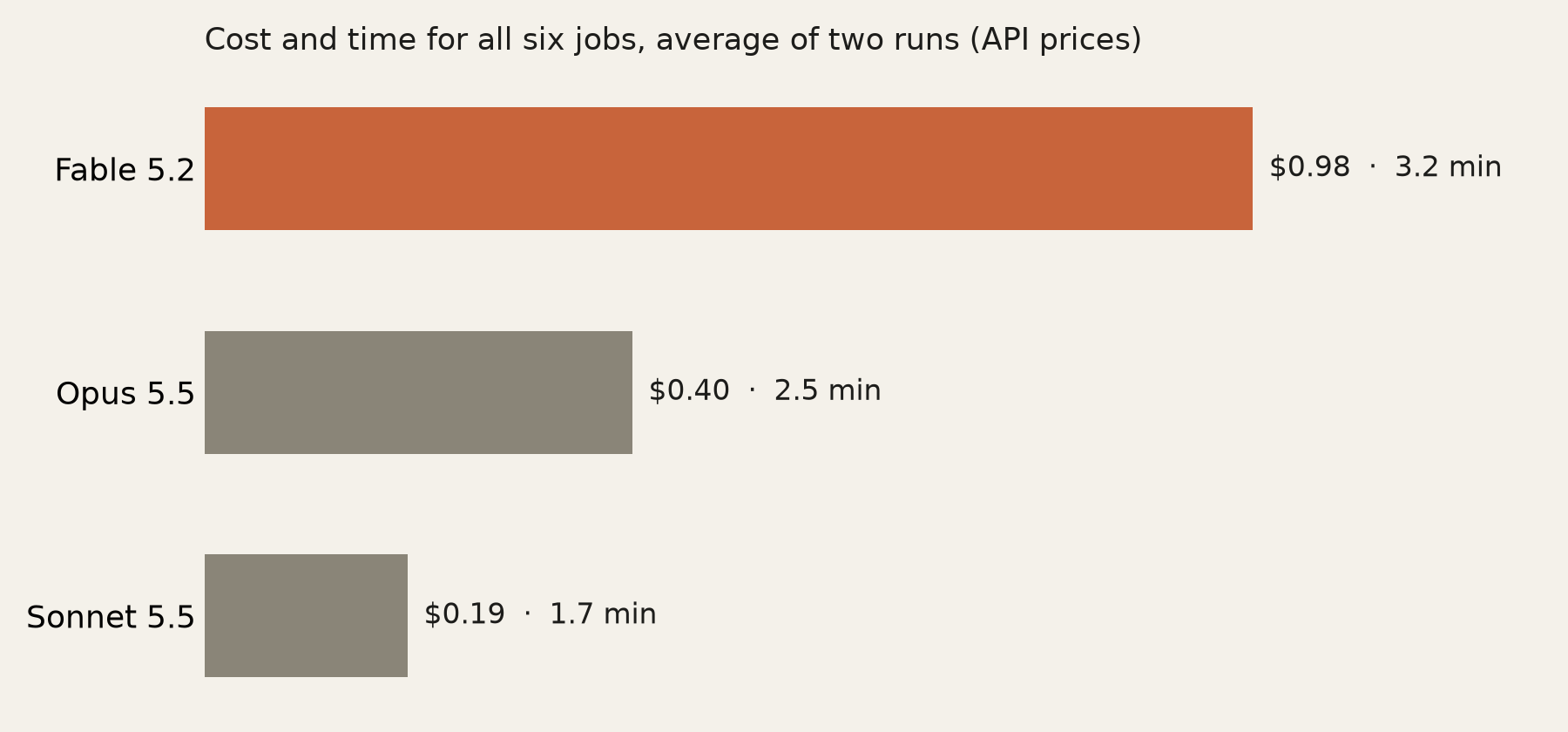
Fable also wrote more on every job, so the gap per job was wider than the price list suggests. Across all six jobs, one full set cost $0.98 on Fable, $0.40 on Opus and $0.19 on Sonnet.
What one set of six jobs cost at API prices, as Claude Code reported it, with the average waiting time.
A dollar for six jobs is nothing on its own. On a subscription, though, the same ratio comes out of your weekly limit, and Anthropic's help pages say Fable uses up your limit faster than the other models.
## Where Fable 5.2 earns its price
Our jobs were small on purpose, because that's what most people use Claude for. Fable was built for much bigger work, and our earlier tests found real differences there.
When we gave [Fable 5.2 and Opus 5.5 five office jobs](/blog/claude-fable-vs-opus), Fable got a weekday right that Opus got wrong three times in a row, and its slides needed no fixes. In [Pat's Fable 5.2 review](/blog/fable-5-2), Fable came first on all three large builds, at about four times the cost of Opus.
Anthropic's launch numbers point the same way. Fable 5.2 leads Opus 5.5 by a few points on everyday knowledge work, and by about 20 points on whole freelance projects done start to finish.
Testers who left Fable running overnight or across a weekend came back with finished software. They also found it slow and hungry for tokens, which matches what we saw on small jobs.
Across all of it, the bigger and longer the job, the more Fable pulls ahead. On a quick email or a spreadsheet question, there's no room for it to show a difference.
## How to use Claude Fable 5.2 in the Claude app
Fable 5.2 is on every paid plan: Pro, Max, Ultra, Team and Enterprise. It isn't on the Free plan.
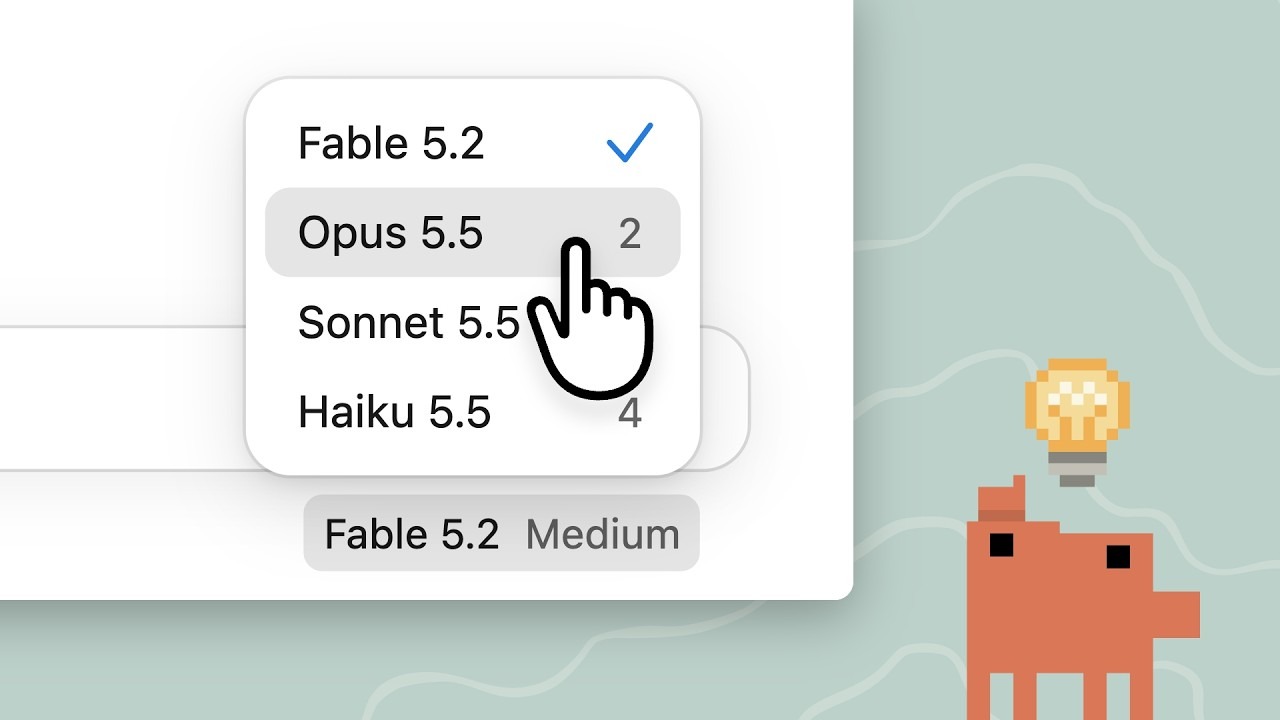
To switch, open the model menu in the message box and choose Fable 5.2. Your default model stays the same, so new chats go back to it.
The model menu in Claude, with Fable 5.2 selected at medium effort. Source: Anthropic
How much you get depends on your plan:
- **Pro and Team standard seats:** Fable is included through November 16 at 11:59 pm Pacific, for up to half of your weekly limit, plus one Fable reset. After that it bills to usage credits you pay for separately.
- **Max, Ultra and Team premium seats:** Fable is part of your plan, for up to half of your weekly limit. You also get one to three Fable resets depending on how long you've subscribed, good until March 8, 2027.
A Fable reset gives back the weekly usage you spent on Fable, not what you spent on other models. To use one, go to **Settings, then Usage**, and choose **Reset for free** under Limit resets.
Leave the effort setting at medium for normal work. Anthropic says medium suits chat and everyday knowledge work, and high suits hard research and long unattended jobs. People on Reddit have also pointed out that Anthropic's own chart shows the top setting thinking longer and costing more while scoring lower than the setting below it.
If you're on Pro, give Fable one job that's big enough to matter before Monday night. Something like this:
```
Here are our last six months of customer emails and our current FAQ page. Find the 10 questions customers ask most that the FAQ doesn't answer, write an answer for each in the same style as our FAQ, and point out any FAQ answers that contradict each other.
[attach your files]
```
Run the same prompt on your usual model in a new chat, and compare the answers and the usage each one took in Settings, then Usage.
## Claude Fable review: our verdict for everyday work
Fable 5.2 didn't get anything wrong in our test. Neither did Sonnet 5.5 or Opus 5.5, and that's the result that matters if most of your Claude time goes on email, notes, documents and spreadsheets.
Fable's one clear edge on small jobs was precision about length. It cost about five times as much as Sonnet and took about twice as long.
So keep Sonnet or Opus as your everyday model, and save Fable for the projects too big to check in an afternoon. If you're new to the lineup, our [Sonnet vs Opus test](/blog/claude-sonnet-vs-opus) shows how far the cheaper model goes, and our [Fable 5.2 launch post](/blog/claude-fable-5-2) has the full launch offer.
## Sources
- [Anthropic: Introducing Claude Fable 5.2 and Claude Mythos 5.2](https://www.anthropic.com/claude-fable-and-mythos-5-2)
- [Claude Help Center: Claude Fable models on your plan](https://support.claude.com/en/articles/15424964)
- [Claude Help Center: Claude Fable 5.2 launch offers](https://support.claude.com/en/articles/17506494)
- [Claude Platform Docs: Prompting Claude Fable 5.2 (effort levels)](https://platform.claude.com/docs/en/build-with-claude/prompt-engineering/prompting-claude-fable-5-2)
- [Claude: API pricing](https://claude.com/pricing)
- [Anthropic: Which Claude model should you build with?](https://claude.dev/blog/which-claude-model-should-you-build-with)
- [Reddit r/ClaudeAI: Fable 5.2 launch thread](https://www.reddit.com/r/ClaudeAI/comments/1xs0dct/fable_52_just_landed/)