
Anthropic Releases Claude Haiku 5.5
Anthropic released Claude Haiku 5.5, its fastest and cheapest-to-run model, and anyone can pick it from the model menu in the Claude app, free plan included.

Anthropic released Claude Haiku 5.5 on Wednesday. It's the company's fastest model so far and the cheapest one it has made to run.
Haiku is the smallest Claude model line, below Sonnet, Opus and Fable, and the one built for speed and price. Anthropic calls 5.5 "the most capable small model we've ever released."
Where to find it
Open Claude on the web, iPhone or Android and tap the model menu next to the send button. Haiku 5.5 is listed there for Free, Pro, Max, Team and Enterprise users, according to Anthropic's Haiku page. It's in Claude Code too.
The same menu holds the effort setting. Claude's help article says effort controls how much thinking Claude puts into each response. Higher effort gives more thorough answers, but they take longer and use up your plan's limit faster. Lower effort stretches your usage further.
Haiku 5.5 is the first Haiku with that setting. Each model has a recommended level marked "Default" in the menu. Claude's separate thinking switch stays on for Haiku 5.5 in the app, so effort is the one dial you can turn.
What it's built for
Anthropic built it for high-volume jobs where speed matters more than deep reasoning. Its own examples are summaries, sorting and labeling requests, looking things up in a database, live customer support, browser tasks and filling in forms.
It's also meant to work as a helper for the bigger models. On a coding project, Opus 5.5 or Sonnet 5.5 can hand smaller pieces of the work to Haiku, which does them faster and for less.
One early customer, Asana, ran it through the tests for AI Teammates, its AI agent for project work. Asana told Anthropic it saw "over a 30% reduction in latency for task completions," meaning tasks took more than 30% less time to finish than with the model it uses today.
How it compares with Sonnet 5.5
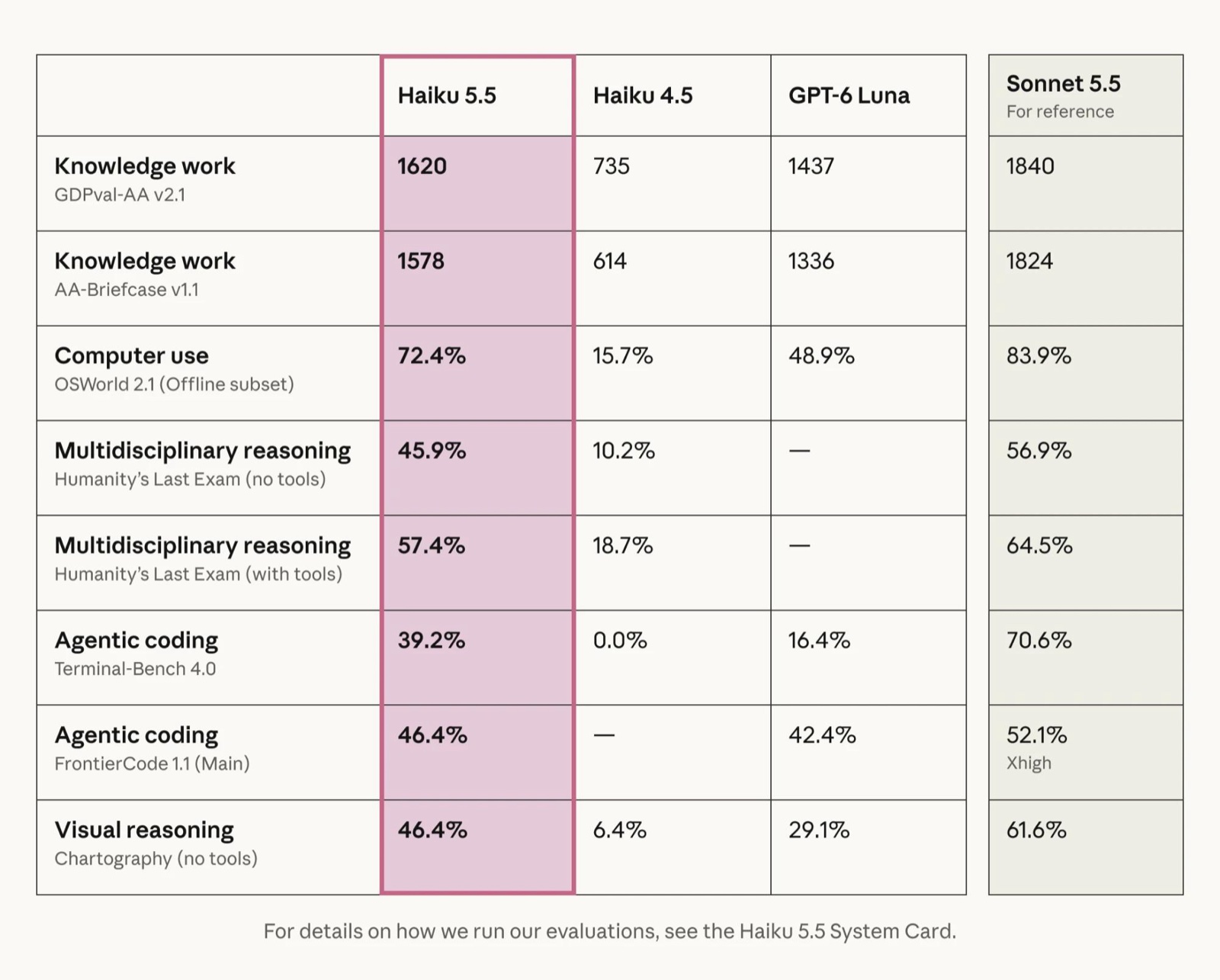
Anthropic published a comparison table with its launch. Haiku 5.5 scores below Sonnet 5.5 on every row and far above the old Haiku 4.5.
On the top row, a test of everyday knowledge work where a higher score is better, Haiku 5.5 scores 1620. Sonnet 5.5 scores 1840 and Haiku 4.5 scored 735.
The table also includes OpenAI's GPT-6 Luna, the model ChatGPT's Free and Go plans are switching to this week. Haiku 5.5 scores higher than Luna on every row where both were tested.
Anthropic's advice is to keep the hard work on the bigger models. It says "Sonnet 5.5 and Opus 5.5 remain better choices for complex agentic coding," and that Haiku 5.5 is "best suited to more narrowly scoped tasks."
In practice, if a job is the same short task repeated many times, like tagging support emails or summarizing call notes, Haiku is the better fit. If a job needs judgment across many steps, like a long research report or a big change to an app, stay on Sonnet or Opus.
What it costs
In the Claude app, your plan price stays the same. Anthropic hasn't said whether a Haiku 5.5 message counts for less of your plan's usage limit than a Sonnet or Opus message.
For anyone paying per use through Anthropic's developer platform, the drop is big. AI companies bill by tokens, small chunks of text (a million tokens is roughly 750,000 words), and Haiku 5.5 costs $0.10 per million tokens you send and $0.50 per million it writes back. That's for prompts up to 100,000 tokens.
Haiku 4.5 cost $1 and $5, and Sonnet 5.5 costs $2 and $10. Anthropic says Haiku 5.5 costs about 75% less to run than Haiku 4.5 on average.
Prompts over 100,000 tokens, roughly 75,000 words, cost five times as much, $0.50 and $2.50. Anthropic says prompts under that line make up about 90% of requests to its previous Haiku.
Anthropic made two more price moves the same day:
- Sonnet 5.5 got cheaper too. Anthropic halved the price of cache reads (the text a model re-reads from earlier in a long task), which it says cuts Sonnet 5.5's cost on most agentic work by about 20%.
- Max and Team plans get monthly API credits. Max 5x gets $100 a month, Max 20x gets $200, and Team plans get up to $500 shared across the team. Claude's help article says the credits are for building your own apps and agents on Anthropic's platform, and they don't cover Claude Code sessions or extra usage after you hit your plan's limit. Pro isn't eligible.
Most of the early reaction is about how much model you get for the price. A lot of people also read it as a shot at OpenAI, since Anthropic put GPT-6 Luna right in its own table. Developers seem most excited about running lots of cheap helper agents at once, and there aren't many hands-on reports from everyday users yet.
Haiku is the affordable pick for quick jobs, cheaper to run than even Sonnet. I haven't tested Haiku 5.5 yet, but here's the prompt I'll be giving my agent:
"Haiku 5.5 just launched. Conduct a thorough audit of the systems we run and recommend where we could route work to Haiku 5.5 without degrading performance."
That works for anyone with a Claude setup that repeats the same small job every day. The idea is to let the agent find the routine pieces worth moving to Haiku, with the judgment calls staying on Sonnet or Opus 5.5.
If you mostly chat with Claude, the test is simpler. Haiku 5.5 is in the model menu, and a summary or list cleanup is an easy way to see if it holds up next to Sonnet.
Sonnet 5.5 is the bar Haiku has to clear on your own work, and I put it through a full round of tests when it came out (the write-up is here):



Comments
Sign in to join the conversation.