
Meta's Muse Wonder Model Is Headed to Its Muse App
Meta's most capable model is built for long, multi-step jobs and remembers what you told it before. It reaches the Muse app first for people on the $20 and $100 plans.

Meta released Muse Wonder on Monday, the most capable AI model it has built, and it's coming to Muse, Meta's agent app that shops, fills out forms and sends emails for you.
It reaches the app first for people on Muse's existing paid plans, Power at $20 a month and Maximum at $100. Meta hasn't said when that starts, or whether people on the free plan get it later.
Meta's launch video walks through what the model is for:
What Meta built Muse Wonder to handle
Meta built Muse Wonder for long jobs with many steps. Its announcement names working through an insurance claim, making sense of a lease, sorting out someone's finances and building a working app, with extra training on law, finance and health questions.
There are two versions. Muse Wonder is the one headed to the Muse app. Muse Wonder Full is a bigger version that, for now, only runs in Muse Code, Meta's coding agent.
Alexandr Wang, who runs Meta's AI lab, said on X the goal was a model "useful for real world tasks for real people," shaped by how people already use Muse.
On the Artificial Analysis leaderboard, an independent ranking that combines many tests into one score, the bigger Muse Wonder Full sits second, behind only Claude Opus 5.5.
Watch it plan a Saturday run from a calendar and a health app
Meta's clearest demo shows the model doing a whole job without help. Someone asks it to plan next Saturday's run using the health app and calendar open in their Chrome browser, tell them what it noticed about their habits, map the route and add it to their calendar.
It opens both apps and reads them before planning anything. From the history it works out that the long run grows by 1 km a week, that the routes stay flat to protect a sore knee, and that Saturdays end with a library visit by 10 AM.
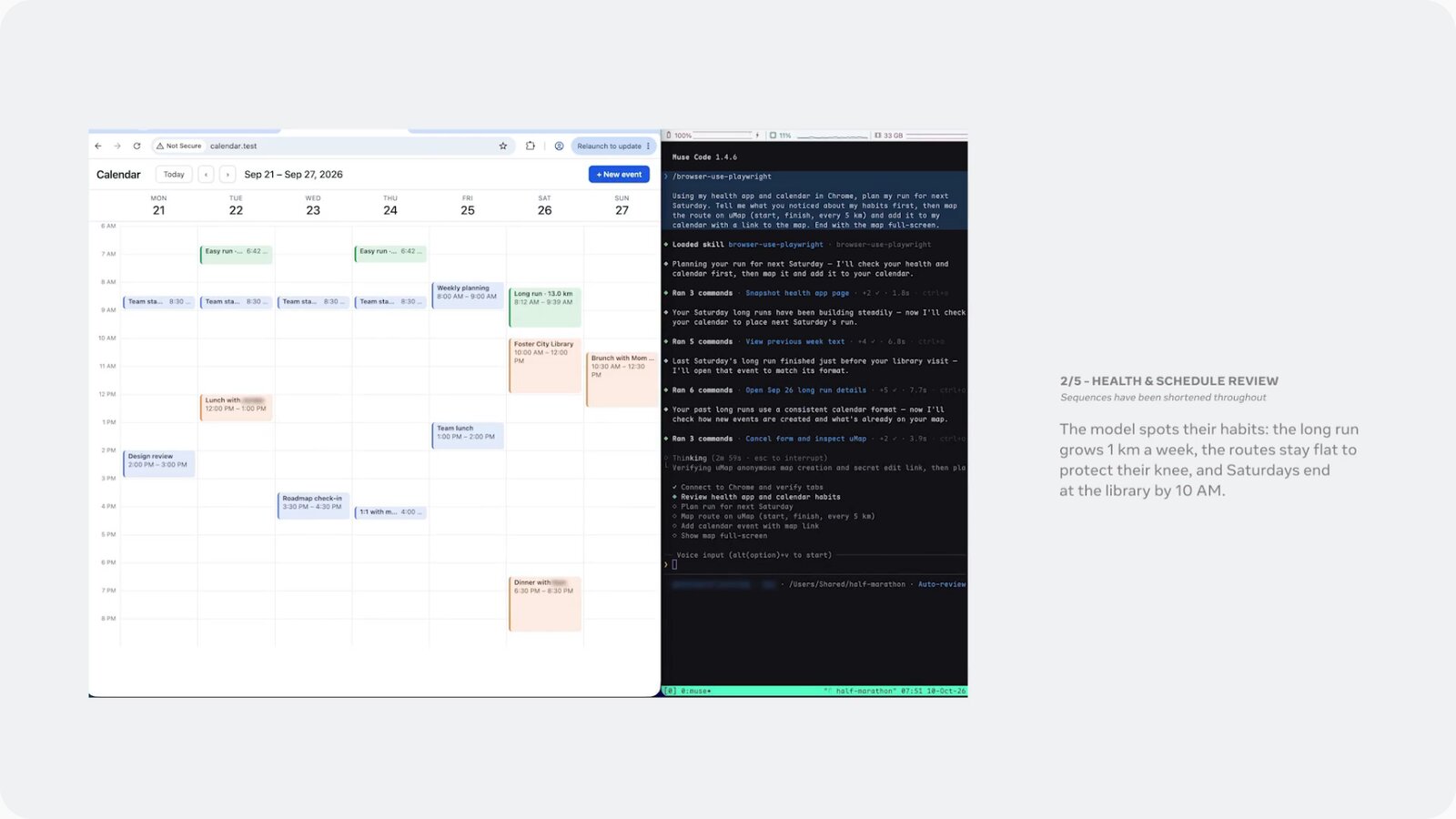
Then it plans a flat 15.1 km run with an 8:00 AM start so the runner finishes before the library. It draws the route on a free map site with a marker every 5 km, saves a link to the map, and creates a calendar event that holds the link and the route notes.
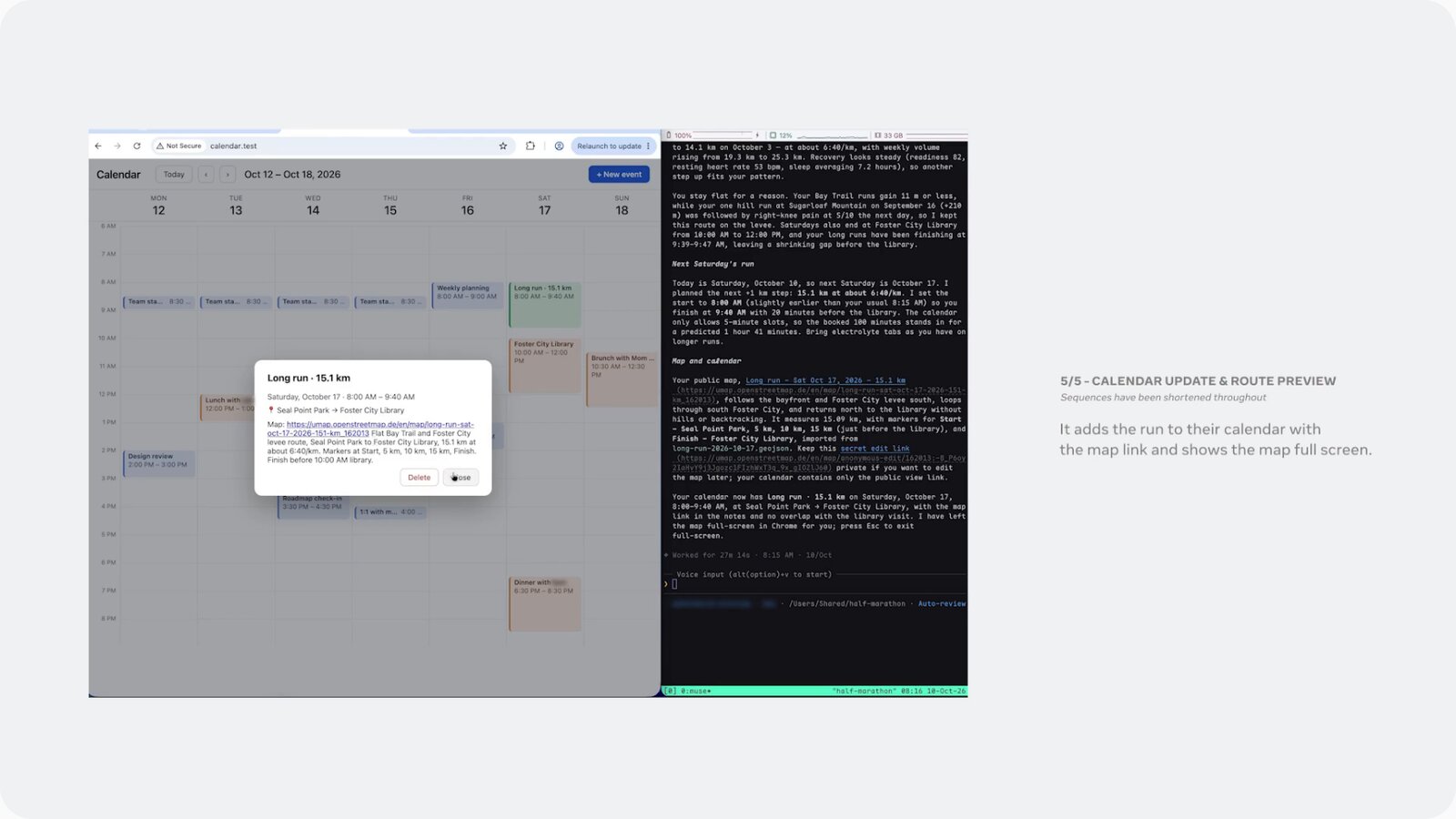
Meta ran this demo in Muse Code, which worked through a Chrome browser on the computer to do it. It shows the kind of job the model can handle, and Meta hasn't yet shown how the same job will look inside the Muse app.
How Active Memory and Active Focus change a long job
Two new features do most of the work in that demo.
Active Memory is Meta's name for carrying the things you care about from one conversation to the next and bringing back the details that fit the task in front of it. In the launch video, one of Meta's researchers says the team worked to make the model remember what's important to you "over days, weeks, months, and beyond."
So you shouldn't have to re-explain your preferences every time you start a new chat. Meta hasn't said yet what controls you'll get to see or delete what it remembers.
Active Focus covers what happens when a job gets hard. Meta says the model keeps going, tries other approaches, recovers from errors and finishes the job, asking you questions when it needs to and checking with you before anything important.
Wang told CNBC that Meta trained it to "try other approaches instead of stalling," because real tasks like booking a dinner reservation keep hitting roadblocks.
A model that remembers more about you also holds more about you, and that's the biggest worry people raised about the launch. Muse has already faced a claim that it read someone's private messages without permission, which Meta disputed, saying the Mac app can only read Messages after you switch on several permissions yourself.
Meta says it trained Muse Wonder not to share private information without your permission, and it has promised a full safety report "soon."
When you'll get Muse Wonder, and what you'll pay
In the Muse app. Paid subscribers get it first, on the $20 Power or $100 Maximum plan, and CNBC reports you'll need one of those plans to use it. Muse itself stays free, and free users keep Muse's current model for now. Meta hasn't given a date or said which countries come first. If you only use the Muse app, the $20 plan is the one to watch.
In Muse Code. This is Meta's separate coding tool, and Muse Wonder is there today. Muse Wonder Full needs the $50-a-month or $200-a-month Muse Code plan, per Engadget.
For developers. If you build your own apps, the model costs $4 per million tokens of input and $20 per million tokens of output through the Meta Model API.
The new model won't get Muse past sites that refuse it. Amazon blocked Muse from shopping on Amazon.com in September, and that block still stands whichever model Muse runs on. If you want Muse to buy something, check that the store lets it in before you count on it.
Two jobs to hand Muse Wonder once it reaches your app
The first tests how well it pulls the details out of a long document, and the second tests whether it finishes a job. Paste your lease into the chat for the first one, and fill in the brackets in the second.
For the lease example Meta keeps using:
Here's my lease. List every date I have to act on (renewal notice, rent increases, move-out notice) and every fee I could be charged. Then add a reminder to my calendar a week before each date. Show me the list and check with me before you add anything.
To test whether it follows through:
I need to return [item] I bought from [store]. Find the return policy, start the return, and tell me each step as you finish it. If something blocks you, try another way before asking me. Don't spend any money without asking first.
Muse is the agent I use most for personal stuff, partly because the free plan goes a long way.
When I gave Grok Bot, Muse and ChatGPT Dots the same three jobs, one of them was running the support inbox for a coffee shop I made up. Muse promised a customer a refund and then never issued it.
Finishing a job like that refund is what Meta says Active Focus fixes. At $20 a month, the same price as ChatGPT Plus, paying Muse subscribers get to find out first whether it does. OpenAI's Dots, by comparison, need ChatGPT Pro, which starts at $100.
It's also Meta's biggest step yet toward getting regular people to pay for its AI, a few months after its cheaper Muse Spark models started taking on the top models at a fraction of the price.
Here's my full test of all three agents:
Sources
- Meta: Introducing Muse Wonder and Muse Wonder Full
- Meta Research: Muse Wonder, a frontier model for personal and professional agents
- Meta: Muse Wonder model card
- Alexandr Wang on X
- CNBC: Meta debuts Muse Wonder AI model
- TechCrunch: Meta releases its first frontier model, Muse Wonder
- Engadget: Meta says it's caught up to the frontier
- Artificial Analysis: model leaderboard
- Adweek: Amazon locks out Meta's Muse


Comments
Sign in to join the conversation.