The prompt
Invent a launch, make its 20-second launch film, and build its launch page with a torn-paper reveal and the film embedded.

Context you should know: this is going into a video watched by a large audience. Your build is put on screen next to two other frontier models doing the same task, and your work will be credited to you by name. Every model gets this identical prompt.

**Study the references first.** Watch both films frame by frame (ffmpeg is installed) and scroll the Opus 5.5 launch page in a headless browser. The film: about 40 hard cuts in 20 seconds, getting faster as it goes. Every shot is a macro or microscope-like image of a different material, such as pollen, egg shell, lace, mushroom gills, a blueprint, torn paper or fruit skin. Every shot is composed around the same curved horizon, so one arc rhymes into the next. There's heavy film grain. Three short serif phrases grow in size, the film ends on the name, and the last frame loops back into the first. The page: three torn-paper panels fade up from black, and "Introducing" rises out from behind the planet's edge. On scroll, the torn scraps slide outward while staying locked to the curve, and the title rises and wipes on with a letterpress ink texture. The torn edges have a fibrous white paper seam on one side and a cast shadow on the other.

**The launch is yours.** Pick a subject: a product, a model, a mission, an expedition, a scientific instrument, anything with a reason to be revealed. Invent its name. It must not be an Anthropic product, and there must be no Anthropic or Claude branding anywhere. Say what it is in one sentence on the page.

Requirements:

1. **The film. 20 seconds, 1920×1080, H.264 MP4 with an audio track, rendered by you.**
   - Every image in it comes from the shared image tool (gpt-image-2, the same one for every model). **At most 40 images.** No stock, no downloaded images, no images lifted from the references.
   - Design the shot list around one repeating composition, the way the reference does, with a different material each time and chosen to suit your subject. Grade, grain, crop and align the shots in your own code so the arcs actually line up cut to cut.
   - Cut rhythm that accelerates, on-screen text in a few escalating phrases, the name at the end, and a last frame that loops cleanly into the first.
   - Assemble and render it yourself (ffmpeg, or frames from your own renderer). Check the result frame by frame.
2. **The sound. All of it synthesised in code. No sample files, no downloaded audio, no sound libraries.** Web Audio, or offline DSP in any language, rendered to the film's audio track.
   - **Realistic paper foley** is the centrepiece: not one generic crumple, but a family of distinct sounds, such as a sheet sliding across paper, a stack being shuffled, a page turning, a slow tear with fibres giving way, a crumple, a flick, a scrap landing. Each one has to sound like the real thing, so build it from noise, filters, envelopes, granular texture and randomisation. Two plays of the same sound should never be identical.
   - Hit every visual beat the way the Kimi K3 film does: each cut, each text change and the final reveal has its own sound. Add a music bed or tonal bed of your own if it helps. Keep it clean and mixed, with no clipping.
3. **The launch page.**
   - **The hero reveal**, with the Opus 5.5 page's mechanics as the target: three torn-paper collage panels made from your own generated imagery. They fade up from black, an intro word rises from behind a curved horizon, and on scroll the side scraps slide outward while staying locked to the curve, then your launch name rises and wipes on with a speckled letterpress ink texture.
   - **The torn edges are drawn in code:** a noise-driven, fibrous tear, a thin exposed paper seam on one edge, a soft cast shadow on the other, and film grain over everything. Not a PNG mask.
   - **The same paper foley plays live on the page**, synthesised in the browser: the scraps sliding, the title landing, pages turning as sections enter. Start sound on first click or keypress (browsers block autoplay audio) and show a small sound toggle.
   - **The film is embedded** in the page as its centrepiece, with the page's own player styling.
   - Below that, a short launch article for your subject in the same typographic voice: a date eyebrow, a table of contents, and three or four sections. Use a serif and a sans from an open CDN. Anthropic's fonts are off limits.
4. **No lifted assets.** Nothing downloaded from anthropic.com, x.com or Kimi. No copying the reference page's code or shaders. Rebuild the effects from what you observe.
5. **Ship it runnable.** A static site that runs from one documented command, deployable as-is, with the MP4 inside it, and a README listing the subject, the shot list with each image prompt, how each sound is synthesised, and the image count.
The exact prompt from the article.
The builds
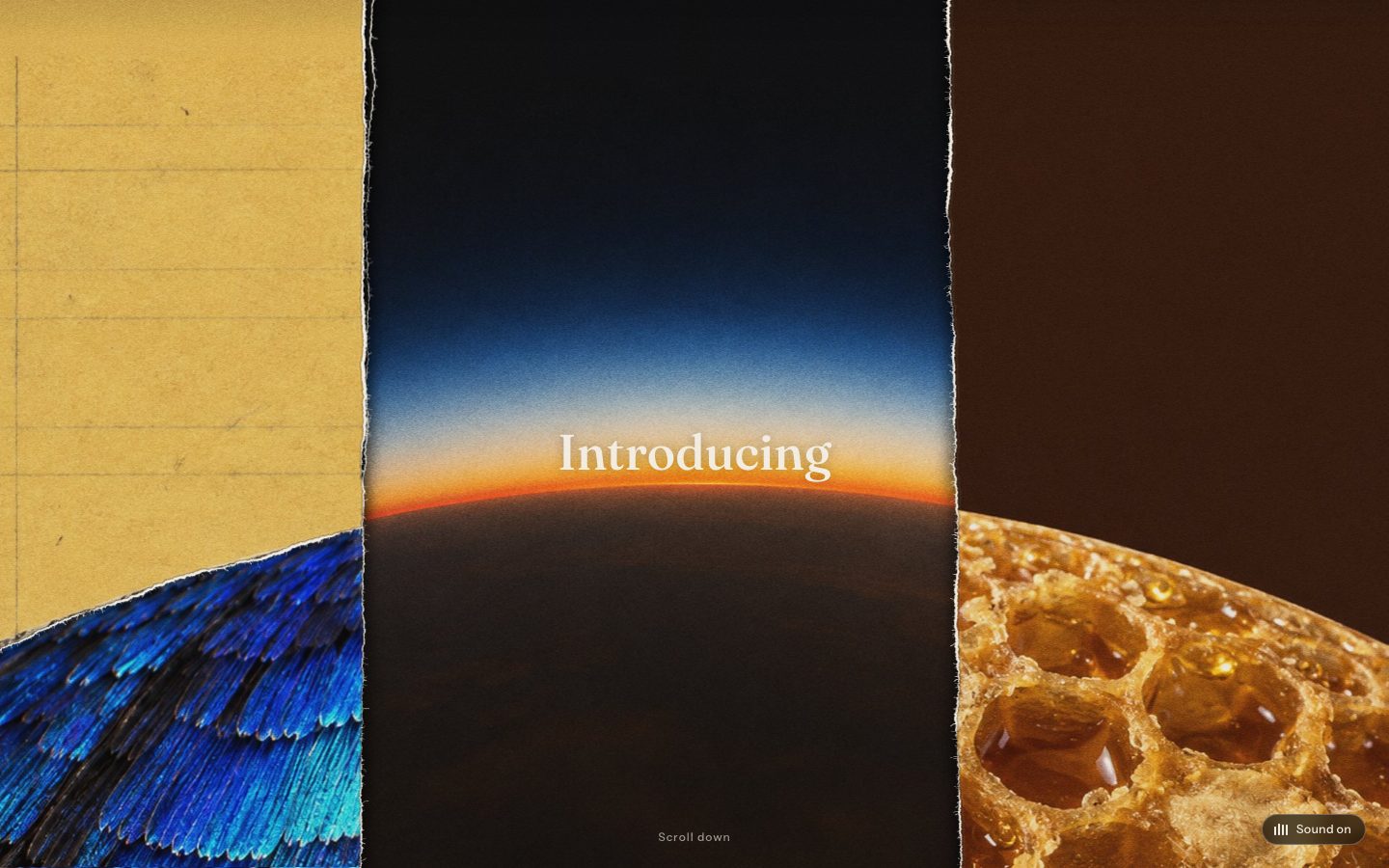
Opus 5.5 · Screenshot of the buildRuns in your browser
Written by
Pat Simmons. Pat tests AI models and tools on the AI for Mortals YouTube channel.