AI Scams: Voice Clones, Deepfakes and How to Spot Them
Cloned voices, deepfake video calls and AI trading bots run on old tricks. How each one works, the signs the FBI and FTC point to, and what to do.

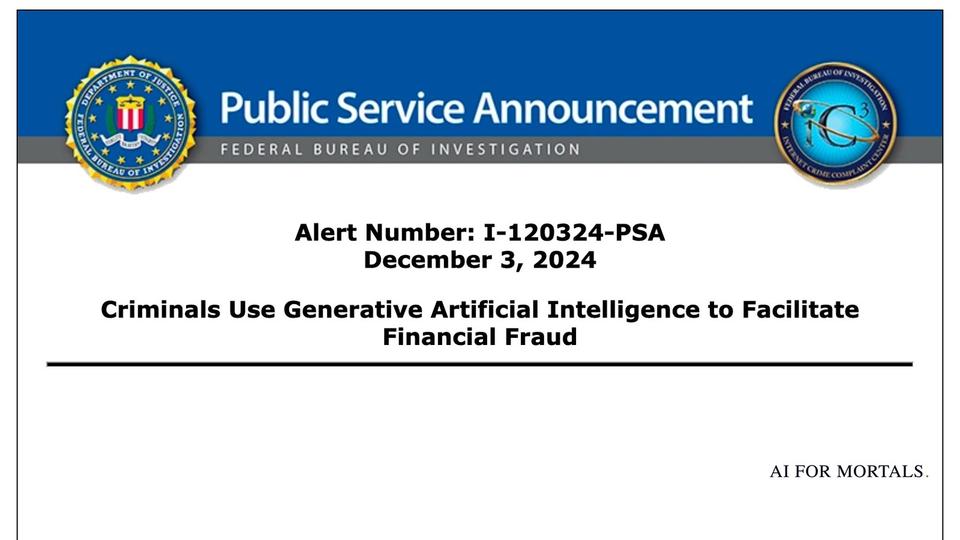
An AI scam is an old con, like a family emergency, a message from your boss or a can't-lose investment, made more convincing with AI: a cloned voice of someone you know, a deepfake video, or a phishing message with no spelling mistakes. The FBI warns that criminals use generative AI to commit fraud on a larger scale and make their schemes more believable. The FBI and FTC advice comes down to three habits: hang up and call the person back on a number you already have, agree on a secret word with your family, and never send money, gift cards or crypto because someone is rushing you. Report it at ReportFraud.ftc.gov and ic3.gov.
Last checked November 8, 2026: every warning on this page comes from the FBI, FTC, SEC, CFTC and FCC pages linked where each point appears. Pat hasn't covered scams in his videos, so this guide sticks to what those agencies have published.
What is an AI scam?
An AI scam is a fraud where the criminal uses AI tools to fake a voice, a face, a photo or a message so the con is easier to believe. The FBI's December 2024 public service announcement sorts the fakes into four kinds: AI-written text, AI-generated images, cloned voices and AI-generated video.
The scams underneath are familiar ones. The FBI's examples include romance and investment schemes, fake charities after natural disasters, counterfeit products and sextortion, where criminals make fake explicit photos of a victim and demand payment.
The FBI says AI cuts the time and effort a con takes. Criminals write believable messages faster, so they can reach more people, and translation tools clean up the grammar and spelling mistakes that used to give foreign scammers away. Making AI content is legal on its own: the FBI says synthetic content "is not inherently illegal," but it can be used for fraud and extortion.
The most common AI scams right now
The most common AI scams copy someone you trust: a relative in trouble, your boss, a celebrity, a government agency or a new online friend. Impersonation leads the FTC's numbers too. People reported losing more than $12.5 billion to fraud in 2024, and imposter scams were the most commonly reported type. That's the newest full year in the FTC's published data books as of this check, and the FTC doesn't say how much of it involved AI.
This table matches each scam to what the AI fakes, the giveaway the agencies point to, and what they tell you to do.
| Scam | What the AI fakes | The tell | What to do | Source |
|---|---|---|---|---|
| Family emergency call | A loved one's voice, cloned from a short clip posted online | An urgent plea for money, a request to keep it secret, and payment by wire, crypto or gift card | Hang up and call them on a number you know is theirs, or ask for your family's secret word | FTC, FBI |
| Fake boss or official on a video call | A live video of a company executive, police officer or other authority figure | A call you didn't expect that ends in a request for money or sensitive information | Hang up, look up the organization's number yourself and call it directly | FBI, FTC |
| Phishing emails, texts and fake websites | Polished messages with no spelling mistakes, and fake sites with chatbots that push you to click links | A message you didn't expect asking for personal or account details | Skip the link and contact the company through a website or number you already trust | FBI, FTC |
| Deepfake celebrity ads | Photos or videos of famous people promoting products or investments | A celebrity pushing a deal through an ad or a link in a text | Look the offer up yourself; a celebrity endorsement doesn't make an investment legitimate | FBI, FCC, SEC |
| AI trading bots and "AI-powered" investments | Professional-looking websites and promo videos for a trading program | Guaranteed or very high returns, "can't lose" claims, pressure to buy in fast | Check registration through Investor.gov and get a second opinion before you pay | SEC, CFTC |
| Romance scams and fake online friends | Profile photos, photos sent in chats, and videos to "prove" the person is real | Someone you haven't met in person asks for money or offers to get you into crypto | Never send money to someone you haven't met in person, and reverse image search their photo | FBI, FTC |
| Government and bank impersonation | Fake IDs and credentials for police, government agencies or banks | Threats of arrest, or orders to move your money to "protect it" | Contact the agency or bank through the number on its own website | FBI, FTC, SEC |
Tax and shopping scams fit the same rows. The FTC lists the IRS among the agencies scammers pretend to be, and the FBI says criminals use AI images of celebrities to promote counterfeit products or orders that never arrive. The FCC's consumer guide passes on a Better Business Bureau report of deepfaked Taylor Swift and Jennifer Garner videos sending people to counterfeit cookware websites.
How voice-clone and deepfake scams work
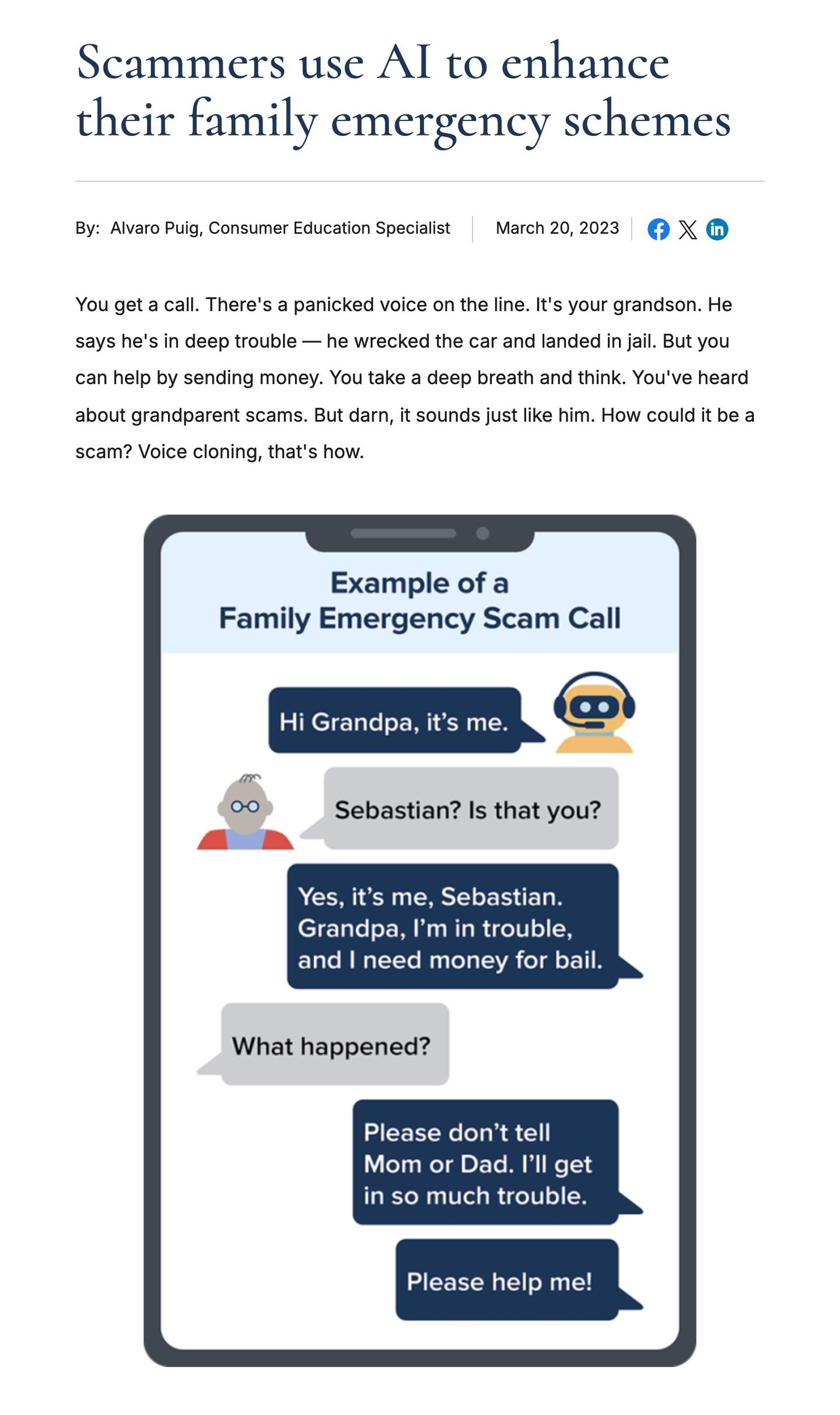
A voice-clone scam needs two things, according to the FTC: a short audio clip of your family member's voice, which the scammer could get from content posted online, and a voice-cloning program. When the scammer calls, they sound like your loved one.
The FBI describes the same move. Criminals generate short audio clips in a loved one's voice, pose as a relative in a crisis, and ask for immediate money or a ransom. The FBI also says criminals have gotten into people's bank accounts by impersonating them with AI-generated audio.
Deepfake video works the same way on screen. The FBI says criminals make videos for live video chats with supposed company executives, police or other authority figures, and videos for private chats that "prove" an online contact is a real person. The SEC's investor alert adds that a deepfake video of a CEO announcing false news can be used to move a stock's price.
Deepfake phishing is the targeted version. Spear phishing, in the FBI's definition, is a message aimed at a specific person or group to get them to click a malicious link or open an attachment, and the FBI says criminals write these with AI. The SEC warns that AI tools might pull personal details about you from social media, so a pitch can sound like it was written just for you.
Robocalls with cloned voices are illegal in the US unless you agreed to them. In February 2024 the FCC ruled that AI-generated voices count as "artificial" under the Telephone Consumer Protection Act, and its consumer guide says calls using voice cloning are illegal, with some exceptions, unless you gave your consent in advance. AI voices are also getting quicker at answering in real time, which we covered in AI phone voices just got fast enough to fool you.
What is a common AI scam sign?
The most common sign is pressure to pay right now in a way that's hard to undo: a wire transfer, cryptocurrency, a payment app or a gift card. The FTC's How To Avoid a Scam page lists four signs that show up in scams of every kind:
- Someone pretends to be from an organization you know, and the caller ID can be faked.
- They say there's a problem or a prize.
- They pressure you to act immediately, sometimes telling you not to hang up.
- They tell you exactly how to pay.
Family emergency scams add one more sign: the caller might ask you to keep it secret, so you don't check with anyone else (FTC).
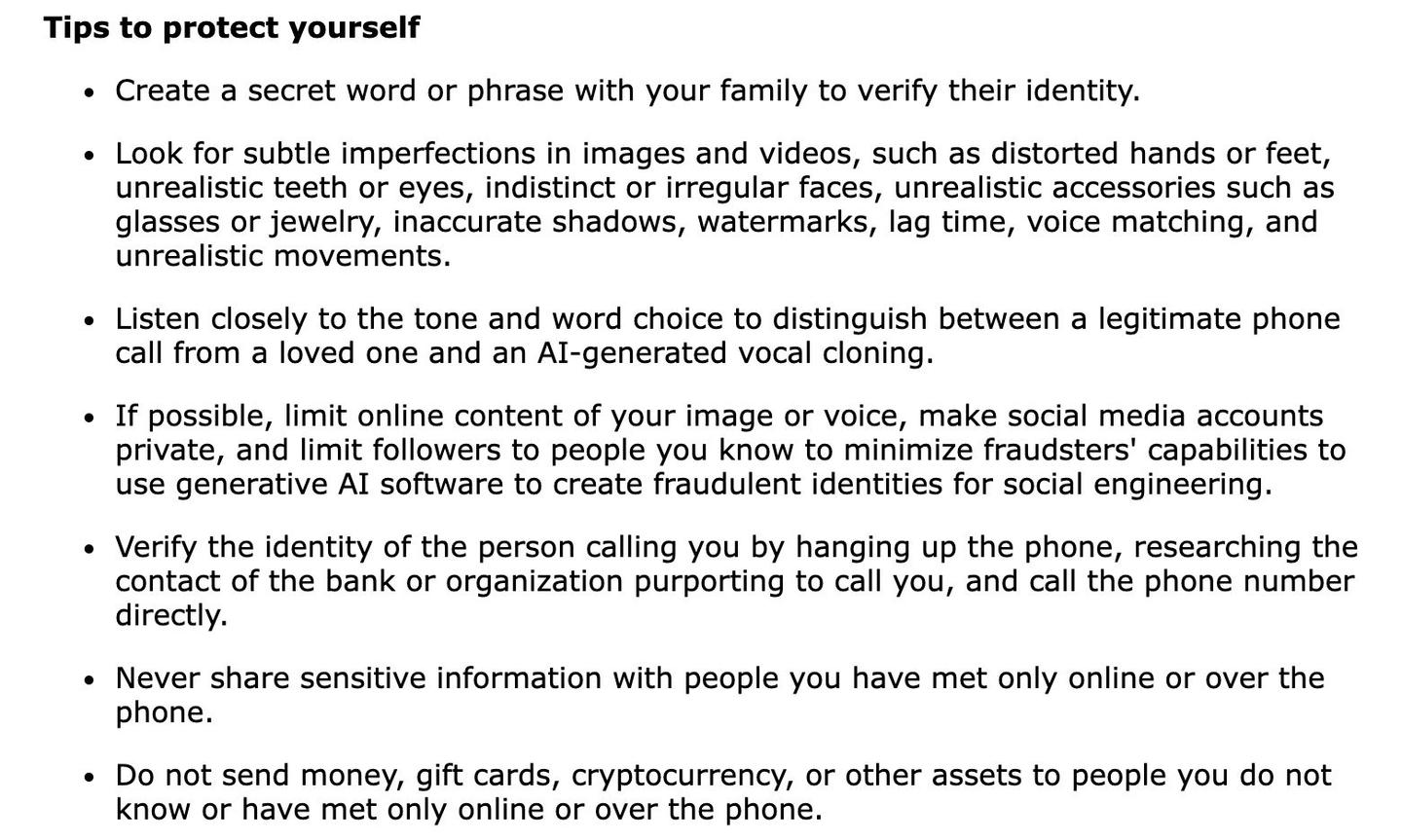
The FBI also lists tells for fake images, video and audio: distorted hands or feet, unrealistic teeth or eyes, irregular faces, odd glasses or jewelry, wrong shadows, watermarks, lag, voice mismatches and unnatural movements, plus a caller's tone and word choice. It says it "can be difficult to identify when content is AI-generated," and its first tip is a check that doesn't depend on spotting glitches: a secret word or phrase your family agrees on.
How do I know if I am chatting with a scammer?
If someone you've never met in person asks you for money, treat it as a scam. The FTC's bottom line on romance scams is to never send money or gifts to a sweetheart you haven't met in person, and it warns these scammers may even offer to help you start investing in crypto.
The FTC lists the stories these scammers tell. They want to move the conversation off the dating app or social site, they can't meet because they live far away (working on an oil rig, say, or in the military), and then an urgent cost comes up, like a plane ticket, a visa or medical bills. They also tell you how to pay, usually by wire, gift card, payment app or crypto.
AI makes the profile harder to doubt. The FBI says criminals use AI to create large numbers of fake social media profiles, make realistic profile photos, send photos during private chats, and make videos that "prove" the contact is a real person.
If you have doubts, the FTC says to stop replying, talk to someone you trust, search the person's job title plus the word "scammer," and run a reverse image search on their profile photo. A photo tied to a different name is a sign of a scam.
AI trading bots and "make money with AI" offers
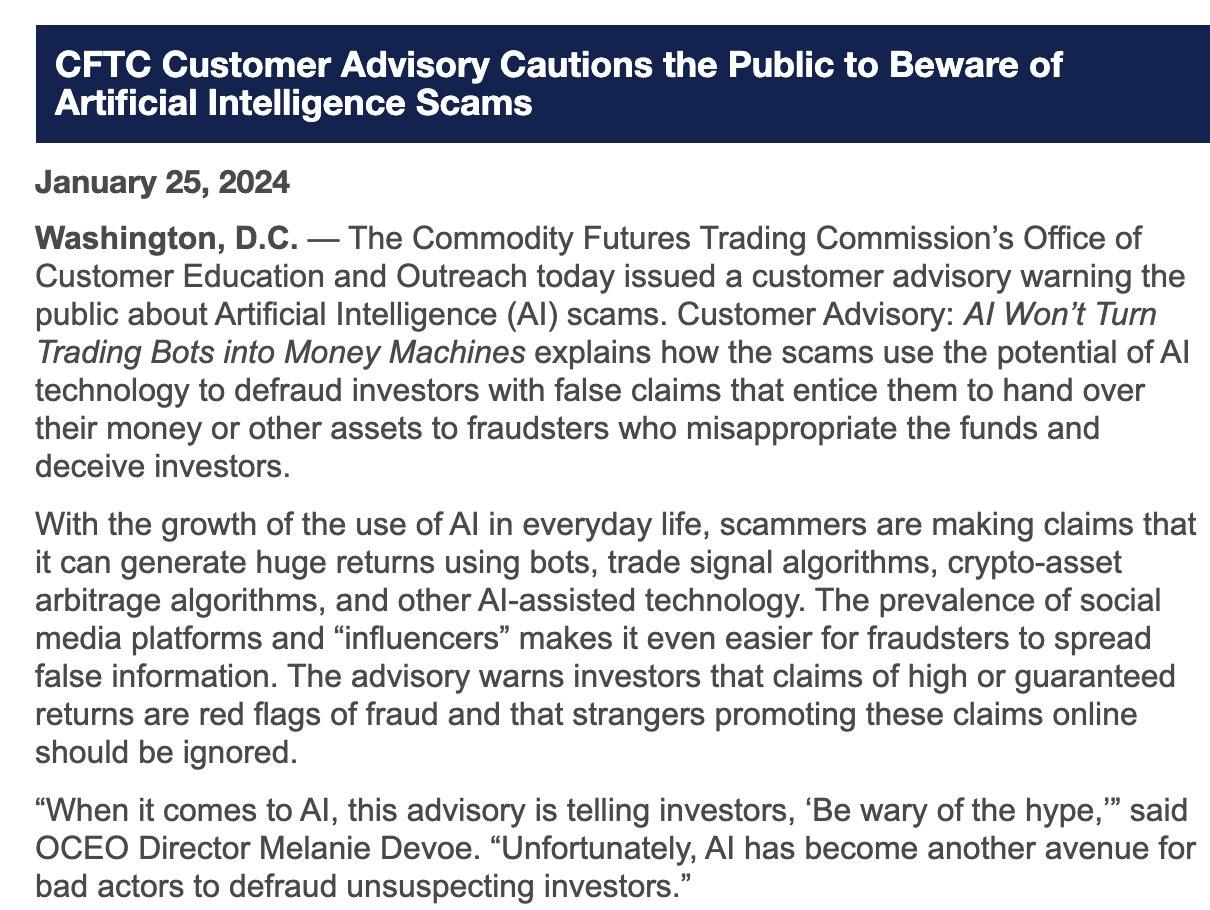
Any trading bot or AI investment that promises guaranteed or very high returns is a red flag, according to both the SEC and the CFTC. The joint investor alert from the SEC, NASAA and FINRA quotes the kind of claims unregistered platforms make, like "Our proprietary AI trading system can't lose!" and "Use AI to Pick Guaranteed Stock Winners!" The CFTC's advisory, AI Won't Turn Trading Bots into Money Machines, says AI technology "can't predict the future or sudden market changes."
The CFTC's case study is Mirror Trading International, where Cornelius Johannes Steynberg took more than $1.7 billion in bitcoin from at least 23,000 people over about three years. He sold a bot trading program that guaranteed at least 10 percent a month, very little money was ever traded, and the CFTC says it ran as a Ponzi scheme. Investment scams were also the biggest reported loss in the FTC's 2024 data, at $5.7 billion.
Before you put money into an AI trading app you saw advertised, run the checks the regulators list:
- Confirm the firm or person is registered, using the free Check Out Your Investment Professional tool the SEC points to on Investor.gov.
- Check how old the trading website is at lookup.icann.org, and reverse image search the people behind it (CFTC).
- Get a second opinion from a financial advisor, friend or family member (CFTC).
- Treat high-pressure sales and promises of quick profits as warning signs, and don't invest just because someone famous recommends it (SEC).
"Make money with AI" business offers get the same scrutiny. The FTC charged that Automators AI promised to set up profitable stores on Amazon, Walmart and Facebook Marketplace using AI to pick top-selling products, and most clients didn't even earn back what they paid to buy in (FTC consumer alert).
What to do if an AI scam targets you
Stop replying or hang up, then check the story through a number or website you already trust before you send anything. The FTC and FBI steps, in order:
- Call the person or company back on a number you know is theirs, or reach them through another family member or friend (FTC).
- Talk to someone you trust before you pay or share anything (FTC).
- If you already paid, contact your bank, payment app, wire service, gift card company or crypto exchange immediately and ask them to reverse the payment (FTC).
- Report it to the FTC at ReportFraud.ftc.gov and to the FBI at ic3.gov, with the scammer's contact details, the payment details and how they first contacted you (FBI).
- For an investment scam, you can also report it to the SEC at sec.gov/tcr or to the CFTC.
The FTC says it will never tell you to move your money to "protect it," withdraw cash, or buy gold and give it to someone. If someone claiming to be from the FTC asks you to, it's a scam.
Questions people ask about AI scams
Can a scammer clone my voice from social media?
The FTC says a scammer could get the short clip they need from content posted online. The FBI suggests limiting the photos and recordings of yourself online, making social media accounts private, and only accepting followers you know.
What is a family safe word?
A safe word is a secret word or phrase your family agrees on ahead of time, so you can check who's really calling; the FBI recommends one. If you don't have one yet, the FTC suggests asking a question only the real person could answer, like "What kind of dog do you have?"
Are AI voice robocalls legal?
Robocalls using AI-generated voices are illegal in the US unless you gave consent in advance, with some exceptions, under the FCC's February 2024 ruling.
Can AI fake a live video call?
The FBI says criminals use AI-generated video for real-time video chats with people posing as company executives, police and other authority figures. Hang up and call the organization on a number you look up yourself.
Is there a legitimate way to make money with AI?
The FTC's test for any money-making offer is the paperwork. Ask the seller for the legally required one-page disclosure document, plus an earnings claim statement if they say how much you can make, and walk away if what they tell you contradicts it (FTC).
Should I trust investment tips from a chatbot?
The SEC warns against relying only on AI-generated information for investment decisions, because it can be based on false or outdated data and can even be made up. It suggests checking the underlying sources and talking to a registered investment professional.
Do AI companies try to stop scammers using their tools?
OpenAI publishes reports on disrupting malicious uses of AI with case studies of misuse it detected and stopped, and lists scams and spam among the activities it works to prevent.
Can a scam trick an AI agent that works for me?
Instructions hidden in a web page, email or file can change what an AI agent does, a weakness called prompt injection. We've covered two safeguards for agents: 1Password fills in passwords so the agent never sees them, and Amex is building a check of an agent's purchases against what you approved.
Sources
- FBI IC3: Criminals Use Generative Artificial Intelligence to Facilitate Financial Fraud (December 3, 2024)
- FTC: Scammers use AI to enhance their family emergency schemes (March 20, 2023)
- FTC: Scammers Use Fake Emergencies To Steal Your Money
- FTC: How To Avoid a Scam
- FTC: What To Know About Romance Scams
- FTC: What To Do if You Were Scammed
- FTC: Vetting a business or coaching opportunity before you buy in
- FTC: New FTC Data Show a Big Jump in Reported Losses to Fraud to $12.5 Billion in 2024
- SEC, NASAA and FINRA: Artificial Intelligence (AI) and Investment Fraud investor alert
- CFTC: Customer Advisory Cautions the Public to Beware of Artificial Intelligence Scams
- FCC: FCC Makes AI-Generated Voices in Robocalls Illegal
- FCC: Deep-Fake Audio and Video Links Make Robocalls and Scam Texts Harder to Spot
- OpenAI: Disrupting malicious uses of AI





Comments
Sign in to join the conversation.