
Amex Adds a Safety Check for AI Agent Purchases
American Express published Intent Intelligence, a way to record exactly what you asked an AI agent to buy and check the purchase against it before the charge goes on your Amex card.

American Express published its Intent Intelligence framework on October 13. It records exactly what you asked an AI agent to buy, and Amex checks the agent's purchase against that record before the charge goes on your Amex card.
You approve the request with Amex first, including the store, your maximum budget and the product details. The agent then pays with a stand-in card number tied to that one request, so it never gets your real card number.
You can't use it yet. Amex published it for the companies that build shopping agents and checkouts, and it starts protecting your purchases once they build it in.
What happens when your agent tries to buy the wrong thing
Amex's own example is a pair of sneakers. You ask an agent for white Nike sneakers in a size 9, and it tries to buy a pair from Adidas. Because Amex already knows what you approved, it can stop the charge before it goes through, Amex's VP of agentic partnerships told TechCrunch.
The same check covers a price that's over your limit, the wrong store or the wrong size. Today, a card company usually only sees the final charge, after the agent has already decided what to buy. With this framework, Amex sees your request before the agent shops.
How the check works, step by step
I haven't been able to try this myself, but Amex's newsroom post and the full framework lay out four steps.
- You tell the agent what you want. The agent asks follow-up questions until it has the details: the item, the store if you care, the most you'll pay and a deadline.
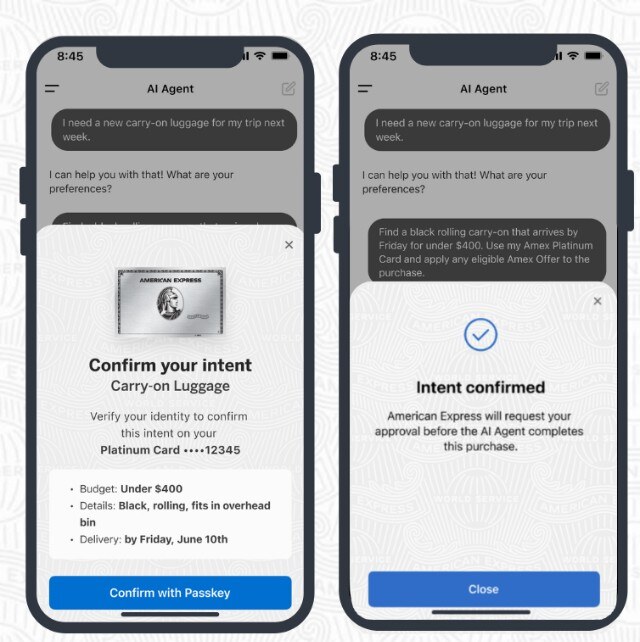
- You confirm it with Amex. You check the summary and sign off, for example with a passkey (the fingerprint or face scan your phone already uses to sign you in).
- Amex locks in your limits. It saves a record of your request that expires on the date you set.
- The agent pays with a card number made just for that request. The number only works within your limits, and Amex checks every charge against what you signed off on.
Amex's sample screens show the sign-off popping up right inside the agent's chat. Here, someone asks for a black rolling carry-on under $400 that arrives by Friday, then confirms the request with a passkey.
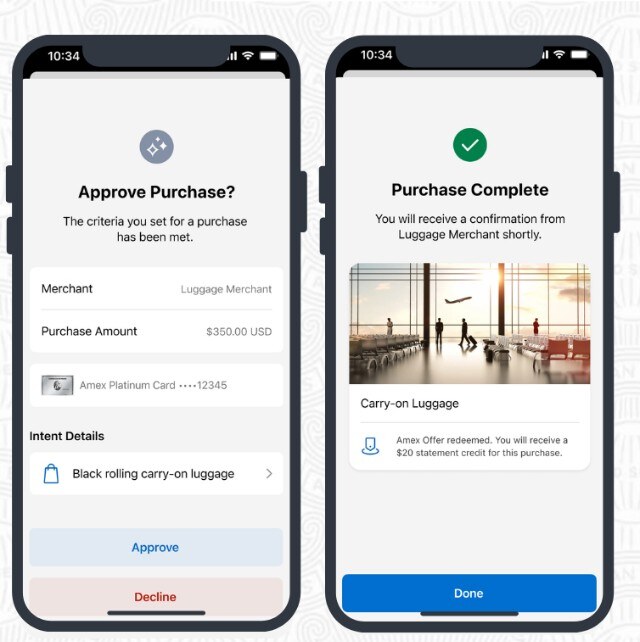
One sign-off can cover more than one purchase, up to a number of purchases and an end date you approve. Depending on how the agent is built, it either buys on its own within those limits or comes back for one last tap. In Amex's sample, it comes back when it finds a match, with the store, the price and the card it will use, and you tap Approve or Decline.
You can also edit or cancel a request later, through Amex or through the agent, Amex told Digital Transactions.
The framework also limits what the agent passes along about you. If you say "buy a flight for my mom's birthday on July 12," Amex's guidance says the summary the agent sends Amex should read only "Flight on July 12th," with the personal details left out.
You can also hand an agent a looser job, or a purchase that waits for something to happen. Amex's examples include "build me a website, but don't spend more than $100," and "if the sneakers I want are restocked before April 15th, buy one pair in a US women's size 8 for $200 or less."
Why Amex is building this before the problem shows up
Amex says it hasn't seen a rise in disputed charges from agent purchases yet. It already sees "thousands" of agent purchases a week through the companies it works with, though, and expects agents to do more without asking you first.
Amex's example of where that's headed is paper towels. If you let an agent reorder household basics whenever you run low, the only limits you care about are price and pack size, and nobody stops to ask you before each order. A check at the card company is what catches the agent when it gets one wrong.
The record also helps when a purchase turns into a fight. If an agent buys something outside what you approved, your signed request is the evidence that you didn't ask for it. It works the other way too: someone who approved a purchase can't easily claim the agent went rogue.
Amex is unusual here because it's both the bank that issues your card and the network that moves the payment. It says other card companies could use the same framework on their own networks, but if you pay with a Visa or Mastercard, none of this applies unless your card company adopts something like it.
When you'll actually see it
There's nothing for you to switch on, and it only protects purchases once agent and checkout companies build it in.
It's part of Amex's developer kit for agent payments, which came out in April. Amex says it's in talks with partners, but it hasn't named any agent or store that uses the check today.
Until then, you can give your agent the same limits yourself. Paste something like this into ChatGPT, Claude or whichever agent shops for you:
Find me a black rolling carry-on that fits in an overhead bin, under $400 including shipping, arriving by Friday. Before you buy anything, show me the exact item, the store and the total, and wait for me to say yes.
Now that personal agents are becoming a thing, there's going to be a huge opportunity in agent payments, and I think a whole cottage industry will grow out of the big card companies.
Before any of that money shows up, stores have to trust agents, and right now the stores decide whether an agent gets to shop at all. I recently gave OpenAI's Dots, its always-on agent, my Amazon shopping list, and Amazon blocked it straight away. Amazon has also blocked Meta's Muse agent since September 20. TikTok went the other way and built its own checkout right into the app.
Stores worry about agents that don't say who they are and purchases that turn into disputes. A check like this answers part of that, because the card company has proof you asked for the purchase. Here's my video putting three personal agents (Grok Bot, Dots and Muse) through the same jobs, shopping included:
The cottage industry around agent payments is already starting. Stripe built a directory where agents can find businesses and pay them, and now Amex is building the check on the card side.
It's really cool to see Amex on top of this, because finance companies stepping in will be crucial, and frankly, there's a lot of money to be made.
Sources
- American Express: Intent Intelligence framework for trusted agentic commerce
- American Express: Intent Intelligence, building trust in agentic commerce (the full framework)
- American Express Developers: Agentic Commerce Experiences
- TechCrunch: Amex introduces a framework to prevent AI agents from making unauthorized purchases
- Digital Transactions: Amex's next step for agentic commerce is a framework
- The Star: Amazon blocks Meta's Muse AI agent from its retail site



Comments
Sign in to join the conversation.