AI Voice Scams: How Cloned-Voice Calls Work and How to Check a Call Is Real
Scammers clone a relative's or an official's voice from a short clip.

On this page
- What is an AI voice scam?
- How scammers clone a voice
- How do you know if you're talking to a scammer?
- What to do on the call: hang up, call back, ask for the safe word
- Can a scammer access your phone if you answer a call?
- Is AI calling illegal?
- AI voice scam news: what the FBI and FTC have warned
- What to do if you already sent money
- Questions people ask about AI voice scams
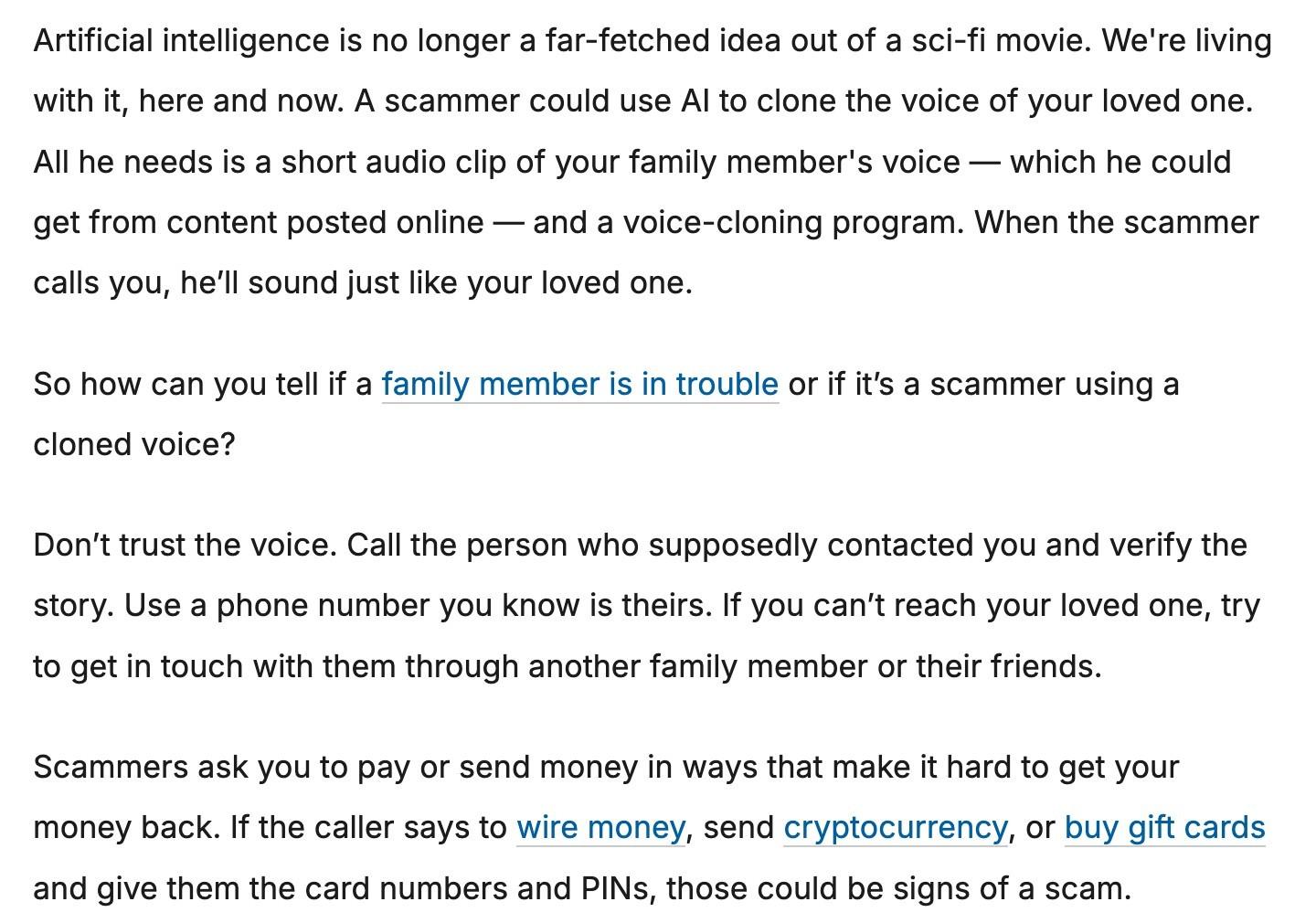
An AI voice scam is a phone call or voice message that uses a cloned copy of a real person's voice, such as a relative, a boss or an official, to rush you into sending money or handing over a code. The FTC says a scammer needs only a short audio clip of your family member's voice and a voice-cloning program, and the clip can come from something posted online.
The FTC and the FBI give the same core defense: don't trust the voice, hang up and call the person back on a number you already know is theirs. The FBI also says to agree on a secret word or phrase with your family. Anyone who insists you pay by wire transfer, cryptocurrency or gift card is a scammer.
This page covers cloned-voice phone calls and voice messages. Our broader guide explains how other AI scams work, including deepfake video calls and trading bots.
What is an AI voice scam?
An AI voice scam is a familiar phone con, the fake emergency or the fake official, run with a voice that AI copied from someone you trust. The FTC's own example is a grandparent call: a panicked voice that sounds just like your grandson says he wrecked the car, landed in jail and needs money.
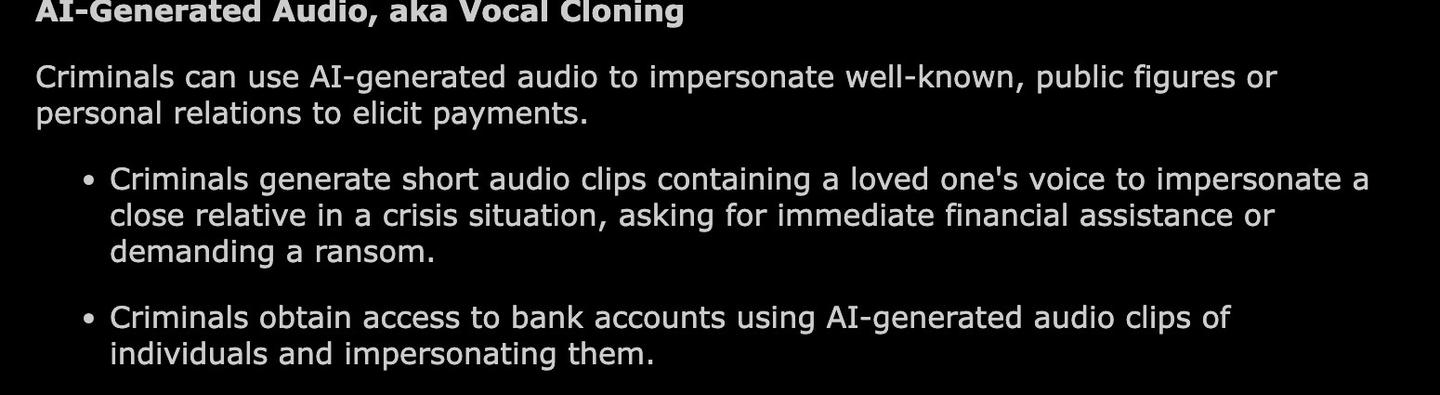
The FBI's December 2024 warning lists three ways criminals use AI-generated audio, which it calls vocal cloning. They impersonate public figures or relatives to get payments, they generate short clips of a loved one's voice to fake a crisis and ask for emergency money or a ransom, and they have used AI-generated audio clips of people to get into those people's bank accounts.
Cloned voices are hard to catch by ear. AI phone voices are now realistic enough to pass for a call-center agent, and the FBI's May 2025 warning says AI-generated voice clones and a real person "can sound nearly identical."
How scammers clone a voice
Scammers clone a voice by running a short recording of the person through a voice-cloning program. The FTC says the recording can come from content posted online, and that when the scammer calls, "he'll sound just like your loved one."
Natural-sounding AI voices now come built into mainstream apps, as our look at how realistic voice AI like GPT-Live has become shows. A scammer can use a cloned voice in a live call or in a recorded voice message. The FBI's 2025 warning describes campaigns that sent AI-generated voice messages, which it calls "vishing" (voice phishing).
The FBI suggests limiting how much of your voice and image is online. Its advice is to make social media accounts private and limit followers to people you know, which gives fraudsters less material to copy.
How do you know if you're talking to a scammer?
You often can't tell from the voice, so judge the call by what it asks you to do. The FBI says AI-generated content "is often difficult to identify," and it suggests listening closely to tone and word choice while also checking the call another way.
The FTC's guide on how to avoid a scam lists four signs, and each one fits a cloned-voice call:
- The caller pretends to be someone you know or an organization you trust.
- There is a problem, such as a family emergency, or a prize.
- You're pressed to act right now, sometimes told not to hang up.
- You're told to pay a specific way.
On payment, the FTC's phone scams page is blunt: anyone who insists that you can only pay by wire transfer, gift card, cryptocurrency or payment app "is a scammer." Those methods make it hard to get your money back.
A familiar name or number on the screen proves nothing. The FTC says scammers can make any name or number show up on your caller ID, which is called spoofing. Secrecy is another warning sign: in the FTC's example call, the fake grandson says "Please don't tell Mom or Dad."
The FBI adds two more tells. A caller who asks for a two-factor code, the one-time login code your bank or email sends you, is trying to take over your account. A known contact who suddenly asks you to move the chat to a new app or a new number should be checked through a number or platform you already trust.
What to do on the call: hang up, call back, ask for the safe word
Hang up and call the person back on a number you know is theirs. If you can't reach them, the FTC says to try another family member or their friends. If the caller claims to be a bank, a company or a government agency, look up its number yourself and call that.
The FCC's guide to stopping unwanted robocalls says to use an official number from an account statement or the organization's website. The FTC adds that you shouldn't call a number the caller gives you or the number from your caller ID.
A family safe word gives you a second check that doesn't depend on how the voice sounds. Both FBI warnings recommend you "create a secret word or phrase" with your family to verify their identity. Agree on it ahead of time, and ask for it when a call from a relative involves money or an emergency.
If you're unsure, stop and tell someone. The FTC suggests talking to a friend, family member or neighbor before you do anything, because saying it out loud can help you see the scam.
This table pulls the checks from the FTC, FBI and FCC guidance into one place.
| Check | What to do | Who says so |
|---|---|---|
| Don't trust the voice | Treat a familiar voice as unproven, because AI clones can sound nearly identical to the real person | FTC, FBI |
| Hang up and call back | Call a number you know is theirs, or one you looked up yourself, never the number that called you | FTC, FBI, FCC |
| Ask for the family safe word | Agree on a secret word or phrase in advance and ask for it on any urgent call | FBI |
| Refuse wire, crypto and gift cards | Anyone who insists on these payment methods is a scammer | FTC, FBI |
| Never share a two-factor code | Give no login code to anyone by phone, text or messaging app | FBI |
| Don't trust caller ID | Scammers can make any name or number show up on your screen | FTC, FCC |
| Talk to someone first | Tell a friend or family member before you pay or share anything | FTC |
Can a scammer access your phone if you answer a call?
None of the FTC, FBI or FCC guidance pages linked here say that picking up a call, by itself, gives a scammer control of your phone. Their warnings are about what happens after you answer: the FCC's guide to caller ID spoofing says that if you answer, scammers "use scam scripts to try to steal your money or valuable personal information."
The FCC's advice is to avoid answering calls from numbers you don't know and to hang up right away if you do answer one. If a caller or a recording asks you to press a button to stop the calls, hang up, because the FCC says scammers use that trick to identify potential targets. The FTC adds that pressing numbers on a robocall can lead to more robocalls.
The FCC also says not to respond to any questions, especially ones that can be answered with "Yes" or "No," and never to give out account numbers, Social Security numbers or passwords on an unexpected call.
The FCC names one way a scammer can get into something on your phone: your voicemail. Some voicemail services let anyone in who calls from your own number, and a hacker can spoof your number to do that, so the FCC says to set a voicemail password. The FBI adds that you should not click links in a text or message until you have confirmed who sent it.
Is AI calling illegal?
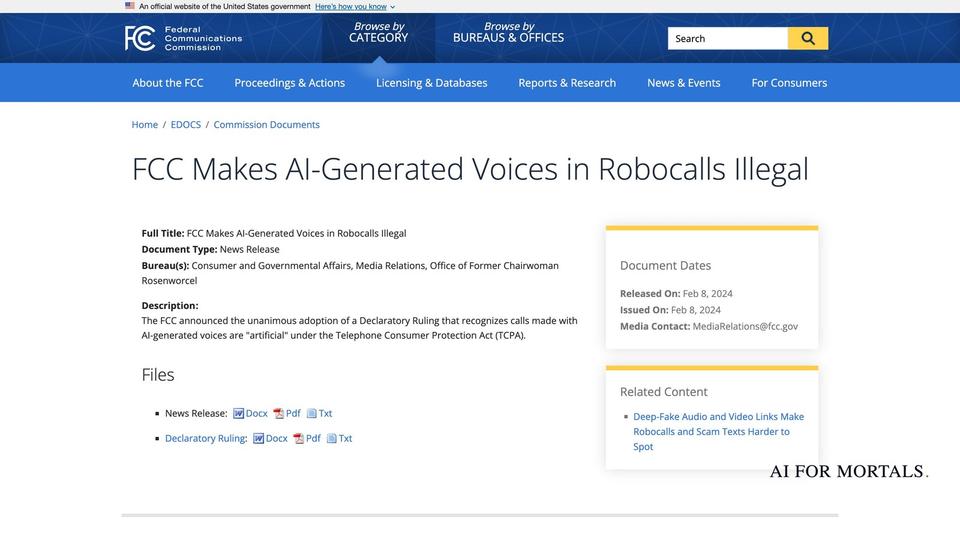
In the US, robocalls that use an AI-generated voice are illegal unless the person being called agreed to receive them or the caller is exempt, according to the FCC. On February 8, 2024, the FCC unanimously adopted a ruling that makes AI-generated voices in robocalls illegal by counting them as "artificial" under the Telephone Consumer Protection Act, the main US law that limits junk calls.
The ruling took effect immediately. The FCC said it gives state attorneys general new tools to go after the people behind voice cloning robocall scams, since using AI to generate the voice in these calls is now illegal in itself. A coalition of 26 state attorneys general had written to the FCC in support.
The FBI says creating or sharing synthetic content "is not inherently illegal," though it can be used for crimes such as fraud and extortion. Faking caller ID to defraud someone is illegal under the Truth in Caller ID Act, and the FCC says illegal spoofers can face penalties of up to $10,000 for each violation.
The FTC treats an illegal call as a clue in itself: "If someone is already breaking the law calling you, what they're calling about is probably a scam."
AI voice scam news: what the FBI and FTC have warned
AI voice scams are real, and the FTC, FCC and FBI have each issued warnings or rules about them since 2023. This table lists the ones this page draws on, oldest first.
| Date | Agency | What it said |
|---|---|---|
| March 20, 2023 | FTC | Scammers can clone a loved one's voice from a short clip posted online; don't trust the voice and call back on a number you know |
| February 8, 2024 | FCC | AI-generated voices in robocalls count as "artificial" under federal law, so those calls are illegal without consent |
| December 3, 2024 | FBI | Criminals use cloned voices of relatives to fake emergencies and have used AI audio clips to get into bank accounts; create a family secret word |
| May 15, 2025 | FBI | Since April 2025, criminals have sent texts and AI-generated voice messages posing as senior US officials |
| June 15, 2026 | FTC | Imposter scams were the most reported fraud of 2025, with $3.5 billion reported lost |
The FBI's May 2025 warning says the people targeted were often current or former senior federal or state officials and their contacts. The messages tried to build trust before getting into personal accounts, sometimes by sending a malicious link under the cover of moving the chat to another messaging app.
The FTC's June 2026 data release says people reported losing about $16 billion to fraud in 2025, the highest on record, and nearly one in three fraud reports were about imposter scams. The FTC doesn't say how much of that involved AI. Phone calls were the second most common way scammers reached people in the FTC's 2024 fraud data, after email.
The 2026 release also flags bank impersonators. Some of the costliest imposter scams start with a fake security alert, often from a bank, and the victim is talked into moving money to "protect" it.
What to do if you already sent money
Contact whoever you paid through right away, tell them it was a scam and ask them to reverse the payment and refund your money. The FTC's guide on what to do if you were scammed says your money might already be gone, "but it's always worth asking."
| How you paid | Who to contact first |
|---|---|
| Bank transfer or Zelle | Your bank or credit union |
| Payment app (Venmo, Cash App, PayPal) | The payment app |
| Wire transfer (Western Union, MoneyGram) | The wire transfer company |
| Gift card | The gift card company, using the number on the back of the card |
| Cryptocurrency | The cryptocurrency exchange or ATM operator |
| Credit or debit card | The card issuer, using the number on the back of the card |
Keep the gift card and the receipt if you paid that way, since the FTC says you may need them for your claim. Cryptocurrency payments don't have the legal protections that credit and debit cards do, so that money is harder to get back.
Then report it. The FTC takes reports at ReportFraud.ftc.gov, and the FBI takes them at its Internet Crime Complaint Center, ic3.gov. The FBI asks for the caller's name and phone number, the payment details (date, type, amount and accounts involved) and how the contact started.
If you gave the caller your Social Security number, the FTC points you to IdentityTheft.gov for a recovery plan. If you gave away a password, change it.
Questions people ask about AI voice scams
Are AI voice scams real?
Yes. The FBI has issued public warnings that criminals use AI-generated voices, including one in December 2024 about fake family emergencies and bank account access, and one in May 2025 about fake senior US officials.
Can a scammer clone my voice from social media?
The FTC says a scammer can get the short clip it needs from content posted online. The FBI suggests making social media accounts private and limiting followers to people you know.
What is a family safe word?
It is a secret word or phrase your family agrees on in advance so you can confirm who is really calling. The FBI recommends one in both of its AI voice warnings.
What if the call shows a number I recognize?
Hang up and call back on the number you have saved for that person. The FTC and FCC both say scammers can fake the name and number on your caller ID.
What if the caller says they're from my bank?
Hang up and call the number on your account statement or the bank's website, as the FCC advises. The FTC says some of the costliest imposter scams start with a fake security alert, often from a bank, that talks people into moving money to "protect" it.
Can an AI voice scam come as a voice message?
Yes. The FBI's 2025 warning describes AI-generated voice messages, and its advice is the same: find the person's number yourself and call to check.
Should I answer calls from numbers I don't know?
The FCC says not to, and to hang up right away if you do answer one. For a call you think is spoofed, its advice is "don't hang on, hang up!"
Sources
- FTC: Scammers use AI to enhance their family emergency schemes (March 20, 2023)
- FTC: How to avoid a scam
- FTC: Phone scams
- FTC: What to do if you were scammed
- FTC: People reported losing $3.5 billion to imposter scams in 2025 (June 15, 2026)
- FTC: Reported fraud losses of $12.5 billion in 2024 (March 10, 2025)
- FBI IC3: Criminals use generative AI to facilitate financial fraud (December 3, 2024)
- FBI IC3: Senior US officials impersonated in malicious messaging campaign (May 15, 2025)
- FCC: FCC makes AI-generated voices in robocalls illegal (February 8, 2024)
- FCC: Stop unwanted robocalls and texts
- FCC: Caller ID spoofing

Comments
Sign in to join the conversation.