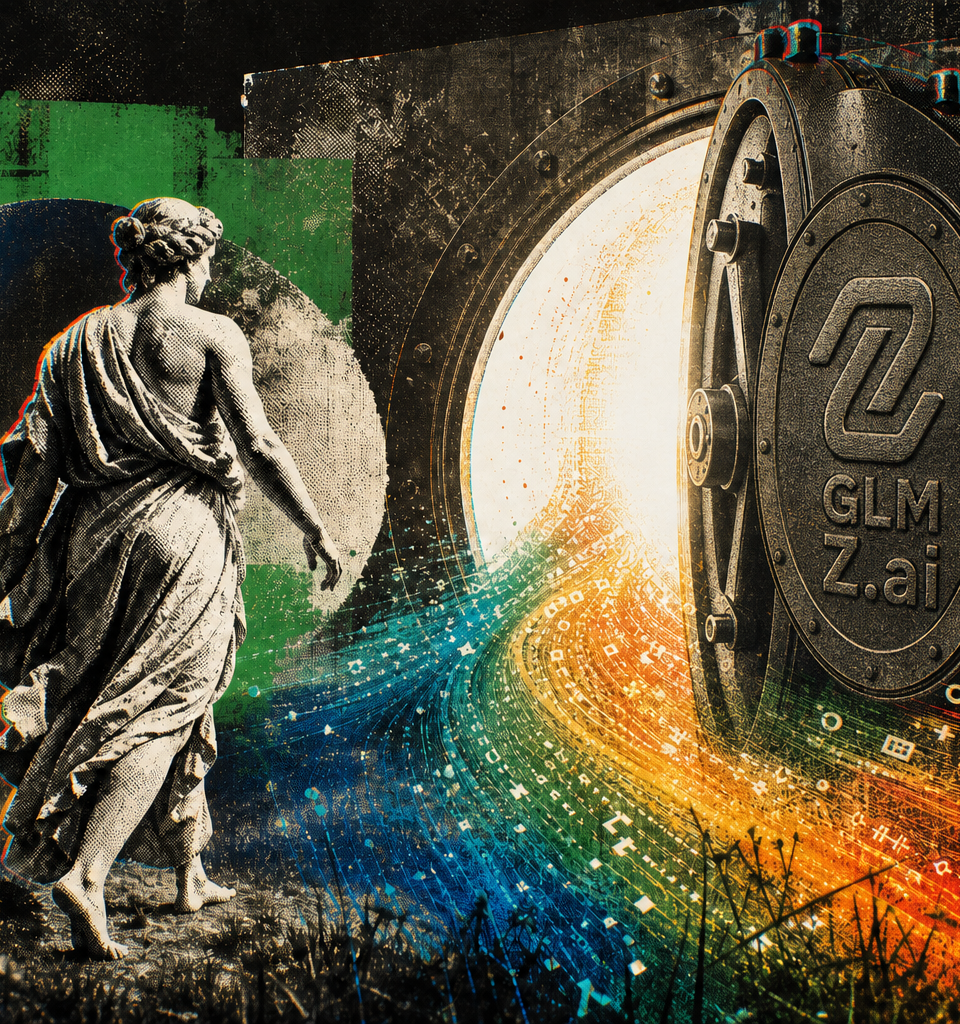
A Chinese lab called Zhipu released a new AI model today called GLM-5.2, and the part that got everyone's attention is the price tag, which is zero. The model is "open weights," and on coding tasks it lands within a few points of the most expensive models from American labs. For the first time in a while, the free option is sitting close to the top of the table.
What "open weights" actually means
Most of the AI you use comes to you through a door you rent. You pay for ChatGPT, or for Claude, and you talk to the model through an app or a website. You never get the model itself. The company keeps the actual file on its own servers and lets you borrow it by the month.
Open weights flips that. Zhipu published the real model under a free MIT license, which is about as permissive as licenses get. Anyone can download GLM-5.2 from HuggingFace, a sort of public library for AI models, and run it on their own machine or their own server. You are not renting a seat anymore. You have the thing.
That distinction matters more than it sounds. A model you can download is a model nobody can take away from you, raise the price on, or quietly change underneath you. It is yours to keep.
The numbers, in plain terms
GLM-5.2 can hold about a million tokens of text at once, which works out to a very long document or a whole codebase in a single sitting. That is the same working memory as GPT-5.5 and Claude Opus 4.8, the current flagships from OpenAI and Anthropic. So on raw capacity, the free model is even with the paid leaders.
On coding, it gets close on quality too. On one test that measures how well a model handles real programming tasks, GLM-5.2 scored 81 against Opus 4.8's 85. On another, it came within roughly one percent of Opus. On a popular community leaderboard for coding, called Design Arena, it ranked first, just ahead of Claude Fable 5, the Anthropic model that was pulled from the market a few days ago. Across all these tests, GLM-5.2 is the highest-ranked open model anyone has released.
Then there is what it costs to actually run. Through an API, GLM-5.2 runs at about $1.40 per million words of input, a fraction of what the top US models charge for the same work. Free to download, cheap to run at scale. For a small team watching its software bill, that combination is hard to ignore.
The catch worth knowing about
Here is the honest part. Most of those scores come from either the community or from Zhipu's own benchmarks, not from independent testers. That is a real caveat, because open models have a known habit of "benchmaxing," which means tuning a model to score well on the specific, easy-to-game tests that make for good headlines, without the everyday quality holding up the same way.
So the leaderboard wins should be read with a raised eyebrow. Plenty of people who have kicked the tires are impressed; plenty of others think the rankings are inflated. The real-world quality is genuinely contested right now, and "ranked #1" is a claim worth verifying before you bank on it.
The headline says GLM-5.2 beat Claude Fable 5, and that claim does not hold up. Benchmaxing is exactly the move that produces a result like that, and a free open model edging out a top closed one on a community board is the most gameable result there is.
What is believable, and genuinely exciting, is the part nobody is leading with. A free, downloadable model landing within a few points of Opus 4.8 on coding is a real result, the kind that holds up even after you discount the leaderboard hype. That gap has been closing for a year, and every month the open option gets a little harder to dismiss. You may not download GLM-5.2 yourself, but the team that builds the tools you use is watching this closely, because a capable free model changes what your software is allowed to cost.
It also lands at an awkward moment for Anthropic. Fable 5 is still dark, with no word on when it comes back, and a Chinese lab just shipped a strong open model into that silence. The march toward good open-source AI keeps going, and the longer the best closed models stay quiet, the more that march matters.