Google Launches Universal Cart for Shopping Across Stores
Universal Cart holds products from different stores in one place, fills up from AI Mode in Search and the Gemini app, alerts you to price drops and lets you pay without leaving it at some stores.

Google launched Universal Cart in the US on October 15. It's one shopping cart for products from different stores, and you fill it while you shop in AI Mode, the chat-style tab in Google Search, or in the Gemini app.
The cart keeps everything you've saved, alerts you when a saved item gets cheaper or comes back in stock, and at some stores lets you pay without leaving it. Everywhere else, it hands your items to the store's own site so you can finish buying there.
Google first showed the cart at its I/O conference in May and said it would arrive "this summer." It's showing up in mid-October instead, a few weeks before Black Friday.
How you fill one cart from Search and Gemini
I haven't tried Universal Cart myself yet, but Google's launch post walks through how it works.
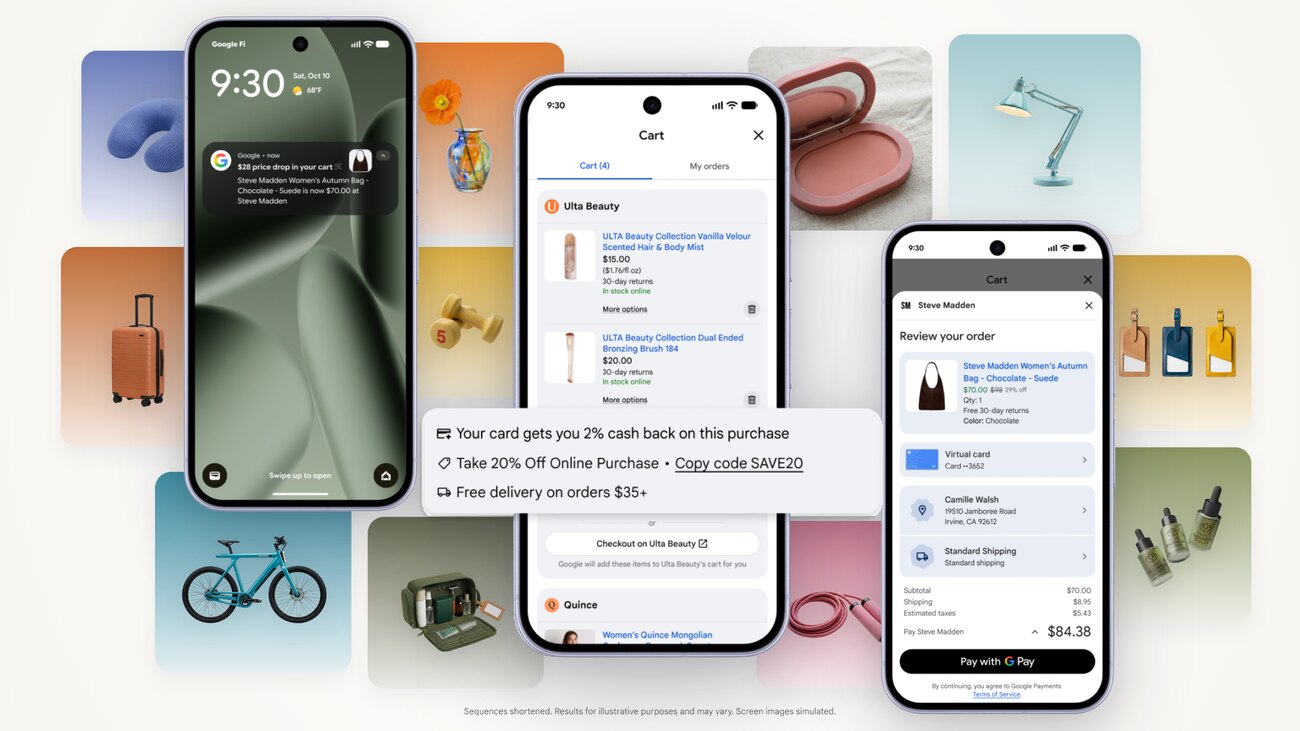
You save products to the cart as you come across them on Google. In Google's example, you save a handbag from Steve Madden while searching in AI Mode, then later save a sweater from Quince and a lip gloss from Ulta Beauty while chatting in the Gemini app. All three are waiting in the same cart when you come back, so you can pick up where you left off instead of digging through old tabs and screenshots.
Google's help page adds regular Google Search and Google Shopping to the places you can save from. Inside the cart, your products are grouped by store, with each one's price and whether it's in stock, and you can remove anything you've changed your mind on.
A My Orders tab sits next to the cart. When a store shares your order with Google, it shows there with updates like "shipped" and "delivered." Your cart and your orders are saved in Google Wallet, so the privacy settings for Google Wallet are the ones that control that data.
All of that saving happens inside Google, and you can't add something while you're browsing a store's website, because Universal Cart doesn't come with a button for other sites the way a browser extension would.
Google said in May that YouTube and Gmail would get the cart next, and it hasn't given a date for either.
Google's May preview also showed the cart warning you when PC parts you'd saved from different stores don't work together. The launch post doesn't mention that feature.
Price-drop alerts and the card that earns you the most
The cart checks your saved items against Google's Shopping Graph, the catalog of more than 60 billion product listings that powers Google's shopping results, which Google keeps refreshing. When a saved item drops in price or comes back in stock, you get a notification.
In Google's sample screens, that alert shows up on a phone's lock screen as "$28 price drop in your cart," for the Steve Madden bag, now $70.
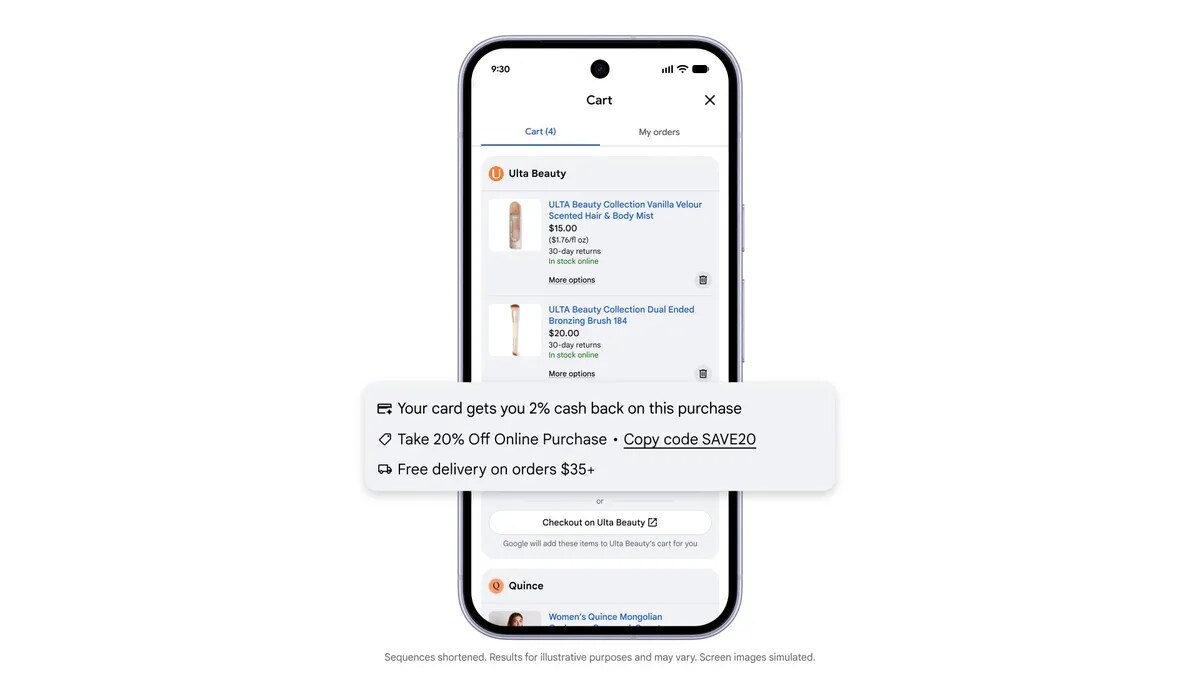
The cart is built on Google Wallet, so it knows the cards you've saved there and what each one gives you back. When you go to pay, it suggests the card with the best perks, and it shows any promo codes it finds for that store right in the cart.
Two ways to pay: inside the cart, or on the store's site
Some stores let you pay inside the cart with Google Pay in a few taps. At others, the cart sends your items to the store's own cart, and you finish buying on the store's site. Google names Nike, Sephora, Target, Ulta Beauty, Walmart, Wayfair and many Shopify stores among the first to support these checkouts, without saying which store uses which.
Google's demo shows both. The Steve Madden bag gets paid for with Google Pay without leaving the cart, and the Ulta Beauty items open on Ulta's own checkout page, already in the bag.

In the demo, each store has its own section of the cart and its own checkout button, so buying from two stores takes two checkouts.
Either way, the store stays the seller. Your order confirmation and customer support come from the store, and so do returns.
The cart doesn't buy anything on its own
With Universal Cart, you still pick the item and tap to pay. Google has a separate system for handing the buying to an AI, the Agent Payments Protocol, where you tell an agent which brands and products you want and how much it can spend, and it buys only when those conditions are met.
Google said in May it would start bringing that to its own products with Gemini Spark, its always-on personal agent in the Gemini app, and it isn't part of this launch.
That's the same idea as the Amex check on AI agent purchases we covered this week: you set the limits, and the purchase gets checked against them.
Checkout in Universal Cart runs on the Universal Commerce Protocol, an open standard Google introduced in January so that AI tools and stores can handle things like checkout together. TikTok's one-tap Buy Direct checkout connects stores through the same standard.
Who can use it, and when to buy
Universal Cart is rolling out in the US across Google Search and the Gemini app, and Google's launch post doesn't mention a paid plan. For checkout outside the US, Google's May roadmap names Canada and Australia in the coming months and the UK after that, with no mention of the EU.
Google also published a When to Buy Guide the same day, built from past search and discount data across US stores. It says fragrance deals don't get better as Christmas gets closer, handbags are a better buy in mid-December than on Black Friday, and large suitcases and motorized tech toys usually hit their deepest discounts in late December.
If something on your list falls in one of those later windows, you can save it to the cart now and let the price-drop alert tell you when it gets cheaper.
Google first showed Universal Cart in May and promised it for the summer, and it's arriving just in time for holiday shopping. And since the cart only fills up from Google's own search and the Gemini app, to me it's Google's way of making sure your holiday shopping starts with Google.
Everyone wants to own that first step. TikTok put checkout right in the For You feed, ChatGPT added virtual try-on to its shopping results, and when I handed OpenAI's Dots my Amazon shopping list, Amazon blocked its built-in browser. Amazon also isn't on Google's list of launch stores.
Stores still decide who gets to shop with them. I had Grok Bot, Dots and Muse book the same trip up to the checkout page, and a bot check on the flight site blocked two of the three:
Universal Cart sidesteps that problem, because you do the shopping yourself, and the stores that support checkout from the cart work with Google on it.
Sources
- Google: An intelligent new shopping cart (Universal Cart launch)
- Google: Introducing the Universal Cart and more ways to help you shop (I/O, May 2026)
- Google Pay Help: Manage your universal cart
- Google: The When to Buy Guide for holiday shopping
- TechCrunch: Google's Universal Cart shopping tool launches in the US
- The Verge: Google launches its 'universal' online shopping cart ahead of the holidays
- CNET: Google Rolls Out Its Universal Cart Shopping Tool
- TNW: Google launches Universal Cart in the US, with checkout built into Search and the Gemini app

Comments
Sign in to join the conversation.