The prompt
# Build Prompt — Charybdis: The Whirlpool

A single build. A real-time, controllable open-sea scene from *The Odyssey*: Odysseus'
galley caught at the edge of **Charybdis, the great whirlpool**, with **Scylla's** cliff
looming on the far side of the strait. This is a graphics-and-feel showpiece. It has to
look like a **2026 AAA video game** — real dynamic lighting, real materials, real depth —
not a tech demo. Everything is generated in code.

---

You are a world-class real-time graphics engineer working in the browser. Build a
production-quality, full-screen, interactive ocean-and-whirlpool scene using **WebGPU via
Three.js (WebGPURenderer + TSL)**, native ES modules, no build step.

**Ground rule on assets:** build ALL geometry and ALL materials procedurally, in code —
no pre-made 3D model files, no downloaded image textures, no HDRIs. You MAY use Three.js
and its official addons, plus open-source *libraries* for simulation, physics, and
post-processing (e.g. a physics engine like `@dimforge/rapier3d` or `cannon-es`, an FFT
ocean reference such as the technique in `jbouny/fft-ocean`, `lil-gui` for controls). The
point is that YOU build the ship, the figure, the whirlpool, and every texture from math —
libraries are for the hard rendering/physics plumbing, not for the content.

## The single most important thing: it has to look REAL

The last version of a scene like this failed in one specific way: **the ocean was okay,
but the ship read as a flat, dimensionless blob and the figure on it looked like a stick
figure.** That cannot happen again. The ship and the figure have to hold up in a close-up.
Hit the realism bar below on every element, and do not stop until they all clear it.

### Ocean (physically-based, FFT-driven)
- Drive the surface with an **FFT / Tessendorf ocean spectrum**, ideally **multi-cascade**
  (2–3 frequency bands: long swell + chop + capillary ripples) rather than a handful of
  Gerstner waves. Derive correct normals and the **Jacobian** for foam.
- **Persistent, rolling whitecap foam** that accumulates where waves steepen and break, and
  lingers/streaks off the crests. **Spray and mist** off the tops in wind.
- **Physically-based water optics:** color absorbs with depth (bright over shallows, deep
  saturated blue-green in the trough), **Fresnel** reflectance, **subsurface scattering**
  glow through backlit crests, **sun glitter**, and **screen-space reflections (SSR)** so
  the ship, cliff, and sky land on the water. Fog to the horizon.

### Charybdis — the whirlpool (the hero effect)
- A genuine, physically-suggestive **vortex**: the ocean surface spirals down into a
  **funnel** that punches below sea level, water accelerating and stretching toward the
  throat, with a dark churning core and a ring of breaking foam around the rim.
- Downdraft **spray/particle** system pulled inward and down. The whole thing is **live and
  animated**, with a `whirlpoolStrength` control that grows it from a swirl to a
  ship-swallowing maelstrom.
- The galley responds to it: buoyancy plus the vortex's inward/rotational pull, so the ship
  **lists, spins, and gets dragged** toward the throat as strength rises.

### The galley (this is where it must not be a blob)
Build a believable **Homeric-era Greek galley** as real 3D geometry with volume and correct
proportion, close-up-worthy:
- **Hull:** loft it from spline cross-sections (a keel line + ribs + a smooth planked
  skin), a **high curved sternpost and prow**, a painted **oculus (eye)** on the bow. Real
  thickness — you should be able to orbit it and see a solid, hollow-decked ship, not a
  slab.
- **Materials (PBR):** use `MeshPhysicalMaterial`-equivalent with **procedural wood-grain**
  (albedo + roughness + normal generated from noise), plank seams, tar/pitch darkening at
  the waterline, salt/wetness sheen (**clearcoat**), and weathering. Bronze fittings with
  proper metalness.
- **Rig:** mast + yard (TubeGeometry), a **square sail** as a real subdivided cloth that
  **billows and luffs** via position-based / spring cloth sim driven by wind, ropes/rigging
  as thin tubes, banks of **oars** along both sides.
- **Ambient occlusion** in the crevices so it reads as solid.

### Odysseus and the crew (no stick figures)
- A **properly-proportioned humanoid** figure — real head, torso, arms, legs with correct
  scale — braced at the helm, plus a few crew at the oars. Segmented or lightly skinned
  bodies with **PBR skin and cloth (tunic/cloak)**, simple believable poses that react to
  the pitch and roll. Stylized is fine; **stick-figure or featureless-blob is a fail.**

### Lighting & rendering pipeline (name-checked, all required)
- **Image-based lighting:** generate a procedural HDR sky and turn it into an environment
  map with **PMREM** for real reflections/ambient. **Physically-correct sun** as the key
  light.
- **Cascaded shadow maps (CSM)** so the ship and cliff cast crisp shadows on the water and
  themselves. **SSAO** for contact shadowing. **ACES filmic tone mapping** + **bloom** on
  the sun/foam/spray. Optional **depth-of-field** for the cinematic beats.
- Run a real **post-processing pipeline** (TSL/EffectComposer): SSAO → SSR → bloom → DoF →
  ACES output. Correct **linear/sRGB** color management throughout.

## Scylla (the far side)
On the opposite cliff of the strait, suggest **Scylla** — a rock-bound, many-necked
silhouette that occasionally lunges. It doesn't need to be the focus; it frames the danger.

## Feel & interactivity (make it play like a game)
- Free-orbit camera **and** a cinematic "follow the ship" rig with slight shake near the
  vortex. Smooth, damped, no snapping.
- A clean control panel (`lil-gui`): `whirlpoolStrength`, sea state / wind, time of day,
  camera mode, and a live **FPS** readout. Let the viewer crank the whirlpool and feel the
  ship get taken.
- Steering: let the player nudge the galley (rudder/oars) to fight the pull — it should
  *feel* like you're losing a battle with the sea as strength climbs.

## Runtime handling (required)
WebGPU detection with a graceful message, loading and failure states, resize, touch,
capped DPR, hidden-tab pause, `prefers-reduced-motion`, accessibility, and performance
safeguards (LOD / throttling so it holds a smooth frame rate). Live FPS readout.

## Standards & iteration — do not stop early
This is judged on how real and how alive it looks. **Do not consider it done until every
element above clears the realism bar.** After you build it, **render it, screenshot your
own output, and inspect it** — the ocean, the whirlpool, and especially the ship and the
figure in close-up. If the ship reads flat, if the figure reads like a stick, if the water
looks like noise instead of a real sea — **fix it and go again.** Do a minimum of **three
full self-review-and-improve passes**, more if it's not there yet. No placeholders, no
invented APIs, no console errors, no hidden fallback rendering.

## Deliverable
Complete, directly runnable code (index.html + JS modules, and any pinned library imports)
plus brief launch instructions. It must run at a smooth frame rate and look like a modern
game.
The exact prompt from the published test.
The builds
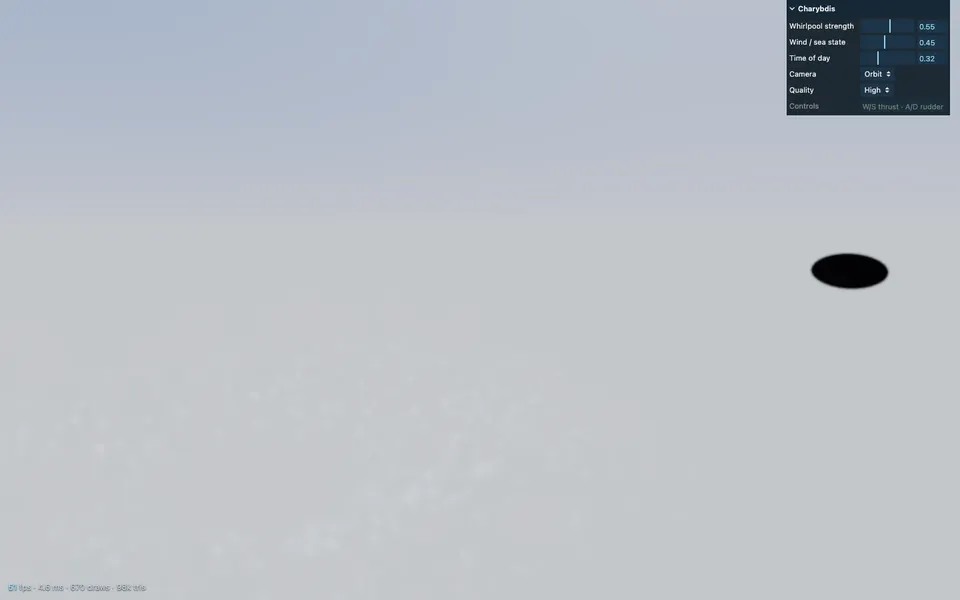
Kimi K3 · Screenshot of the buildRuns in your browser
Featured in
Kimi K3 vs Fable 5 vs. GPT 5.6 (Raw Results)
This build’s chapter starts at 0:39.

Written by
Pat Simmons. Pat tests AI models and tools on the AI for Mortals YouTube channel.