The prompt
# Build Prompt — Odysseus and the Trial of the Bow

This is a playable 3D archery game of Odysseus'
famous shot from the _Odyssey_: draw the great bow and send a single arrow through
twelve aligned axe-heads.

---

You are a world-class WebGPU, Three.js, and TSL graphics engineer AND game developer;
create a production-quality, fully playable 3D archery game: **Odysseus and the Trial
of the Bow.**

Deliver a directly runnable index.html and main.js using native ES modules, with no
framework, build step, image texture, HDRI, model, or video. Everything — the bow, the
arrow, the axes, the hall, the figures — is built procedurally in code.

## The game
The player is Odysseus in the great hall of Ithaca. Twelve bronze axe-heads stand
upright in a row down the hall, each with a ring/socket hole, **all holes aligned**.
The goal: **draw the bow and shoot one arrow cleanly through all twelve holes.**

**Core mechanic — draw and release:**
- **Draw:** press-and-hold (mouse/touch) to draw the bowstring back. Model a real
  **force–draw curve** — string tension rises with draw length and stores elastic
  energy; the bow visibly bends and the string pulls taut. Holding too long introduces
  a **noise-driven aim sway** (simplex "breathing" that grows with hold time), so a
  perfect shot requires timing, not just full power.
- **Aim:** move to aim; give a subtle aiming reticle and a faint **ballistic
  trajectory-arc preview** sampled from the same physics model (assist toggle).
- **Release:** let go to loose the arrow. Launch velocity comes from the stored draw
  energy. The arrow flies with **gravity, quadratic aerodynamic drag, and
  fletching-stabilized spin (angular momentum)**, plus a subtle **archer's-paradox**
  flex as it leaves the bow.
- **Physics loop:** integrate with a **fixed-timestep accumulator** (semi-implicit
  Euler or Verlet) so the simulation is stable and deterministic regardless of frame
  rate.
- **Collision:** use **continuous / swept collision detection** — raycast the
  arrowhead along its travel each substep — so the fast arrow cannot **tunnel** through
  the thin aligned rings. Test passage through each ring's inner radius vs. striking
  the blade. Passing all twelve = win; clipping any axe = miss. Score each pass by how
  centered the arrow threads the ring.

**Feel & feedback:**
- On release, a brief **time-dilation slow-motion** (scale delta time, not
  frame-skip) with an **arrow-cam** that follows the arrow down the line of axes, plus
  a motion trail.
- Clear **win** (arrow threads all twelve, the hall reacts) and **miss** (which axe it
  hit) states, and a quick retry.
- Optional: **Web Audio synthesized** SFX — bow creak on draw, string twang on
  release, arrow whoosh, thunk on hit (no imported audio files).
- Optional: suitors watching in the background; a shot counter / best streak.

## Rendering quality (hold this bar)
- Use **WebGPURenderer** and **TSL**. **ACES filmic** tone mapping and **TSL bloom**.
- **PBR metallic-roughness** materials: high-metalness anisotropic **bronze**
  axe-heads with **Fresnel rim light**, procedural **wood-grain** (noise) on the bow
  and hall beams, **FBM / triplanar stone** for the walls and floor.
- Torch-lit atmosphere: **noise-driven torch flicker**, **volumetric light shafts /
  god rays**, **emissive flames** with bloom, **depth-based haze** down the hall, and
  **instanced dust motes** drifting in the light.
- **Soft shadows (PCF / shadow maps)** and **ambient occlusion**. Use **instanced
  rendering** for the twelve axes, the watching suitors, and particles.
- Camera: a **critically-damped spring** rig — over-the-shoulder aim → arrow-cam on
  release → ease back on retry. **Depth-of-field focus pull (bokeh)** during the
  slow-mo, a subtle **FOV kick** on full draw, and **camera shake** on release.
  (Free-orbit allowed for replay only.)

## Runtime handling (required)
Handle WebGPU detection with a graceful message, loading and failure states, window
resize, touch input, capped DPR, hidden-tab pausing, accessibility (keyboard-playable
alternative to draw/aim/release, reduced-motion option), and performance safeguards.
Show a live FPS readout and a difficulty/assist control (arc hint on/off, waver
amount).

## Deliverable
Return complete, executable code and brief launch instructions — no placeholders, no
invented APIs, no console errors, no hidden fallback rendering. The game must actually
be playable and winnable.
The exact prompt from the published test.
The builds
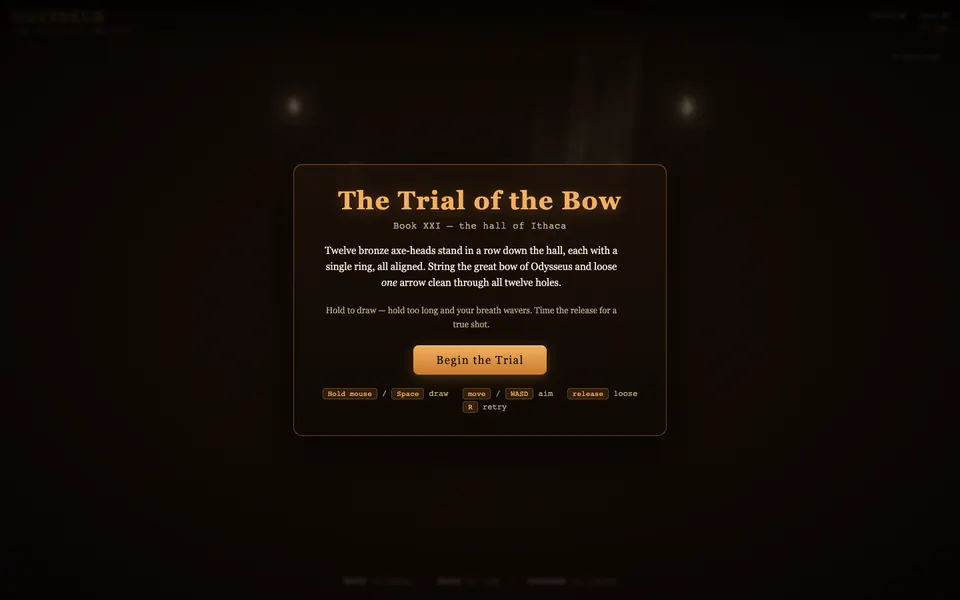
GLM 5.2 · Screenshot of the buildRuns in your browser
Featured in
GLM 5.2 vs Kimi K3: Which Open Source Model Wins?
This build’s chapter starts at 17:29.

Written by
Pat Simmons. Pat tests AI models and tools on the AI for Mortals YouTube channel.