AI for Healthcare Workers: How to Use ChatGPT, Claude and OpenEvidence Safely, With Prompts
Healthcare workers can use AI to draft letters, handouts and notes and to search medical research, with patient details kept to plans covered by a HIPAA business associate agreement.

On this page
Healthcare workers use AI mostly for paperwork and lookups: drafting referral letters, prior authorization letters and patient instructions, checking billing codes, and finding the research behind a clinical question. A clinician checks everything before it's used. Patient information goes only into a tool covered by a HIPAA business associate agreement (BAA), the contract federal privacy rules require before a vendor handles patient data for a provider. OpenAI's and Anthropic's personal plans aren't on their lists of BAA-covered products.
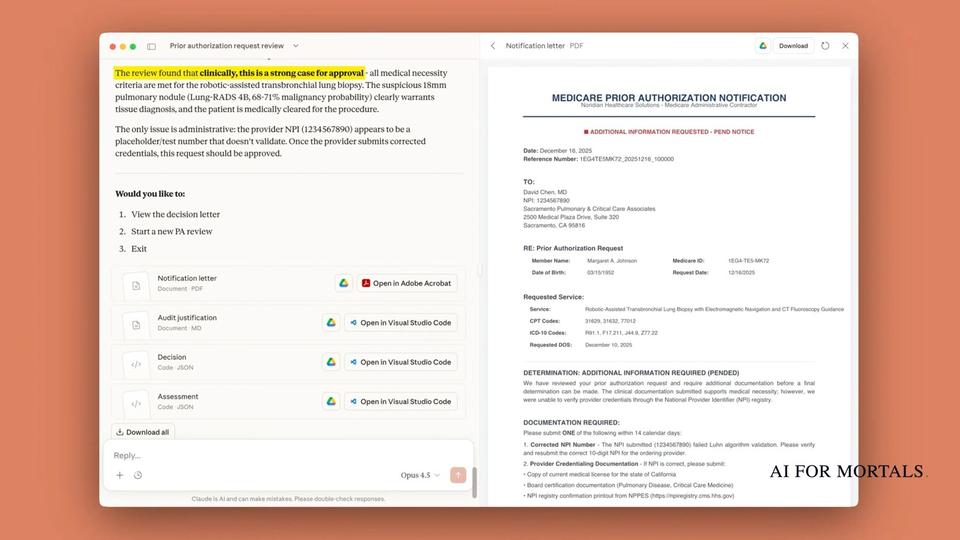
Three products are built for this work. OpenAI's ChatGPT for Clinicians is free for verified US physicians, nurse practitioners, physician assistants and pharmacists. Anthropic's Claude for Healthcare adds lookups for ICD-10 codes, Medicare coverage rules and the NPI Registry. OpenEvidence is a medical search engine for healthcare professionals. None of them replaces clinical judgment, and each company says so.
Last checked November 18, 2026: every plan, price, eligibility rule and BAA detail below comes from OpenAI's, Anthropic's, OpenEvidence's, Microsoft's and the US Department of Health and Human Services' own pages, checked on that date and linked where they're used.
How is AI being used in healthcare?
AI in healthcare is mostly used to cut the time clinicians spend on documentation and research. OpenAI says teams use ChatGPT for Healthcare to "draft clinical and administrative documentation" and to adapt patient education materials for readability and translation. Anthropic lists speeding up prior authorization reviews, building claims appeals and sorting patient portal messages.
For one nurse, doctor or therapist, the jobs these tools are built for fall into four groups:
- Drafting letters, handouts and note summaries for you to edit
- Finding and summarizing published research, with citations
- Looking up billing codes, Medicare coverage rules and provider IDs
- Turning a recorded visit into a draft note (an "ambient scribe")
The first three work in a general chatbot as long as no patient details go in. The fourth needs software your employer buys and signs a BAA for, covered in the scribe section below.
Is there a medical ChatGPT?
Yes. OpenAI has two: ChatGPT for Clinicians for individual clinicians and ChatGPT for Healthcare for whole organizations. Anthropic offers Claude for Healthcare, and OpenEvidence is a separate medical search tool built only for professionals.
ChatGPT for Clinicians (free for some US clinicians)
OpenAI made ChatGPT for Clinicians "available for free to verified individual clinicians in the U.S." According to OpenAI's help page for it, eligible clinicians are physicians (MD/DO), nurse practitioners, physician assistants and pharmacists. To sign up you need a ChatGPT account, a valid NPI (the 10-digit National Provider Identifier) and a license the verification company can confirm.
It adds clinical search that cites medical sources, deep research across medical journals, ready-made skills for referral letters, prior auth and patient instructions, and continuing medical education (CME) credit on eligible questions. OpenAI says conversations aren't used to train its models, and individual users can sign a BAA if they need HIPAA support.
ChatGPT for Healthcare (for hospitals and health systems)
OpenAI sells ChatGPT for Healthcare to organizations. Its announcement names AdventHealth, Baylor Scott & White Health, Boston Children's Hospital, Cedars-Sinai Medical Center, HCA Healthcare, Memorial Sloan Kettering, Stanford Medicine Children's Health and UCSF among the first users. It includes shared templates for discharge summaries, patient instructions, clinical letters and prior authorization support, and it can draw on a hospital's own approved policies.
The organization keeps control of patient data, and OpenAI offers a BAA. OpenAI says content shared with ChatGPT for Healthcare is not used to train models. No price is listed; the page asks organizations to contact sales.
Claude for Healthcare
Anthropic announced Claude for Healthcare on January 11, 2026, for healthcare providers, payers (insurers) and health tech companies. It added connectors, which let Claude look things up in outside databases, to four sources:
- The CMS Coverage Database, for Medicare coverage rules, prior authorization checks and claims appeals
- ICD-10, for diagnosis and procedure codes, using CMS and CDC data
- The NPI Registry, for checking providers and credentialing
- PubMed, with more than 35 million biomedical literature records
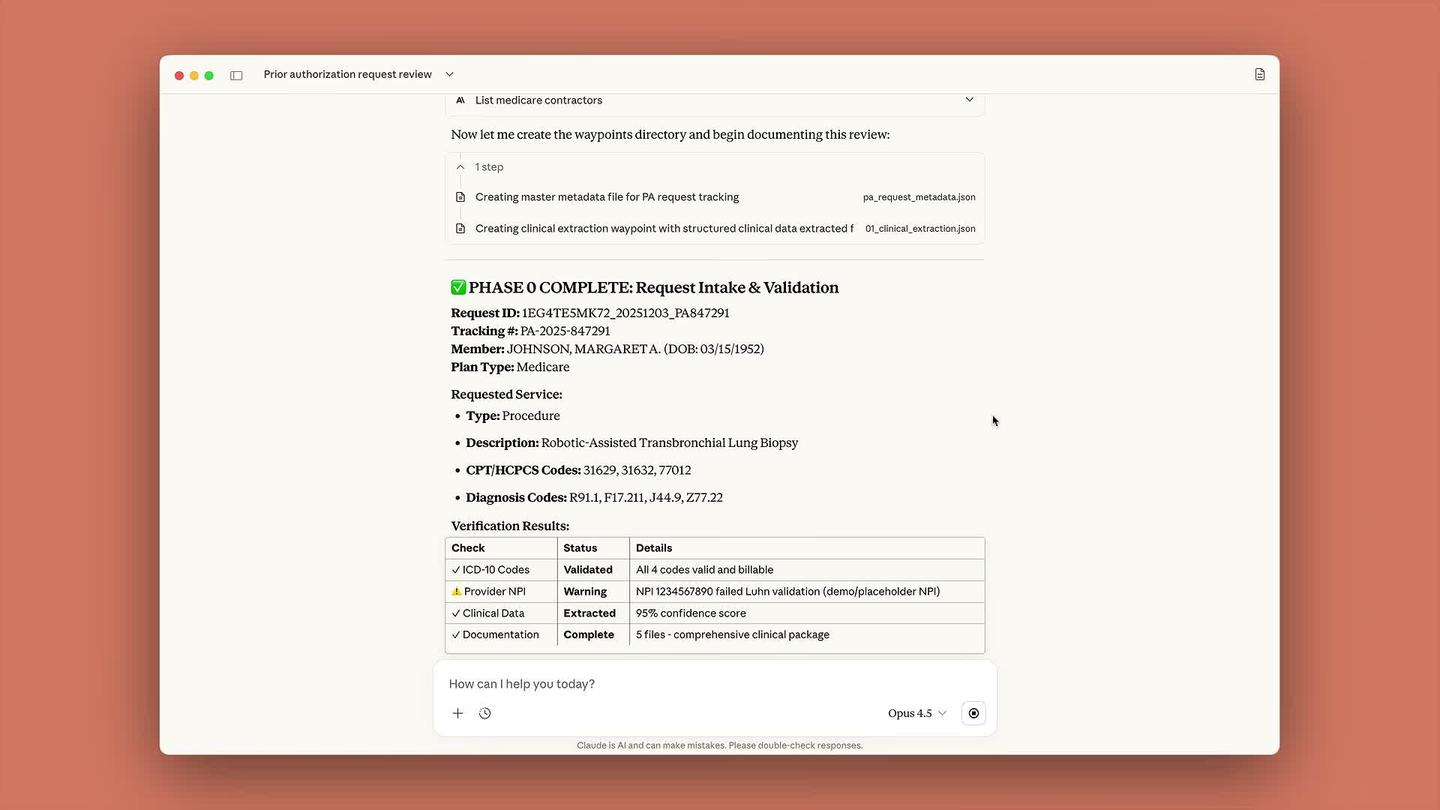
Anthropic also added two Agent Skills (saved instructions Claude follows for a task): one for FHIR, the standard health systems use to exchange data, and a sample prior authorization review. The connectors and skills are available on every paid Claude plan: Pro, Max, Team and Enterprise. A February 7, 2026 note on the same page says the HIPAA-ready products are for healthcare providers and payers.
OpenEvidence
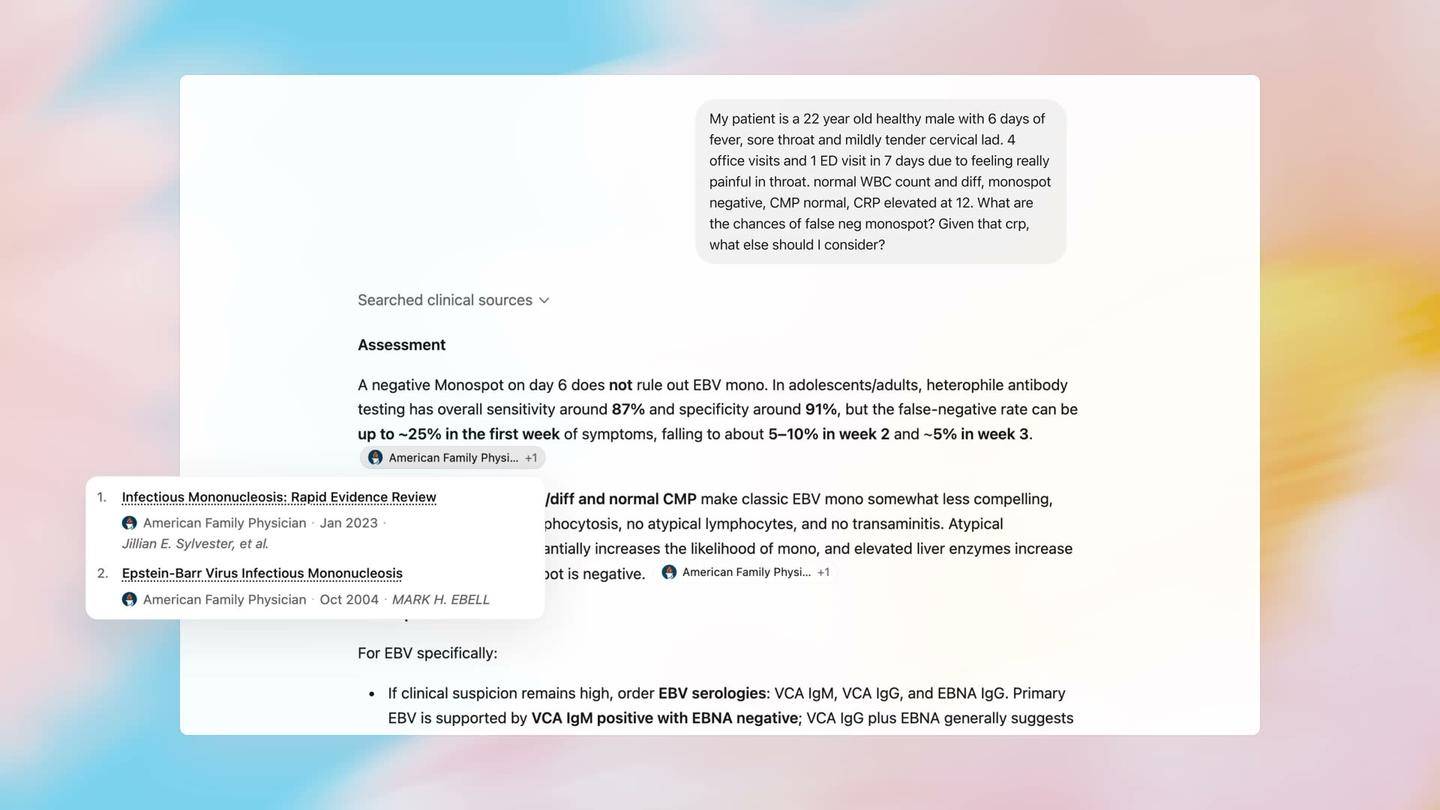
OpenEvidence is a medical search engine that answers clinical questions from journals it partners with, including the New England Journal of Medicine, JAMA, Nature and Cochrane, plus NCCN cancer guidelines. Its terms of use say the service is for "physicians and other healthcare professionals" and "not intended for use by patients or other consumers." Registration asks for your profession, specialty and NPI or other license number. Its App Store listing shows the app as free, with "NPI Required."
ChatGPT for healthcare: what you can and can't paste in
Paste patient information only into a plan your organization (or you, as an individual clinician) has a BAA for. Anything with no patient details, such as a blank handout, a policy question or a published study, can go into any chatbot.
HHS defines a business associate as a person or company that creates, receives, keeps or sends protected health information (PHI) for a covered entity. Covered entities include health plans and healthcare providers who send health information electronically for certain standard transactions. HHS's examples of business associates include cloud service providers that store patient data. The HIPAA rules let a covered entity share PHI with a business associate once it has "satisfactory assurances, in the form of a contract or other written arrangement," which is the BAA.
Here is what each company says its BAA covers:
- OpenAI: its list of HIPAA eligible products names ChatGPT for Healthcare, ChatGPT for Enterprise with Regulated Workspace, ChatGPT FedRAMP, ChatGPT for Clinicians and the API with modified retention. Free, Go, Plus and Pro aren't on it.
- Anthropic: its BAA page covers HIPAA-ready services such as its API, Claude in Microsoft Foundry and Enterprise plans. A standard Enterprise plan isn't covered until an owner turns on HIPAA compliance in settings and accepts the BAA. Free, Pro, Max and Ultra are consumer plans and aren't on that list.
- OpenEvidence: its terms say that if a covered entity sends PHI through the service, OpenEvidence's BAA applies.
Even on a covered plan, some features fall outside the BAA. Anthropic says sending data to outside services through connectors isn't covered, and Skills are off by default in HIPAA organizations. OpenAI tells ChatGPT for Clinicians users not to include "patient names, medical record numbers, or other protected health information" in searches of public healthcare databases such as PubMed or the NPI Registry.
On a personal account, strip out names, dates of birth, record numbers, addresses and anything else that identifies the patient, or describe the case in general terms. Lawyers face a similar confidentiality rule, covered in how lawyers use AI under their own professional rules.
Which AI tool is best for healthcare work?
The right tool depends on the job and on whether patient data is involved. This table sorts the main options by job, using only what each company states. No ranking here comes from testing.
| Tool | Best fit | Who can use it | Price (as stated) | BAA |
|---|---|---|---|---|
| ChatGPT (Free, Go, Plus, Pro) | Drafting and research with no patient details | Anyone | Free plan, paid plans per month (pricing page) | Not on OpenAI's HIPAA list |
| ChatGPT for Clinicians | Clinical search with citations, documentation drafts, CME | Verified US physicians, NPs, PAs, pharmacists | Free | Yes, for individual users |
| ChatGPT for Healthcare | Organization-wide use with hospital policies and templates | Healthcare organizations | Contact sales | Yes |
| Claude Pro or Max | Code, coverage and research lookups through the healthcare connectors, no patient details | Anyone | Pro $20 a month ($17 billed yearly); Max $100 a month (pricing page) | Consumer plan, not on Anthropic's BAA list |
| Claude Enterprise (HIPAA-ready) | Organization-wide use with patient data | Organizations | $20 a seat a month billed yearly, 20-seat minimum, plus usage at API rates | Yes, once an owner turns on HIPAA compliance |
| OpenEvidence | Point-of-care questions answered from medical journals | Healthcare professionals with an NPI or license number | Free in the App Store | Its terms apply a BAA to PHI from covered entities |
| Microsoft Dragon Copilot | Ambient notes and nursing flowsheets inside the EHR | Organizations (nurse version US only) | Contact sales | Not stated on the product page |
For what every ChatGPT plan costs in dollars, see what every ChatGPT plan costs.
AI charting and ambient scribes
AI charting tools listen to a visit or a nurse's spoken observations and turn them into a draft note for you to review and sign. They run inside your organization's systems, so your employer chooses and pays for them.
Microsoft's Dragon Copilot has separate versions for physicians, nurses and radiologists. For nurses, Microsoft says it captures observations as they happen and turns them into "structured flowsheet documentation for quick nurse review and approval," and it can draft nurse notes and summaries. The nurse version works inside EHR mobile apps such as Epic Rover and on desktop, and it's available in the United States. The physician version is sold in the US, Canada, the UK, Ireland and six other European countries.
Other scribes are built on the big AI models. OpenAI names Abridge and Ambience among companies using its API for "ambient listening, automated clinical documentation," and Anthropic says startups build ambient scribing on its developer platform.
AI prompts for nurses, doctors and therapists
These prompts are templates for text with no patient details in it. Fill in the brackets, read every line of the answer, and check facts against your own references before anything goes to a patient or into a chart. In ChatGPT for Clinicians or another BAA-covered plan, your organization's rules decide what you can add.
For nurses: a shift handoff template
I'm a [med-surg / ICU / ED] nurse. Build me a blank shift handoff template in the SBAR format (situation, background, assessment, recommendation) that fits on one printed page.

Include short prompts under each heading for what to cover on a [type of unit], such as lines and drains, fall risk, pending labs and family updates.

Leave every patient field blank. Don't invent any patient details.
One tip: ask for a second version for the patient type you see most and keep both.
For nurses and doctors: a patient handout in plain language
Rewrite the discharge instructions below as a one-page handout for an adult patient who reads at about a 6th-grade level.

Use short sentences and headings: what to do at home, medicines, warning signs, and when to call us. Keep every instruction, dose and time exactly as written. If something is unclear, list it at the end as a question for me instead of guessing.

[paste your standard instructions, with no patient name or details]
One tip: ask for the same handout in Spanish or another language, then have a qualified translator check it.
For doctors: a letter of medical necessity skeleton
Draft a letter of medical necessity template for [treatment or device] for a patient with [condition].

Structure: the request, the diagnosis with a placeholder for the ICD-10 code, treatments already tried and why they failed, why this treatment is needed now, and what is likely to happen without it.

Use [brackets] for every patient detail, date and code so I can fill them in. Don't cite studies unless I paste them in.
One tip: in Claude, the ICD-10 connector can look up the code for the diagnosis you name.
For doctors and pharmacists: a literature question
In adults with [condition], what does the published evidence say about [treatment A] compared with [treatment B] for [outcome]?

Give me the main guidelines and the largest trials, each with its journal, year and a link. Say where the evidence is weak or conflicting. If you can't find a source for a statement, leave the statement out.
One tip: open each citation before you rely on it. OpenAI's help page tells clinicians to review cited sources before using deep research results in care.
For therapists: psychoeducation material
I'm a [licensed therapist / counselor]. Write a one-page handout for clients that explains [a skill, such as box breathing or a thought record] in plain, warm language.

Include what it is, when to use it, step-by-step instructions, and a short blank worksheet at the end. Don't include any client details or diagnoses.
One tip: keep session notes and anything a client said out of personal chatbot accounts.
For nursing and medical students: practice questions
Quiz me on [topic, such as heart failure or insulin types] with 10 NCLEX-style questions, one at a time.

Wait for my answer before showing the next one. After each answer, tell me whether I was right and explain why each wrong option is wrong. At the end, list the topics I missed so I know what to review in my textbook.
One tip: check any explanation that surprises you against your course textbook.
Can you use ChatGPT for a medical diagnosis?
No tool on this page is meant to diagnose on its own. Clinicians can use them to think through a differential diagnosis or check the evidence, and patients can use them to prepare questions for their doctor. The decision stays with a licensed clinician.
The companies say this in their own words:
- OpenAI lists "Reasoning through differentials" as a use of ChatGPT for Clinicians and says the product "is intended to support, not replace, professional judgment." Clinicians "remain responsible for all care decisions."
- OpenAI says its consumer health space, ChatGPT Health, "is not intended for diagnosis or treatment."
- OpenEvidence's terms say it is "in no way intended to serve as a diagnostic service or platform."
- Anthropic says Claude is designed to include disclaimers, acknowledge uncertainty and send people to healthcare professionals for personal guidance.
For a clinician, a useful prompt asks for a list of possibilities with the evidence for and against each, and the tests that would tell them apart. Leave out identifying details unless you're on a BAA-covered plan.
Questions people ask
Is ChatGPT for Clinicians free?
Yes, for verified US physicians, nurse practitioners, physician assistants and pharmacists. OpenAI says it plans to expand to other countries and groups over time.
Can nurses use ChatGPT for Clinicians?
Nurse practitioners can. Registered nurses aren't on OpenAI's current eligibility list, so an RN would use an employer's covered plan or a regular ChatGPT account with no patient details.
Is OpenEvidence free?
Its App Store listing shows it as free and says an NPI is required. Its terms say it is for physicians and other healthcare professionals, and not for patients.
Is Claude for Healthcare HIPAA compliant?
Anthropic calls its healthcare products "HIPAA-ready" and offers a BAA for its API and Enterprise plans once HIPAA compliance is turned on. Pro and Max get the healthcare connectors but aren't on Anthropic's BAA list.
What is the best AI for therapists?
None of the product pages above names therapists as a group it's built for, and therapists aren't on OpenAI's ChatGPT for Clinicians eligibility list. For handouts and worksheets with no client details, any general chatbot works. Anything with client information needs a plan your practice has a BAA for.
Can AI help with medical billing codes?
Yes. Claude's ICD-10 connector looks up diagnosis and procedure codes on every paid plan. ChatGPT for Clinicians can connect to public sources including CMS Coverage and the NPI Registry. Check every code before you submit a claim.
Do these companies train their models on health data?
Anthropic says "We do not use users' health data to train models." OpenAI says content in ChatGPT for Healthcare and ChatGPT for Clinicians isn't used for training, and that medical records connected in ChatGPT Health aren't used to train its foundation models.
Can patients connect their own medical records?
Yes, in the US. OpenAI's Health in ChatGPT is rolling out to US users 18 and older on web and iOS on the Free, Go, Plus and Pro plans. On Claude, US Pro and Max subscribers can opt in to share lab results and health records through HealthEx and Function, with Apple Health and Android Health Connect in beta.
Sources
- HHS: Business Associates FAQs
- OpenAI: Making ChatGPT free for clinicians
- OpenAI Help: ChatGPT for Clinicians
- OpenAI: OpenAI for Healthcare
- OpenAI Help: HIPAA eligible products and functionality
- OpenAI: Launching Health in ChatGPT
- Anthropic: Advancing Claude in healthcare and the life sciences
- Anthropic: BAAs for commercial customers
- Anthropic: Claude pricing
- OpenEvidence
- OpenEvidence: Terms of use
- Microsoft: Dragon Copilot



Comments
Sign in to join the conversation.