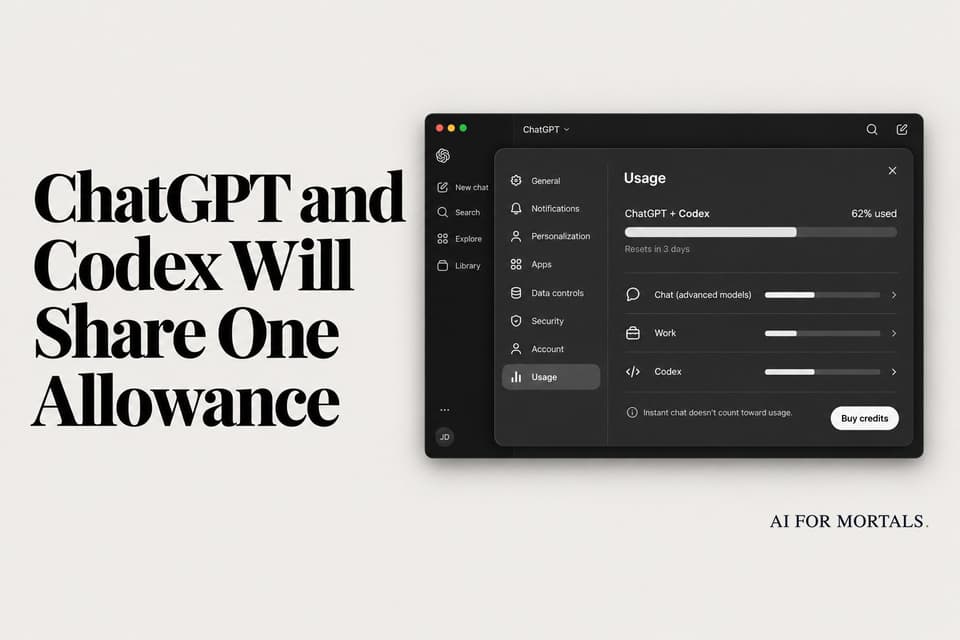
ChatGPT and Codex Will Share One Usage Allowance
From December, chats with ChatGPT's stronger models will draw from the same allowance as Work and Codex on the Plus, Pro and Business plans. Here's how the limits work today, what changes, and who is most likely to notice.
 AI for Mortals Staff
OpenAI is changing how ChatGPT usage limits work. Starting in December, the Plus, Pro and Business plans will get one usage allowance shared across ChatGPT and Codex, its coding agent.
The news sits on a help page OpenAI updated on October 31. It ties the change to folding Work, the ChatGPT mode that takes on longer jobs, into regular ChatGPT chats.
The page gives no exact date and no allowance sizes, and it doesn't mention ChatGPT's free or lower-priced plans.

How ChatGPT usage limits work today
Right now a paid plan has two separate buckets. Regular chats have their own limits, and Work and Codex draw from another.
OpenAI's model help page says it in one line: usage and credit rules in Work and Codex are separate from Chat.

That second bucket already covers more than coding. On Plus and Pro, Codex, Work and ChatGPT for Word, Excel and PowerPoint share one allowance for agent-style jobs.
So today, a long Codex session can run that bucket dry while your everyday chats keep going on their own limits.
What changes in December: one allowance, counted in tokens
From December, chats with ChatGPT's more capable models join the same pool. Only Instant stays outside it, so chats with the more capable models, your Work jobs and your Codex sessions will all draw from one allowance.
Usage will be measured in tokens, the units of text a model reads and writes. How fast you spend depends on the model you pick and the job you hand it, so a stronger model or a harder task uses more of the allowance.
Instant, the quick-answer setting, won't count at all. OpenAI's page says Instant chat "will not draw from your usage."
You'll see your combined remaining usage and reset times in Settings → Usage. When you run out, you can wait for the reset, upgrade your plan or buy credits, which OpenAI says stay valid for 12 months.
OpenAI also says it expects most people won't need to wait for a reset more often than they do now.
Plus subscribers are the most likely to feel it
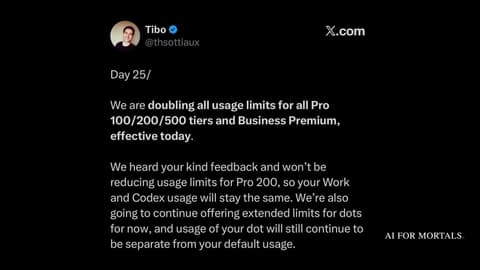
ChatGPT Pro comes in three tiers, at $100, $200 and $500 a month. Two days before the page went up, OpenAI doubled Work and Codex usage for many of its ChatGPT Pro subscribers, on the $100 and $500 plans and for newer $200 subscribers, and called off a planned cut to the $200 plan.
The $20 Plus plan got none of that extra room. Plus also gets GPT-6 Astra, OpenAI's top model, only inside Work and Codex, as our plan-by-plan GPT-6 guide lays out. So the bucket that holds a Plus subscriber's heaviest jobs is the one that's about to take on their chats too.
So the Plus subscribers who use the stronger models for everyday chats and also run Codex or Work are the ones whose two habits will start pulling from one allowance. Someone who mostly chats in Instant shouldn't notice a difference.
OpenAI's page also doesn't say whether image generation will count against the shared pool.
Here's our hands-on with GPT-6 Astra, the model Plus gets in Work and Codex:
How to make one shared allowance last longer
Because Instant doesn't touch the meter, quick lookups, rewrites and simple questions cost nothing there. The meter only starts running when you move a chat up to a stronger setting.
In Work and Codex, the model you pick changes the cost per job. OpenAI built GPT-6.1 Terra, which you pick from the model menu in Work or Codex, so a paid plan covers far more routine tasks than its bigger models do.
Once the change lands, Settings → Usage will show one number with a reset time, which makes it easy to see which habit is eating the allowance.
How big the shared allowance will be is still unknown
OpenAI posted this on a help page, with no blog post, no X post, no exact date and no allowance sizes.
Pro subscribers on the $100 and $500 plans just got twice their Work and Codex room. For Plus, the key detail is still unknown: how big one shared allowance will be next to the two separate ones people have today. Until then, OpenAI's only guidance is that it expects "most users won't need to wait for their usage to reset more often than they do now."


Comments
Sign in to join the conversation.