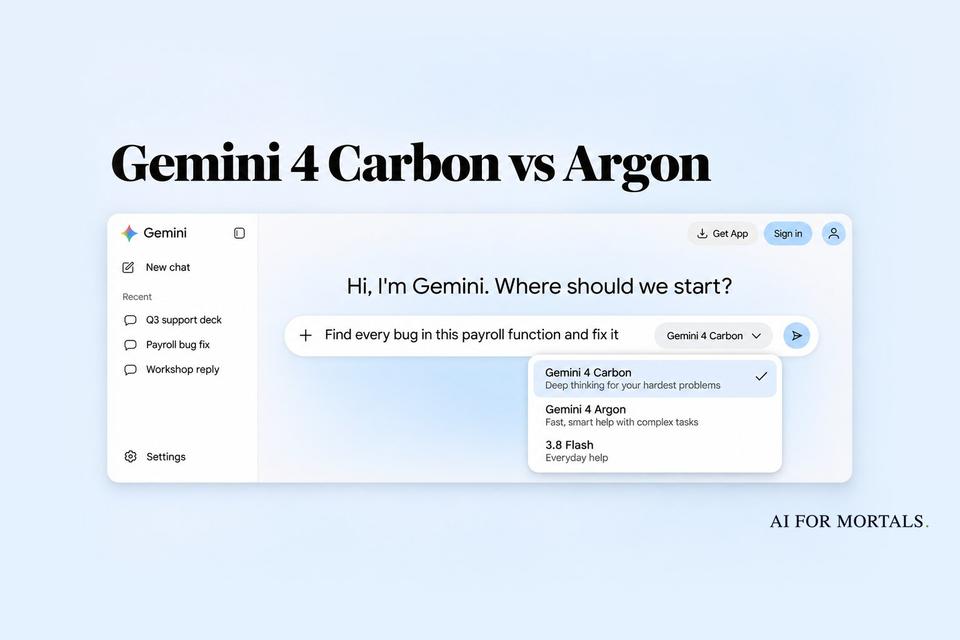
Gemini 4 Carbon vs Argon: Is the Strongest Gemini Worth Switching To?
Google says to bring in Gemini 4 Carbon for your hardest problems. We gave Carbon and Argon the same seven jobs, from a messy email thread to a payroll function with eight hidden bugs. Argon matched it on every one, faster and for less.
 AI for Mortals Staff
On this page
- Gemini 4 Carbon vs Argon: the short answer
- What's different about Gemini 4 Carbon
- The seven jobs we ran on Carbon and Argon
- What the runs cost, and why Carbon can cost more at the same price
- Gemini Ultra pricing: who gets Carbon in the Gemini app
- Gemini Pro vs Ultra: is Carbon worth the upgrade?
- How to test Carbon against Argon on your own work
Gemini 4 Carbon vs Gemini 4 Argon became a real choice on November 10, when Google opened Carbon, its strongest model, to Google AI Ultra subscribers in the Gemini app. Gemini 4 Argon has been in the app since October, and Google says Argon is still the right model for most work.
Google's own line is that if Argon is great for complex tasks, Carbon is "the model you bring in for your hardest problems."
So we tested that. We gave both models the same five office jobs we ran on Claude Fable 5.2 and Opus 5.5 last week, then added two hard ones built to make a model think: a scheduling puzzle with one right answer, and a payroll function with eight hidden bugs.
Argon matched Carbon on all seven jobs. Carbon thought much longer on the hard ones, took up to seven times as long and cost about eight times as much, and on its deepest thinking setting it ran out of room before it wrote an answer.
Gemini 4 Carbon vs Argon: the short answer
- Everyday work (email, documents, spreadsheets, slides, a small tool): use Argon. On these jobs the two models gave answers we couldn't tell apart, and Carbon barely thought harder than Argon did.
- Hard reasoning and debugging: start with Argon too. It found all eight bugs in our payroll code in about 15 seconds. Carbon found the same eight in about 1 minute 50 seconds.
- When Argon gets something wrong on a long, tangled problem: that's the time to bring in Carbon, and to give it time. Google built Carbon to think longer and check its own work, and that's what we saw.
- On Google AI Pro ($19.99 a month): you have Argon and no Carbon, and on our jobs you didn't miss anything.
- On Ultra: Carbon will use your limit faster, so save it for the jobs that justify it.
What's different about Gemini 4 Carbon
Google first showed Carbon on October 28 and gave it only to security teams at first, as we covered then. On November 10 it opened Carbon to developers, businesses and Ultra subscribers.
Google describes Carbon as its strongest model for long, multi-step work: complex coding and debugging, dense documents and data, scientific research and security. It says Argon "remains the ideal choice for the majority of software engineering and knowledge work."
The main difference is how long each one thinks. Google's developer guide says Carbon "spends more thinking tokens per turn to explore thoroughly and verify its work," which makes it slower and heavier on usage than Argon. (Our guide to what a token is explains why that matters for your bill and your limits.)
On Google's own benchmark table, Carbon beats Argon on every row. The biggest gaps are on very long documents (96.2% to 84.2% on a test with 256,000 to 1 million tokens of input), hands-on computer tasks and finding security flaws.

Google also says Carbon is more honest about what it doesn't know. On its 375-task honesty test, Carbon passed 92% to Argon's 70%, and Google says it makes about half as many unsupported claims.
People on Reddit and X are less sure. Several of the busiest launch threads point out that earlier Google models looked great on benchmarks and disappointed on real work, and a lot of people asked for cost per task alongside the scores. We measured both.
The seven jobs we ran on Carbon and Argon
We ran every job through Google's API, two or three times per model, so we could time each answer and see what it cost. Both models ran at the medium thinking level, which is Google's default, and we also ran the two hard jobs on high.
Every prompt below is the one we used. Paste it into Gemini and swap in your own files.
A messy email thread: a tie
The thread was six emails about booking a staff AI workshop at a clinic. The date moved from November 19 to November 20, the budget moved from $2,400 to $2,800 with a $150 travel cap, one person asked about laptops and patient data, and the organizer wanted one reply to everyone.
Here's a messy email thread. Write the reply Dana asked for, addressed to everyone on the thread. Keep it short and friendly, and include a short agenda for the workshop.

[paste the whole thread here]
All four replies got everything right: Friday, November 20, 8:30 to noon, $2,800 with travel capped at $150, a plan for the staff without laptops and a clear promise of no patient data. That weekday is the detail Opus 5.5 got wrong three times in a row in our last test.
Argon answered in about 12 seconds and Carbon in about 20. Each reply cost about a cent.
A 48-page report: a tie
We gave each model the full text of NIST's AI Risk Management Framework, a 48-page government report, and asked for a 150-word summary plus five questions with quotes. One question was a trap: it asked what penalties the framework sets, and it sets none, because it's voluntary.
Below is a long document. First, summarize it in about 150 words for a busy manager. Then answer these five questions, quoting the document where you can:
1. What are the framework's core functions, and which one is described as cross-cutting?
2. List the characteristics of trustworthy AI the framework names.
3. How many categories does each core function have?
4. Is the framework mandatory, and what penalties does it set for organizations that don't follow it?
5. What does MANAGE 4.1 ask organizations to do?

<document>
[paste the document here]
</document>
Both models answered all five questions correctly in both runs, and both said the framework is voluntary and sets no penalties. We checked every quote against the report, and all of them are real.
Each answer took 12 to 29 seconds and cost 1 to 7 cents (a second read of the same report is cheaper, because Google discounts text it has just seen).
A 172-row contact list: perfect data from both
We built a contact list with 172 rows that hid 26 duplicate rows. Phone numbers came in six formats and dates in four, and six pairs of people shared a name but had different email addresses.
Clean up this contact list. Two rows are the same person only when the email address matches (ignoring capitals and stray spaces); two people can share a name. Merge duplicate people into one row each, and when the copies disagree on the signup date, keep the earliest. Format names as First Last in normal capitalization, emails in lowercase with no spaces, phone numbers as (555) 555-5555, states as two-letter codes, and dates as YYYY-MM-DD (dates with slashes are month/day/year). Return the cleaned CSV in a code block, then say how many rows are left, how many duplicate rows you removed, and list any people who share a name but are different people.

[paste your CSV here]
We compared every cell of all four results against our answer key. Each one came back with exactly 146 people and no errors, and every run kept the six same-name pairs apart.
Both models slipped in the summary under the list. Carbon said it removed 25 duplicates in one run and 24 in the other, and both times it miscounted the rows it started with. Argon said 26 (right) and then 27.
The cleaned list itself was right every time. If you need the counts for a report, count them yourself.
A 10-slide deck from rough notes: Carbon's was a little tidier
We gave both models the notes you'd scribble before a team meeting: quarterly support numbers, a missed target, two new hires, a shoutout and a budget ask. We asked for the deck as a single web page, so it opens in any browser.
Turn these notes into a 10-slide presentation for a Monday all-hands. Make it a single self-contained HTML file: each slide is a 16:9 section (1280x720) stacked vertically, clean modern design, readable from the back of a room, no external libraries or images. Use only the numbers in the notes. Return only the HTML in one code block.

[paste your notes here]
All four decks had exactly 10 slides, and every number matched the notes. The two models even made similar design choices: a dark title slide, green cards for wins, a red card for the missed backlog target.

One Argon deck had a broken slide. On its summary slide, the number cards stacked on top of each other and ran off the bottom, so the satisfaction score and the backlog number were cut off.

Carbon's decks had smaller flaws: "4h 10m" wrapped onto two lines in a narrow card in both runs. That's a five-minute fix either way.
A small invoice tool: every build passed every check
For the build, we asked for an invoice maker a freelancer could use, with line items, a discount, tax, saving and printing. Then we tested each result with a script that typed in real numbers and bad ones.
Build an invoice maker as a single self-contained HTML file (no external libraries). I'm a freelancer and I want to type in a client name, add and remove line items (description, quantity, rate), set a discount percent and a tax percent, and see the subtotal, discount, tax and total update as I type. Apply the discount first, then tax on the discounted amount. Keep my invoice if I close the tab and come back. Add a Print button that prints a clean invoice without the form controls. Handle bad input (empty, negative, letters) gracefully. Make it look good on a phone and a laptop. Use these ids and classes so I can wire it up later: #client, #addItem, each line item row has class .item with inputs .item-desc, .item-qty, .item-rate and a button .item-remove, #discount, #tax, and outputs #subtotal, #discountAmount, #taxAmount, #grandTotal, plus #print. Start with one empty line item. Return only the HTML in one code block.
The line about ids and classes is there so our test script could find each field, and you can delete it.
All four builds worked on the first try. Three line items with a 10% discount and 8.25% tax came to $2,932.46 in every one, which is right.
Each build kept the invoice after a reload, ignored negative and empty quantities, printed without the buttons and fit a phone screen. Carbon was a little faster here, at about 41 seconds to Argon's 56.
A scheduling puzzle with one right answer: a tie, at three times the wait
The office jobs didn't stretch either model, so we wrote a harder one. Five people, five rooms, five time slots and five meeting topics, with 14 rules, and exactly one schedule that fits all of them. We checked that by testing every possible schedule.
I need to book rooms for tomorrow and my notes are a mess. Work out who meets when, where and about what, using every rule below. Give the final schedule as a table sorted by time, then say in one line whether any other schedule also fits all the rules.

[paste your people, rooms, times and rules here]
Both models got the one right schedule in every run, at both thinking levels, and both said correctly that no other schedule fits.
On medium, Argon took 14 seconds on average and Carbon took 35. On high, Argon took 51 seconds and Carbon 2 minutes 13 seconds, after thinking through about 10,000 tokens to Argon's 3,000.
A payroll function with eight hidden bugs: same fixes, very different bills
This is the kind of job Google says Carbon is for: debugging. We wrote a short payroll function for hourly staff and planted eight bugs in it, from a 24-hour shift counted as zero hours to a time zone slip that puts Sunday shifts in the wrong week. Then we gave each model the code and a plain-English list of the pay rules.
Our payroll function is giving wrong totals and staff are complaining. Below are the pay rules and the current code. Find every bug, list each one in a single line, then return the complete fixed file in one JavaScript code block. Keep the same function name and export. Our server runs in US Pacific time.

[paste your rules and code here]
We ran every fix against 400 made-up timesheets with known correct totals. Both models found and fixed all eight bugs in every run, and every fix matched our totals to within a cent.
Carbon took far longer to get there, and cost more. On medium, Argon answered in about 15 seconds for about a cent. Carbon thought through 7,000 to 11,000 tokens first and took 1 to 2.5 minutes, for about 10 cents a run.
On high, Argon took about 70 seconds. Carbon thought for 5½ to 6½ minutes in all three runs, hit the cap on a single standard answer and stopped without writing anything, at 33 cents a try.
Google's guide says to switch on "background" mode for hard prompts, which lets an answer run longer. We did, and Carbon came back after about eight minutes with all eight bugs fixed, having thought through about 45,000 tokens, for 53 cents.
In the Gemini app you won't see a token count, but those long thinks come out of your usage limit.
What the runs cost, and why Carbon can cost more at the same price
Through the API, Carbon and Argon cost exactly the same per token: $2 per million tokens you send and $10 per million it writes back, thinking included. That's an introductory price, and Google's pricing page says it doubles to $4 and $20 for both models on December 1.
So the difference in your bill comes from how many tokens each one uses. On the five office jobs, that was almost nothing:
| Five office jobs, one run | Gemini 4 Carbon | Gemini 4 Argon | Claude Fable 5.2 (last week) |
|---|---|---|---|
| Total cost | $0.27 | $0.26 | $1.82 |
| Total time | 3 min 48 s | 3 min 26 s | 4 min 50 s |
The hard jobs are where it adds up:
| Hard jobs, average per run | Gemini 4 Carbon | Gemini 4 Argon |
|---|---|---|
| Puzzle, medium | 35 s, 2 cents | 14 s, 1 cent |
| Puzzle, high | 2 min 13 s, 10 cents | 51 s, 4 cents |
| Payroll bugs, medium | 1 min 49 s, 10 cents | 15 s, 1 cent |
| Payroll bugs, high | about 6 min, 33 cents, no answer | 70 s, 6 cents |
None of the three got a fact wrong in the finished work. On Fable 5.2, the same five office jobs cost about seven times as much, for results that were just as good. Gemini's two models are the cheaper way to get this kind of work done right now.
Gemini Ultra pricing: who gets Carbon in the Gemini app
In the Gemini app, Carbon is for Google AI Ultra only. Here's how the plans line up on Google's subscriptions page:
- Google AI Pro, $19.99 a month: Gemini 4 Argon, no Carbon.
- Google AI Ultra, $99.99 a month: Argon and Carbon, with 5 times Pro's usage limits.
- Google AI Ultra at $199.99 a month: Argon and Carbon, with 20 times Pro's limits.
- Free and AI Plus ($4.99): neither model.
Ultra subscribers also get Carbon in AI Mode in Google Search and in Antigravity, Google's coding app.
Google doesn't publish how many Carbon messages a plan gets. Gemini's limits are based on how much computing your requests use, they refresh every five hours, and there's a weekly cap on top.
Carbon's longer thinking counts against that. In our hard jobs it cost two to eight times what Argon did, so expect it to drain your limit that much faster on the jobs where it thinks hard.
Gemini Pro vs Ultra: is Carbon worth the upgrade?
Not for the jobs we tested. A Pro subscriber with Argon would have gotten the same answers on all seven, quicker.
Bigger projects are a different story for Argon. In Pat's Gemini 4 Argon review, Argon was the cheapest model on four long builds and came last on all four against Opus 5.5, Fable 5.1 and GPT-6 Astra. He also hit Ultra's daily limit after about one build.
Those long builds are the kind of work Carbon was made for, and we didn't run them here. Google's numbers say Carbon closes much of that gap, and our short jobs can't confirm or rule that out.
If you're already paying for Ultra for other things, Carbon is worth trying on your biggest projects. If you're on Pro and wondering whether to upgrade for Carbon alone, our results say keep your $80.
How to test Carbon against Argon on your own work
On Ultra, open the model menu in the chat box in the Gemini app and pick Gemini 4 Argon. Paste in the hardest real job you have, one where you'll know a wrong answer when you see it.
Start a new chat, switch the menu to Gemini 4 Carbon and paste the same prompt. Check the dates, names and numbers in both answers against your source, since that's where models trip up.
A prompt like this one gives Carbon room to show what it can do:
Here are our last two quarters of sales data and our pricing sheet. Find every place where an order was billed at the wrong price, total how much we over- or under-charged each customer, and list the three changes to our process that would have caught these errors.

[attach your files]
If Carbon finds something Argon missed, you've found the kind of job to save it for.
Sources
- Google: Gemini 4 Carbon is now available
- Google: Introducing Gemini 4 Carbon (benchmarks and safety results)
- Google AI Studio: What's new in Gemini 4 Carbon (choosing between Carbon and Argon)
- Google AI Studio: Gemini API pricing
- Google: Google AI Pro and Ultra plans
- Gemini Help: Gemini Apps limits and feature availability
- Google Gemini on X: Carbon rolling out to Ultra
- NIST: AI Risk Management Framework (AI RMF 1.0), the report we tested with
- Reddit r/ClaudeAI: Gemini 4 Carbon launch discussion





Comments
Sign in to join the conversation.