The prompt
Build a Tony Hawk's Pro Skater-style 3D skateboarding game set in a recreation of the THPS1 Warehouse, with every 3D asset created by you in headless Blender.

Context you should know: this is going into a video watched by a large audience. Your game is put on screen next to two other frontier models doing the same task, and your work will be credited to you by name. Every model gets this identical prompt. The bar is the look and feel of *Tony Hawk's Pro Skater 1+2* (2020). Solid graphics matter as much as the gameplay.

**The asset pipeline. This is the heart of the test.** Use Blender 5.1.2. Drive it headless: `blender --background --python <script>.py`. Every 3D asset in the game (the skater, the board, the whole park and every prop) is built by your Python scripts in Blender, then exported as GLB and loaded by the game.
- No downloaded models, textures, HDRIs, rigs or animations. No Mixamo, no asset stores, no Sketchfab. Materials and textures are made procedurally in Blender (shader nodes, then baked to images), generated in your own code, or generated with the shared image tool below.
- **Two tools you may use for realistic people, and only these two.** (1) **MPFB2**, the MakeHuman character generator for Blender (CC0 output), installed as a Blender extension and driven from your Python scripts to generate an anatomically correct human base mesh with a proper skeleton. You then shape, dress, texture and animate it yourself. (2) **The shared image tool** (gpt-image-2), the same one for every model, for photographic texture sources such as skin, face albedo, fabric, denim, sneaker leather, griptape and concrete. At most 30 images.
- Keep the scripts in `blender/` so the entire asset set rebuilds from one command. Commit the GLBs they produce in `assets/`.
- Render a turntable of every major asset (the skater in a T-pose and mid-trick, the board, and the park from a high three-quarter view) to `renders/`, using Cycles or EEVEE. These go on camera, so light them properly.

Requirements:

1. **The skater, photorealistic.** An original character, not a real person's likeness, who looks like a real human being on screen, at the level of the playable skaters in *Tony Hawk's Pro Skater 1+2* (2020). That means realistic anatomy and proportions, a detailed face with real features, eyes and eyebrows, physically based skin with subsurface scattering and pore-level normal detail, hair built from hair cards or strands (not a solid helmet of mesh), and real clothing (a hoodie or tee, jeans or cargo pants, skate shoes with laces and scuffed suede) with fabric folds and textures. A low-poly, blocky, capsule-limbed or faceless figure is a fail. It needs a skeleton, weight-painted skinning that deforms cleanly at the shoulders, elbows, hips and knees, and a separate board. Build a close-up portrait render of the face into `renders/` so the realism can be judged. Author the animations in Blender with Python keyframes and export them as GLB animation clips: idle, push, ride, crouch, ollie, kickflip, heelflip, pop shove-it, at least two grabs (e.g. indy, melon), 50-50 grind, boardslide, manual, nose manual, a vert air, landing, and a bail with a ragdoll or keyframed fall. The feet stay planted on the board through every trick; the board's rotation is its own animated object, synced to the feet.
2. **The Warehouse.** The layout from THPS1: the big ramp in the entry room with the steep drop-in, the halfpipe, quarterpipes along the walls, the kicker ramps, the funbox, the long rails and ledges, the pipes and the rafters you can grind, the windows you can break, the hidden room behind the breakable wall, and the high catwalks. Worn concrete, scuffed plywood ramp surfaces with coping, steel beams, crates, graffiti you design yourself, skylights. Model it in Blender at real-world scale, with a lightmap UV set.
3. **Solid graphics.** Physically based materials; lighting baked in Blender (lightmaps and/or ambient occlusion) combined with real-time shadows from the skylights; tone mapping, SSAO, subtle bloom on the skylights, and anti-aliasing. It should read as a lit, grimy, real warehouse, not a grey-box. A smooth 60 fps at 1080p on a laptop.
4. **Game feel.** Kicks and pushes build speed, and ramps carry momentum convincingly: pumping transitions, getting air out of the halfpipe, landing back into a transition. Grinds snap onto rails and ledges with a balance meter, manuals have a balance meter too, and landing sideways or off-balance bails. The third-person camera follows smoothly and handles vert air without clipping into walls.
5. **Tricks and scoring, THPS rules.** Flip tricks, grabs, grinds and manuals chain into combos. Score is each trick's base points × the number of tricks in the combo, with repeated tricks losing value. A special meter fills as you land tricks; when it's full, one special trick unlocks (design your own and animate it). The combo string and running score show on screen in the THPS style.
6. **A two-minute run with goals.** A timer, a high-score goal, the S-K-A-T-E letters hidden around the park, a hidden secret tape, and "grind the rafters" and "break the windows" goals. Show a goals list and an end-of-run screen.
7. **Controls.** Keyboard and a gamepad (Gamepad API), with the controls shown on the start screen. The THPS layout: jump, flip, grab and grind buttons plus direction for trick variations.
8. **Sound, synthesised in code.** Wheels rolling (pitch rising with speed and changing on concrete vs wood vs metal), pop, landing, the grind scrape, bails and board clatter. No sample files and no licensed music.
9. **Ship it runnable.** A static web build that runs from one documented command, plus `blender/` with a single rebuild command, `assets/`, `renders/` and a README covering the controls, the trick list with point values, what each Blender script builds, and the image count.
The exact prompt from the article.
The builds
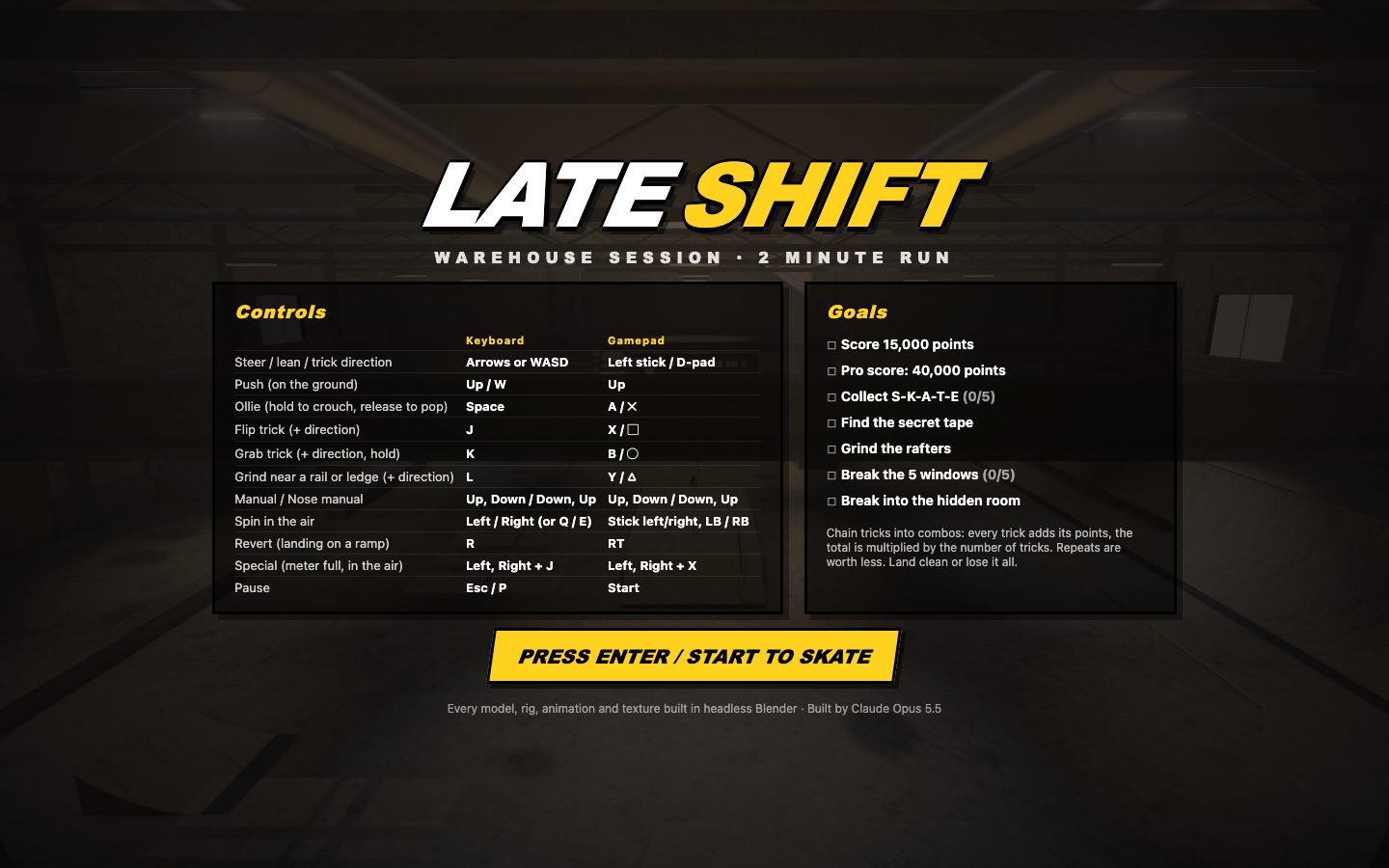
Opus 5.5 · Screenshot of the buildRuns in your browser
Written by
Pat Simmons. Pat tests AI models and tools on the AI for Mortals YouTube channel.