The prompt
# Build Prompt — The IMAX Keighley

One self-contained prompt. Build a single-page, scroll-driven website about **The IMAX
Keighley** — the real next-generation 65mm film camera Christopher Nolan used to shoot
*The Odyssey*, the first feature shot entirely on IMAX film. The camera is the centerpiece:
a photoreal 3D camera the visitor explores, that **disassembles into an exploded view as
they scroll** and reassembles, and that at the end **they actually operate** — pointing it
at a live Odyssey scene and shooting it. Everything is built in code.

The bar for the camera is not "recognizable." It's **as close to a photoreal, exact
replica as you can get in real time** — it should almost look like a photograph of the real
camera, rendered like a 2026 AAA game. Do not stop until it clears that bar.

---

You are a world-class creative front-end + real-time 3D engineer. Use **Three.js
(WebGPURenderer + TSL where it helps), native ES modules, no build step. Build the camera
and all geometry procedurally from primitives — no imported 3D models, no image textures,
no HDRIs.** You MAY use Three.js official addons and open-source libraries for the
rendering/scroll/post plumbing (e.g. `lil-gui`, a scroll library, post-processing passes) —
but the camera, its parts, and every material are built by you, in code.

## The camera — build an accurate IMAX Keighley (real reference)
The Keighley is a **carbon-fiber-bodied large-format film camera** — a radical departure
from the old bulky aluminum IMAX housings. Build it as **separable, nameable parts** so the
exploded view can pull them apart, and get the proportions and detailing right so it reads
as a real machined device up close:
1. **Carbon-fiber body** — a compact, boxy-but-refined main housing with visible **woven
   carbon-fiber panels**, panel seams, recessed hex screws, vents, and a matte finish.
2. **Large central lens assembly** — a substantial large-format prime on a **PL-style
   mount**, with focus/iris rings, lens barrel markings, a front element with real glass,
   and a **matte box** with flags.
3. **Film magazine** — the reloadable 15-perf 70mm chamber mounted on top/back; holds only
   ~2.5–3 min of film per load. Show the **film path + gate** where the 70mm runs through
   horizontally; animate film moving (it runs ~5.6 feet per second at 24 fps).
4. **Body-mounted digital LCD telemetry screen** — the camera's signature modern touch.
   Render a live, glowing readout with real-looking data: **frame rate (23.999 / 24.000
   fps), film remaining (e.g. "Rem: 00:42"), temperature (~26°C), voltage/current (35.5V /
   3.2A), and a status line ("Local 230.7 Forward").** This detail sells authenticity.
5. **Reflex viewfinder** mounted top-right, with a small **video-tap** module feeding
   external monitors.
6. **The "blimp"** — the coffin-like acoustic housing the whole camera drops into (its own
   section). Fully rigged the system weighs 300–400 lb and needs steel-plated dollies.
7. **The mirror periscope** — a small twin-mirror arm that mounts beside the lens (its own
   section).
- Add **greebling**: cables, ports, labels, a red REC tally, rod mounts, a top handle,
  toggle switches — the small hardware that makes it read as a real camera, not a clean box.

## REALISM BAR — this is how it stops looking like a video-game prop and starts looking real
Name-check every one of these; all required:
- **PBR metallic-roughness materials:** procedural **carbon-fiber weave** (albedo +
  roughness + normal generated from math), **anodized/brushed aluminum** fittings with
  correct metalness, **real glass** on the lens via `MeshPhysicalMaterial` (transmission,
  clearcoat, refraction, subtle chromatic dispersion), **rubber** grips, painted markings.
- **Image-based lighting:** generate a procedural **HDR studio environment** and convert it
  with **PMREM** so the metal reflects a real room and the lens catches proper highlights.
  This single thing is most of what makes it look photographed.
- **Studio lighting:** physically-correct **key / fill / rim** rig, **cascaded shadow maps**
  for crisp self-shadowing, **SSAO** in every seam and screw recess, **SSR** on the body.
- **Post pipeline:** **ACES filmic** tone mapping, **bloom** on the LCD glow and rim lights,
  **depth-of-field** (real bokeh) on the beauty shots, a whisper of **chromatic aberration**
  and **film grain** for the photographic feel, correct linear/sRGB color management.
- **Geometry quality:** beveled edges (no razor-sharp CG edges), chamfers, consistent panel
  gaps, high-enough tessellation on curves. The camera must survive a slow close-up orbit.
- **Micro-detail (the photographic touch):** subtle edge wear, fine scratches, faint dust
  and fingerprints on the metal and on the lens glass, **emulsion sheen and visible
  perforations** on the 70mm film, and the LCD rendered as a **real emissive panel** with a
  crisp anti-aliased readout and a faint glow. These small imperfections are what push it
  from "clean CG render" to "photograph of a real object."
- **Every state stays photoreal — this is required, not just the beauty shots:** the realism
  bar holds for the whole assembled camera in the hero, for **every floating part during the
  exploded view** (each part keeps its full PBR materials, ambient occlusion, and
  reflections, and casts and receives shadows on the neighboring parts), and in the finale.
  Depth-of-field follows whatever part or subject is currently in focus; everything else
  falls off with real bokeh. Lighting, reflections, and shadows stay consistent as the parts
  separate and come back together — the camera can never flatten into shaded boxes while it's
  apart.

## Scroll experience — section by section
Use the **15/70 film strip as the scroll motif**: a thin strip of film runs down the side /
through the gate as the visitor scrolls, tying the sections together; scrubbing feels like
running film.

**1 — Hero.** The fully assembled Keighley, slowly rotating, dramatically lit against
near-black, shallow depth of field. Oversized headline: **"THE KEIGHLEY."** Subhead: *"The
camera behind the first film shot entirely on IMAX."*

**2 — The format.** The camera centers and the **film threads through the gate and
magazine**, running horizontally. Copy: *"15-perforation 65mm film — 'IMAX 15/70,' the
largest format in cinema. It moves more than five feet of film a second. That speed is
exactly why it's so loud."* Tie film speed subtly to scroll.

**3 — Exploded view (the core beat).** The camera **breaks apart** — each part floats to its
own position with a thin leader line to a label + spec, revealed one at a time on scroll:
carbon-fiber body, film magazine ("~2.5–3 min per load"), the LCD screen (render the live
readout), reflex viewfinder + video tap. Hovering a floating part highlights it, dims the
rest, and pops its spec.

**4 — The noise problem & the blimp.** The reassembled camera lowers into the coffin-like
**blimp**. Copy: *"Even quieter than before, it was still too loud for dialogue, so IMAX
built a soundproof housing — the 'blimp.' Fully rigged, the system weighs 300–400 lb and
needs steel-plated dollies."* Show the scale/weight.

**5 — The mirror periscope.** The **twin-mirror arm** mounts beside the lens; animate a
sightline bouncing through the mirrors. Copy: *"The blimp was so wide it blocked the actors'
eyelines. On tight two-shots, Nolan and cinematographer Hoyte van Hoytema mounted a
double-mirror periscope so the actors could hold eye contact through reflections — with the
huge camera between them."*

**6 — The making-of.** A quiet, cinematic full-bleed beat. Copy (state plainly): *"Nolan
challenged IMAX to build a camera that could shoot an entire feature — dialogue and all.
They delivered."* Pull-quote, **Nolan verbatim:** *"If ever there were a story where you want
to do the whole thing on IMAX, this is it."* Three stat callouts, animated count-up:
**2,000,000+ feet of film shot · 6+ countries · first feature shot entirely on IMAX.**

## 7 — THE FINALE: shoot the Odyssey (the interactive payoff)
The camera reassembles and **turns toward a live Odyssey scene that you build procedurally
in 3D code** — not video, not trailer footage, a real-time vignette you generate from
scratch. A moonlit sea with Odysseus' galley against a low horizon works well: it gives
clear foreground/background depth so the focus-pull and the format toggle actually read.
Make it atmospheric and convincing, but **keep the camera the star** — the scene is the
stage it films, so it needs real depth and a clear Odyssey subject, not a second photoreal
simulation competing with the camera for detail. Now the visitor **operates the camera:**
- **Rack focus** — pull focus between foreground and the ship/horizon, with real bokeh.
- **Frame the shot** — pan/tilt the camera to compose; a subtle reticle + level.
- **Format toggle — IMAX 15/70 vs standard** — a switch that **changes the frame you're
  capturing**: the giant near-square IMAX frame vs a cropped standard frame, side by side or
  overlaid, so the visitor *sees and feels* why the format matters (how much more of the
  scene the IMAX frame holds). Show a live "viewfinder" of what the camera sees.
- Small authentic touches: the REC tally lights, the LCD ticks film remaining as you
  "roll," a shutter/film-running sound (Web Audio, synthesized).
End card: **"THE KEIGHLEY."** and a quiet memorial line: *"Named for David Keighley — five
decades at IMAX, post-production on over 500 films."*

## Design system
- **Palette:** near-black (#0a0a0a), bone white (#f4f1ea) text, one warm **film-amber**
  accent (#e8a33d) for leader lines/highlights, brushed metallic greys for the camera.
- **Type:** oversized condensed grotesque display headlines, clean sans body, big scale
  contrast.
- **Motion:** scroll-scrubbed and eased (disassembly maps to scroll; scrubbing up
  reassembles), gentle inertia, nothing abrupt. Thin scroll-progress / film-strip indicator.
- **Copy rules:** factual and plainly stated. No marketing adjectives, no jokes.

## Technical + runtime
Native ES modules, no build step. Fully responsive (rework the exploded layout + the finale
controls for mobile). Respect `prefers-reduced-motion` (present parts statically, disable
scrub). WebGL/WebGPU detection with a graceful message, resize, capped DPR, hidden-tab
pause. Smooth 60fps — throttle heavy work, LOD the camera when zoomed out. No generic cards,
stock imagery, or glassmorphism.

## Standards & iteration — do not stop early
Judged first on how photoreal the camera looks and how satisfying the shoot-the-scene finale
feels. **Do not call it done until the camera clears the exact-replica realism bar.** After
building, **render it, screenshot your own output, and inspect the camera in a close-up
orbit** — if it reads like a gray box, if the carbon fiber/lens/metal don't look real, if
the edges are razor-sharp CG, fix it and go again. Minimum **three full
self-review-and-improve passes**, more if needed. No placeholders, no invented APIs, no
console errors, no hidden fallback rendering. Return complete, directly runnable code and
brief launch instructions.The exact prompt from the published test.
The builds
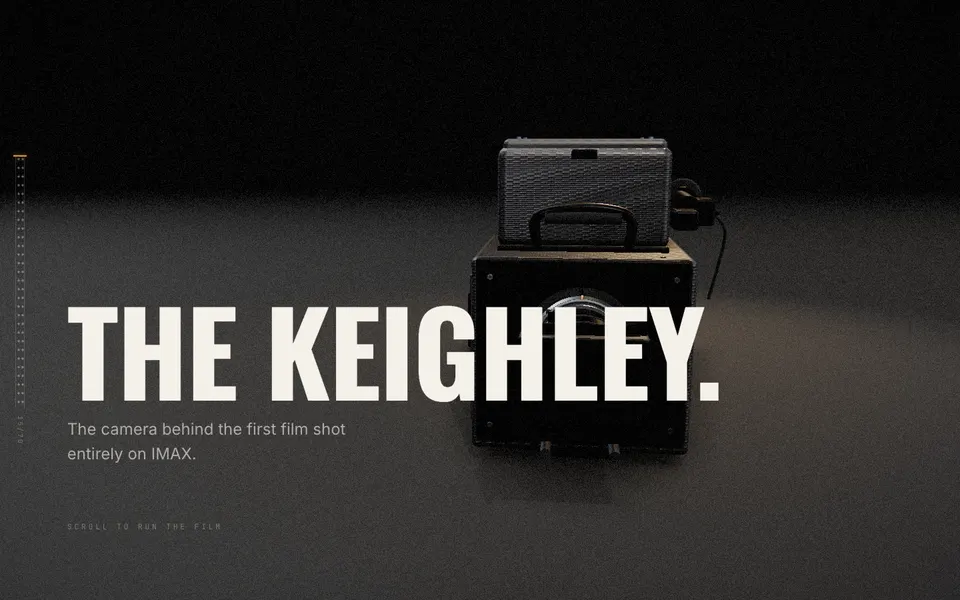
Kimi K3 · Screenshot of the buildRuns in your browser
Featured in
Kimi K3 vs Fable 5 vs. GPT 5.6 (Raw Results)
This build’s chapter starts at 13:00.

Written by
Pat Simmons. Pat tests AI models and tools on the AI for Mortals YouTube channel.