Gemini 4 Carbon, Google's Strongest Model, Opens to Ultra Subscribers
Google AI Ultra subscribers can now pick Gemini 4 Carbon in the Gemini app and in AI Mode in Google Search.
 AI for Mortals Staff
On this page
- Who gets Gemini 4 Carbon, and what Google AI Ultra costs
- What Google says Carbon does better than Argon
- Carbon admits more often when it doesn't know something
- Where Gemini 4 Carbon ranks against Claude Fable 5.2
- Gemini 4 Carbon vs Argon on seven work jobs
- When to pick Carbon over Argon in the Gemini app
Google opened Gemini 4 Carbon, its strongest model, to developers, businesses and Google AI Ultra subscribers. That's two weeks after it gave Carbon to security teams only.
Ultra subscribers can now pick Carbon in the Gemini app and in AI Mode in Google Search.
Google's own post doesn't tell everyone to switch. It says Argon, the model already in the app, "remains the ideal choice for the majority of software engineering and knowledge work," and Google calls Carbon the model for "your hardest problems."
Who gets Gemini 4 Carbon, and what Google AI Ultra costs
- Google AI Ultra (from $99.99 a month): Carbon and Argon in the Gemini app on desktop, mobile and web, in AI Mode in Search and in Antigravity.
- Google AI Pro ($19.99 a month): Argon, and no Carbon.
- Developers and businesses: Carbon through Google's API and Gemini for business, at the same introductory price as Argon.
- Scientists and security teams: scientists can apply for six months of free access, and security teams can still apply through Google's Fairwind Program.
Google's plans page labels Pro "Includes Gemini 4 Argon" and Ultra "Includes Gemini 4 Carbon," and says Ultra has five times Pro's usage limits in Gemini.
Google hasn't said whether Pro will get Carbon in the Gemini app.
Varun Mohan, who works on Antigravity at Google DeepMind, posted that Carbon is available to Ultra users in Antigravity and that "we will quickly expand access to more users." He didn't say which plans or when.
What Google says Carbon does better than Argon
Carbon spends longer on a problem. Google says it uses "more tokens than Argon to explore thoroughly, reason deeply, and run extended verification loops."
Gemini 4 Carbon is now available. It's our strongest model, built to dig deeper, handle long-horizon tasks, and multi-step reasoning. If Argon is great for complex tasks, Carbon is the model you bring in for your hardest problems.
Google on X, November 10, 2026
In practice it thinks through more possibilities and checks its own answer more times before it replies. Our guide to what a token is explains why that counts against your limits.
Because of that extra work, Carbon answers more slowly than Argon in the app and uses up a usage limit faster.
For the Gemini app, Google lists three things Carbon is for: more thorough answers on your toughest tasks, turning dense data and documents into presentations, spreadsheets and reports, and building web apps, prototypes and 3D scenes.
Carbon admits more often when it doesn't know something
Google ran both models through 375 tasks that test whether a model admits when it doesn't know something. Carbon passed 92% of them, and Argon passed 70%.
In the same test, Carbon declined to fill in missing experimental data 98% of the time.
For office work, the equivalent is a report that tells you a figure is missing instead of inventing one.
Where Gemini 4 Carbon ranks against Claude Fable 5.2
Anthropic's Claude Fable 5.2 came out a day before Carbon opened to the public, and it ranks above Carbon on Artificial Analysis' ranking of AI models.
Fable 5.2 scored 65. Carbon was the next-highest model, at 60.

Google is charging less. Until November 30, developers pay a quarter as much for Carbon as for Fable 5.2, and half as much after Google's price doubles on December 1.
Gemini 4 Carbon vs Argon on seven work jobs
AI for Mortals ran Carbon and Argon on the same seven work jobs, from an email reply to a buggy payroll program, and Argon did as well on all seven.
Five were everyday office jobs: the email reply, a summary of a 48-page report, a contact-list cleanup, a slide deck and a small invoice tool. Both models got every fact right in the finished work, and the clearest difference was a broken slide in one of Argon's decks.

The other two were built to make a model think: a scheduling puzzle with one right answer, and a payroll program with eight bugs planted in it.
Both models solved both. Argon found all eight bugs in about 15 seconds, and Carbon found the same eight in about 1 minute 50 seconds.
Across the hard jobs, Carbon took up to seven times as long and cost about eight times as much.
Those seven jobs were short ones. In Pat Simmons's Gemini 4 Argon review, Argon came last on all four long builds against Opus 5.5, Fable 5.1 and GPT-6 Astra, and Pat hit Ultra's daily limit after about one build.
Long builds are the kind of work Google made Carbon for, and the seven-job test didn't include them.
When to pick Carbon over Argon in the Gemini app
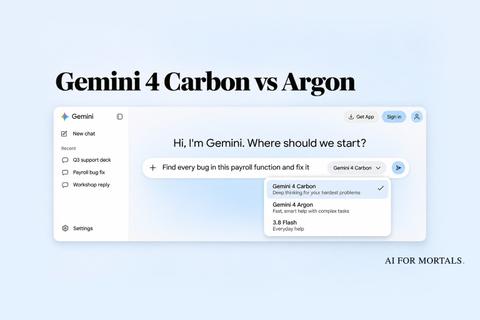
On Ultra, you pick Carbon or Argon in the Gemini app.
Going by Google's own advice and that test, Argon is the one to start with. It's faster, it uses less of your limit, and on everyday work it gave the same answers.
Carbon is for the job where Argon's answer comes back wrong, or where the work has many steps that depend on each other. Google's examples are "complex, multi-step coding and debugging" and "open-ended scientific research and discovery."
A debugging request is a fair way to compare them on your own work:
"Here's our payroll code and the pay rules. Staff say totals are wrong. Find every bug and return the fixed file."
Run the same request on Argon in a new chat. If Carbon finds something Argon missed, that's the kind of job to spend your Carbon limit on.
If you're on Pro, you have Argon, and on those seven jobs Carbon wouldn't have given you a better answer.
Sources
- Google: Gemini 4 Carbon is now available
- Google on X: Gemini 4 Carbon is now available
- Gemini app on X: Carbon rollout to Google AI Ultra
- Google One: Google AI plans
- Varun Mohan on X: Carbon in Antigravity
- Artificial Analysis on X: Intelligence Index, November 9
- Artificial Analysis: AI model leaderboard
- Google AI Studio: Gemini API pricing



Comments
Sign in to join the conversation.