
What Is Harvey AI? What the Legal AI Does, What It Costs and Who It's For
Harvey is an AI platform that law firms and in-house legal teams buy per seat for contract review, legal research and legal agents.

On this page
- What does Harvey AI do?
- Do you have to pay for Harvey AI?
- Who uses Harvey AI?
- Harvey AI for transactional lawyers
- What are Harvey AI's limits for contract drafting?
- Which AI models does Harvey use, and how is it different from ChatGPT or Claude?
- Who owns Harvey AI and who has invested in it?
- Questions people ask about Harvey
Harvey is an AI platform for lawyers and legal teams, made by Harvey AI Corporation, which calls it "the operating system for legal and professional services." Law firms and in-house legal teams use it to review and negotiate contracts, research legal, regulatory and tax questions, analyze large sets of documents and hand longer legal tasks to AI agents.
Harvey sells it to organizations, one seat per user, after a demo. Harvey's own FAQ says that "on average, Harvey costs several hundred dollars per user per month," and the company says more than 3,500 law firms and legal teams in 85+ countries use it.
Last checked November 23, 2026: Harvey's homepage, company page, help-center FAQ, customer terms, its September funding announcement and its November post on OpenAI's GPT-6.2 models.
What does Harvey AI do?
Harvey puts a set of legal AI tools in one web app: a chat box where lawyers ask legal questions, a store for the firm's documents that Harvey can search and analyze, research tools, contract review, and agents that carry out multi-step tasks. Its FAQ says firms and legal teams use it "for research, drafting, contract analysis, due diligence, compliance and litigation."
The Harvey homepage splits the product into platform tools that every customer works in, apps built for one legal job, and connections to the software a firm already uses. The table puts each part in plain English, using the descriptions in Harvey's product menu.
| Part of Harvey | Type | What it does |
|---|---|---|
| Agents | Platform | AI agents designed for legal work, with each task routed to the right agent automatically |
| Vault | Platform | Stores a firm's legal documents and analyzes thousands of them with a single query |
| Knowledge | Platform | Research on legal, regulatory and tax questions |
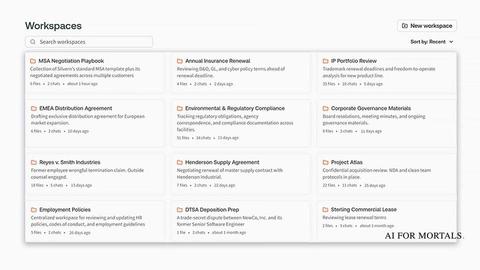
| Spaces | Platform | Shared workspaces for a firm, its clients and co-counsel, with ethical walls (rules that keep some lawyers out of some clients' files) |
| Command Center | Platform | Shows who uses Harvey and for what work, and compares usage with similar organizations |
| Memory | Platform | Remembers each user's preferences |
| Review Tables | Platform | Tables of answers pulled from many documents, with a citation in every cell |
| Legal Work Orchestration | Platform | Coordinates a larger piece of legal work across several agents |
| Contract Intelligence | App | AI contract review and negotiation |
| Horizon Scanning | App | Tracks changes in laws and regulations so a team can act on them |
| Intake | App | Collects legal requests from the rest of a company and tracks them to a resolution |
| Facts & Chronologies | App (marked New) | Connects the facts of a case and builds timelines from them |
| Connector Library | Connect (marked New) | Links other tools to Harvey through MCP |
| Ecosystem | Connect | Lets lawyers use Harvey inside the tools they already work in |
Harvey launched Harvey II, a redesigned interface, on October 26, 2026. The home screen is a single chat box that reads "Ask Harvey anything," with agents, document vaults, Contract Intelligence and shared Spaces listed in a sidebar on the left.

Harvey also works outside its own app. Its FAQ says the Word add-in drafts and edits documents from prompts and precedents, and the Outlook add-in summarizes email threads with their attachments, drafts replies and files emails into Vault. Harvey's iOS and Android apps run queries, scan documents and transcribe calls or hearings with several speakers.
The Connector Library runs on MCP, a standard way for AI tools to plug into other software. It works in both directions: admins can connect their own MCP servers to Harvey, and Harvey's MCP server lets Claude, Google Gemini and Microsoft 365 Copilot use Harvey's research and Vault tools once a workspace turns it on.
AI for Mortals tracks every Harvey update, dated, on its Harvey company page, from Connector Library to Harvey II.
Do you have to pay for Harvey AI?
Yes. Harvey is licensed per seat to organizations, and its FAQ says it costs "several hundred dollars per user per month" on average. Harvey's website lists no free plan and no plan for individuals, and harvey.ai/pricing redirects to that FAQ.
The final price depends on the number of seats, which Harvey products a team deploys, and the contract terms. Harvey's FAQ says most teams start with a demo from its sales team on their own kind of work, followed by a quote, and the main button across the site is "Request a Demo."
Because the organization buys the seats, it also decides who gets one. A lawyer can only log in after the firm's Harvey admin adds them to a workspace, so there is no way to sign up on your own and try it.
Some add-ons are licensed on top. Ask LexisNexis, an add-on that grounds answers in LexisNexis U.S. primary law with Shepard's Citations markers on cited cases, is licensed separately from Harvey's Basic Service.
Law students are the one group that gets in without a firm. Students at schools in Harvey's Law School Program use Harvey through their school login and can earn certifications in legal AI essentials.
Who uses Harvey AI?
Law firms, mid-size firms and in-house legal teams (the lawyers employed inside a company) use Harvey, and those are the three customer groups its homepage names. Harvey's homepage counts 3,500+ law firms and in-house legal teams, 200,000+ professionals using it, customers in 85+ countries and 80+ firms from the AmLaw 100, a yearly ranking of the 100 highest-earning US law firms.
Harvey's September funding post puts the same figure as 80% of AmLaw 100 firms and adds that five of the Fortune 10 companies use it.
Named law-firm customers on Harvey's homepage include Latham & Watkins, A&O Shearman, Norton Rose Fulbright and Reed Smith. Company legal departments on the same page include Deutsche Telekom, Bayer, Procter & Gamble, Booking.com, Comcast and the investment firm KKR.
Harvey sells to legal teams in healthcare and life sciences, energy and utilities, technology, media and telecom, and the public sector, and it has pages for three practice areas: litigation, transactional work and innovation teams.
Harvey is a workplace tool for lawyers. Its acceptable use policy bars customers from using it to give legal advice "without human review by a licensed professional," so a person looking for help with their own legal problem would need a lawyer who uses it.
Harvey AI for transactional lawyers
Transactional lawyers handle deals and contracts, such as mergers, financings and supplier agreements, and Harvey's transactional page lists six jobs it does for them: due diligence, drafting, research, negotiation, deal management, and client alerts for winning and keeping clients.
For due diligence (checking a company's contracts and records before a deal), Harvey says it reviews thousands of documents at a time and flags key risks, "no matter the language or governing law jurisdiction." For drafting, it strengthens clauses and checks a draft for inconsistencies against a firm's "precedents, forms, playbooks, or deal points."
The rest of the list is deal admin. Harvey pulls public company filings from the SEC's EDGAR database for research, writes issues lists with recommendations for the client during negotiation, and builds checklists and extracts deadlines to keep a deal on schedule.
Most of the contract work runs through Contract Intelligence. Its Contract Review Agents detect the type of contract, gather the deal's context and run a review against the team's own standards, and Harvey says inbound contracts such as MSAs (master services agreements) can come back with redlines, the marked-up copies showing proposed changes, "the same hour they arrive."

During a negotiation, Contract Intelligence shows what changed in each round and reviews every new draft against the full history. It can also compare a live deal with the terms the company accepted in contracts it already signed, and it flags renewals, notice periods and other commitments before they need action.
What are Harvey AI's limits for contract drafting?
Harvey's own customer contract says its output can be wrong. The Harvey Platform Agreement states that "the Service is a research tool, and its Output is not legal advice," and that output "may contain errors and misstatements or may be incomplete," so a lawyer has to check every draft before it goes out.
The acceptable use policy makes the same point as a rule: customers may not use Harvey to provide licensed services such as legal advice without human review by a licensed professional.
Harvey describes the problem in a November 19 post on reviewing its work. "A lawyer signs their name to every piece of work that leaves their desk, even when Harvey wrote the first draft," it says, and a due diligence memo "can read cleanly and still be wrong because the agent never opened a side letter or missed an amendment."
Some of the checks Harvey describes in that post are still on the way. Every answer already links each statement to the passage behind it, and Harvey shows which files it is searching while it works. Cite Check, which checks every quote and pin cite in a brief against the full court opinion, is "coming to Early Access later this year," and a short note listing which documents Harvey read in full and which it couldn't open is planned next.
Harvey's drafting checks work from a firm's own precedents, forms, playbooks and deal points, and Contract Intelligence reviews against "your own standards." A team that hasn't written down its preferred positions gives Harvey less to check a draft against.
Bar guidance puts the final check on the lawyer whatever tool they use. The State Bar of California's 2026 guidance on generative AI, approved May 14, 2026, says a lawyer "must exercise independent professional judgment by reviewing, verifying, and correcting AI-generated outputs." It adds that lawyers must not let AI agents "prepare and file pleadings" without "meaningful attorney supervision and review."
Access is the last limit. A solo lawyer or small firm can't sign up and test Harvey on a sample contract, because every seat comes through a demo and a quote.
Which AI models does Harvey use, and how is it different from ChatGPT or Claude?
Harvey runs on models from several AI companies. Its FAQ says it uses models from Anthropic, OpenAI and Google, with Mistral also available in the EU, and that it is "multi-model by design": it breaks a request into smaller tasks, picks a model for each and combines the results.
Before adding a model, Harvey tests it on tasks designed by lawyers, using its BigLaw Bench tests and its open-source Legal Agent Benchmark (LAB). On November 17, 2026, Harvey announced that OpenAI's GPT-6.2 models were coming: GPT-6.2 Sol for all Harvey customers starting that week, and GPT-6.2 Astra for customers with Harvey's Extended AI. In Harvey's early testing, GPT-6.2 Astra fully completed more than three times as many LAB tasks as GPT-6 Astra.
Building on other companies' models puts Harvey among apps built on someone else's AI model, where the value is in what the app adds. Harvey's funding announcement also mentions its first post-trained open-weight model, an openly downloadable AI model that Harvey trained further itself.
What Harvey adds for legal teams, per its FAQ, is the firm's own documents, legal sources and repeatable workflows that lawyers can check, with citations back to the source. It also contractually commits not to use a customer's inputs, outputs or uploaded documents to train the underlying models.
On security, Harvey says it holds ISO 27001, ISO 27701 and ISO 42001 certifications and had its 2026 SOC 2 Type II audit done by Schellman, and customers can keep their data in the EU or Switzerland, the US or Australia. For comparison, here is what ChatGPT, Claude and Gemini keep from your chats on their consumer plans.
AI for Mortals hasn't tested Harvey, so this page doesn't rank it against general chatbots as "the best AI for legal." Harvey points readers to public LAB leaderboards on Artificial Analysis and Vals. Compared with ChatGPT or Claude, Harvey is sold only to legal teams, runs inside a shared firm workspace and ties its answers to the firm's own documents and legal sources.
Who owns Harvey AI and who has invested in it?
Harvey AI Corporation owns and makes Harvey. Its FAQ names its co-founders as Winston Weinberg, the CEO, and Gabe Pereyra, its President.
Harvey's company page lists Sequoia, Kleiner Perkins, a16z, Coatue, EQT, GIC, GV, Goldman Sachs Alternatives, J.P. Morgan, Lightspeed and the OpenAI Startup Fund among its investors.
On September 9, 2026, Harvey announced a $550M funding round at a $15.5B valuation, co-led by Diffusion and Lightspeed. Sapphire Ventures and Whale Rock joined as new investors, and existing backers including Sequoia, Kleiner Perkins, a16z, Coatue and GIC put in more.

Harvey is a specialist company that builds on the big AI labs' models. For who the big AI companies are and what each makes, see the AI for Mortals company directory.
Questions people ask about Harvey
Is there a Harvey app for phones?
Yes. Harvey has iOS and Android apps for phones and tablets, and Vault and past queries sync between mobile and desktop.
Does Harvey work in Microsoft Word and Outlook?
Yes. The Word add-in drafts and edits documents and runs playbooks and tasks such as translation, and the Outlook add-in summarizes threads, drafts replies and sends emails to Vault.
Does Harvey train AI models on my firm's documents?
No. Harvey's FAQ says its Platform Agreement guarantees it doesn't use inputs, outputs or uploaded documents to train the underlying models, and customers set retention rules and can delete data at any time.
Where do lawyers log in to Harvey?
At app.harvey.ai in the US and eu.app.harvey.ai in the EU, with an Australian login listed on Harvey's homepage too. Users sign in with a work email through single sign-on or an emailed code, after their firm's admin adds them.
Can law students use Harvey?
Yes, if their school is in Harvey's Law School Program. They sign in through the school and can earn certifications in legal AI essentials.
Sources
- Harvey: homepage and product menu (checked November 23, 2026)
- Harvey Help Center: Frequently Asked Questions about Harvey (pricing, models, security)
- Harvey: About the company
- Harvey: Transactional
- Harvey: Contract Intelligence
- Harvey: Platform Agreement
- Harvey: Acceptable Use Policy
- Harvey: How Harvey is Building Reviews and Verification
- Harvey: GPT-6.2 Astra and GPT-6.2 Sol, Coming Soon to Harvey
- Harvey: Harvey Raises $550M at a $15.5B Valuation
- Harvey on X: Harvey II is live
- State Bar of California: Practical Guidance for the Use of Generative AI in the Practice of Law (2026)


Comments
Sign in to join the conversation.