What I was testing
I gave Opus 5.5, Fable 5.1 and GPT-6 Astra the same photos of adidas's Adizero Adios Pro Evo 3. The prompt called for a shoe that came apart as you scrolled, with labels explaining each component.
Astra got the sole texture and creases closest to what I wanted. Its page was the weakest, though: the shoe stayed apart when it should have come back together. I still ranked Astra first for the 3D work, followed by Opus and Fable.
“Astra did a much better job at the 3D.”
The prompt
Model the adidas Adizero Adios Pro Evo 3 in Blender as photorealistically as you can, then
build its product page with that model live and interactive on the page.

Context you should know: this is going into a video watched by a large audience, your page is shown
on camera against two other frontier models doing the same task, and your work will be credited to
you by name. Every model gets this identical prompt and the identical reference photographs. What
is being judged first is how close your shoe looks to the real one.

**Reference photography is in `./refs/`** — official adidas studio shots of colourway Cloud White /
Core Black / Solar Turbo, style code KH7678. `evo3-3.jpg` and `evo3-8.jpg` are profile views and are
your primary geometry reference. `evo3-2.jpg` is the sole plan, `evo3-1.jpg` top-down, `evo3-5.jpg`
rear three-quarter. `evo3-13.jpg`, `-6`, `-7`, `-10` are macros of the midsole step, the upper
texture, the collar and the lacing. Look at them before you model anything, and keep checking back.

## Use Blender, headlessly

Blender 5.1.2 is at `/opt/homebrew/bin/blender`. Drive it with
`blender --background --python <your_script.py>`. Build the model in Python so you can iterate:
re-run, render, look at the render, fix, re-run. Do not hand-place vertices you cannot regenerate.

Render turntable and detail stills to `./renders/` with Cycles and actually look at them. A model you
never rendered is a model you never checked.

Export `./shoe.glb` (glTF 2.0, Draco compression on) for the web page. Keep it under 8 MB.

## The construction, which is published and specific

Get these right. They are the difference between this shoe and a generic running shoe.

1. **There is no plate.** It uses **ENERGYRIM**: a carbon perimeter rim in a **U shape, open at the
   front**, leaving bare foam underfoot. It is **asymmetric** — continuous along the lateral side,
   but on the medial side it stops in the heel and reappears in the forefoot. A full-length carbon
   plate is wrong and will be visible in the cutaway.
2. **Midsole: Lightstrike Pro Evo.** Off-white, matte, visibly foam rather than plastic — sculpted,
   with open cell structure at the cut edges. It is **two-tier**: an upper body and a stepped lower
   keel, with a **thin black pinstripe tracing the bond line** along the sidewall. Stack is 39 mm
   heel; adidas markets 36 mm forefoot but independent measurement puts it nearer 33 — model nearer
   39/33 and the rocker will read correctly. Aggressive forefoot rocker, toe tip lifting ~6.5 cm off
   the ground.
3. **Upper: ultralight ripstop**, derived from kitesurf sail material. Translucent white with a fine
   square grid. It is **non-stretch**, so it drapes and wrinkles rather than shrink-wrapping the
   foot — model the wrinkles, they are the tell.
4. **Three Stripes as a halftone dot matrix**, not solid black. Large dots thinning toward the edges.
5. **Outsole: Continental rubber**, a single teardrop pad over the forefoot only with about six
   curved sipes, plus a small translucent heel window. Everything else is bare foam. The rubber is
   charcoal with a violet cast, not black.
6. **No heel counter, no insole, no gusset on the tongue.** The tongue is thin and unpadded with a
   second lace loop low on the side. Laces are flat, white and short, running through translucent
   film loops.
7. **Stamped text** in small condensed caps: `LIGHTSTRIKE PRO EVO` on the foam, `ADIZERO ADIOS PRO
   EVO 3` on the upper.

Sampled colours from the official photography: whites `#EAEEEF`, blacks `#2F3032`–`#3A3B3F`,
Continental rubber `#48474D`, Solar Turbo accent `#FE7875` bright / `#D34144` in shadow.

## The page

8. **A single self-contained `index.html`** that loads `shoe.glb` and puts it on the page live —
   orbitable, lit properly, with real materials. three.js via CDN is fine. No build step, no server,
   no API keys.
9. **Scroll drives a sequence**: the shoe rotates, the upper fades to expose the ENERGYRIM, the
   midsole separates from the outsole, annotations appear anchored to each part. Scrubbing backward
   runs cleanly in reverse.
10. **A complete product page**, not just a viewer: hero, the scroll sequence, a spec table (weight
    97 g at UK 8.5, stack 39/36 mm, 3 mm drop, $500), a section on the record run, a materials
    section, and a purchase call to action. Write copy that sounds like adidas, not placeholder text.
11. **Sixty frames per second** while scrolling and orbiting. Profile it and fix it.
12. **Responsive** down to a phone.

## QA

13. Put your render side by side with `refs/evo3-3.jpg` and compare silhouette, midsole step, stripe
    placement and rocker angle. Fix what is off. Then load the page, scroll it top to bottom and back
    several times, orbit the shoe, check the frame rate and the console. Write `BUILD_NOTES.md`
covering what you got close on and what you could not match.Full prompt from the published experiment.
The builds
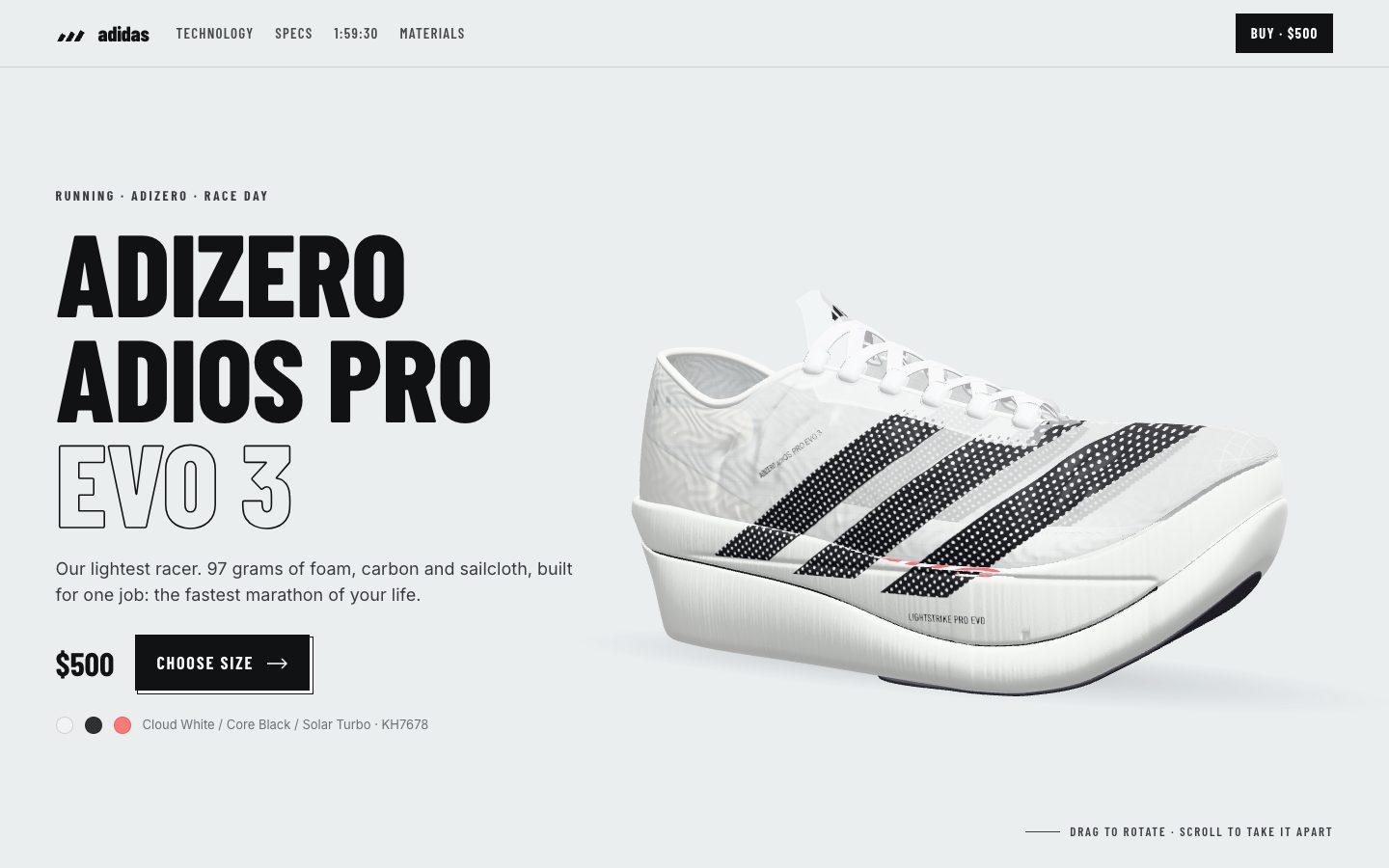
Opus 5.5 · Screenshot of the buildRuns in your browser
Featured in
Opus 5.5: No-Hype Full Review & Testing
This build’s chapter starts at 29:15: Build 4: Adidas shoe in Blender.

Written by
Pat Simmons. Pat tests AI models and tools on the AI for Mortals YouTube channel.