Five Big Banks Put AI Agent Losses on Customers
Citi, PNC and Citizens now say customers answer for whatever an outside AI agent does in their accounts, joining JPMorgan and Bank of America.
 AI for Mortals Staff
Citi changed its online terms this week so that customers who give an outside AI agent access to their bank account are responsible for whatever that agent does. PNC changed its terms on Wednesday, and Citizens emailed customers the same warning.
That makes five big US banks. JPMorgan and Bank of America took the same line in October.
Citi says the change is about safety. "As third-party AI tools become more widely available, we want customers to understand the risks associated with sharing banking credentials or authorizing those tools to access their accounts," a Citi spokesperson told TechCrunch.
The spokesperson added that "customers who choose to grant account access to third-party AI agents are responsible for activities conducted through those agents."
What Citi's new AI agent terms make you responsible for
Citi's terms go furthest. If an AI tool leaks your login or gets hacked, you're responsible for whatever the hackers do with your account, according to TechCrunch's reading of the update.
The banks also say they won't reverse a transaction an agent made, whether you meant it to happen or not. An agent that pays the wrong bill, or moves money after a bad instruction, leaves you to sort it out with whoever got paid.
Citi's terms do exempt the AI agents Citi offers itself. Customers can use those without taking on the extra liability.
Which banks now make you liable for an AI agent
- JPMorgan Chase: announced a similar policy in October, and a Chase spokesperson told Axios that customers shouldn't give their username and password to anyone.
- Bank of America: emailed customers in October, in the message below.
- Citi: changed its Online User Agreement this week.
- PNC: changed its terms on Wednesday.
- Citizens: emailed customers this week with the same warning.
Bank of America's email ends its warning with this line: "If you do share your credentials, keep in mind that you're responsible for activity resulting from that access."

Other banks are going further than a warning. Morgan Stanley has started blocking outside agents from its platforms, Axios reported, and bank executives told it they often can't tell whether an agent in an account was sent by the customer or got in on its own.
What counts as giving an AI agent access to your bank account
The warnings cover two things. The first is handing an agent your bank username and password so it can sign in as you. Bank of America's email names "an AI-enabled tool or agent that offers to act on your behalf," and agents that save your logins and sign in for you, such as Grok Bot's Vault, work this way.
The second is authorizing a tool to reach your account without sharing your password, which is the other half of Citi's statement.
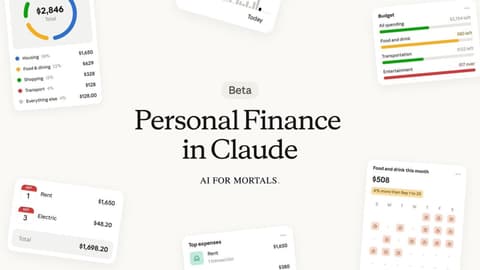
Read-only connections sit at the safer end. Personal Finance in Claude links your bank through Plaid, a service many finance apps use to connect to banks, never sees your bank password, and "can't move, manage, or invest your money," according to Anthropic.
Most banks are heading toward allowing that kind of read-only access, Axios found, since it lets an agent see your information without taking any action in the account.
How to use AI with your money and stay covered
Keep your bank password to yourself. Bank of America and Chase both tell customers never to share it, and sharing it is the step that moves the risk onto you.
Upload statements instead of linking. You can download a PDF or spreadsheet of your transactions from your bank's site and give that file to Claude, ChatGPT or Gemini. We had Claude audit a year of bank statements this way, and it never touched a live account.
If you do link an account, choose read-only. Connections through Plaid let an AI read balances and transactions without the power to move money. Our guide to whether Plaid is safe covers what it can see and how to cut the link later.
Read your own bank's terms. Open your bank's online banking agreement and search it for "agent," "AI" and "third party." Those are the paragraphs these banks just rewrote, and yours may have changed too.
Banks want you using their own AI agents
Outside agents are a business problem for banks as well as a security one. An agent that watches your accounts can point out fees you don't need to pay and savings sitting in a low-interest account, and stock markets briefly wobbled at the prospect, TechCrunch noted.
Citi's exemption for its own agents means a Citi customer carries less risk using Citi's AI than using Claude or ChatGPT on the same account.
Airlines are drawing a similar line. United said on November 11 that it will stop AI agents from booking its flights, and it also pointed to the risk of sharing your login with an AI assistant.
Sources
- More banks say customers using AI agents are on their own, even if they get hacked (TechCrunch, November 18, 2026)
- Bank of America kindly asks that you don't share your banking password with your AI assistant (TechCrunch, October 27, 2026)
- Banks detect unauthorized AI agents in customer accounts (Axios, October 22, 2026)
- Introducing Personal Finance in Claude (Anthropic, November 2026)
- Claude can now analyze your spending with its new personal finance tool (TechCrunch, November 5, 2026)



Comments
Sign in to join the conversation.