Gemini 4 Hydrogen Now Powers Google Search's AI Answers
Google's new fast model replaces Gemini 3.8 Flash in Search's AI answers and in the Gemini app, where the model menu calls it Everyday help.
 AI for Mortals Staff
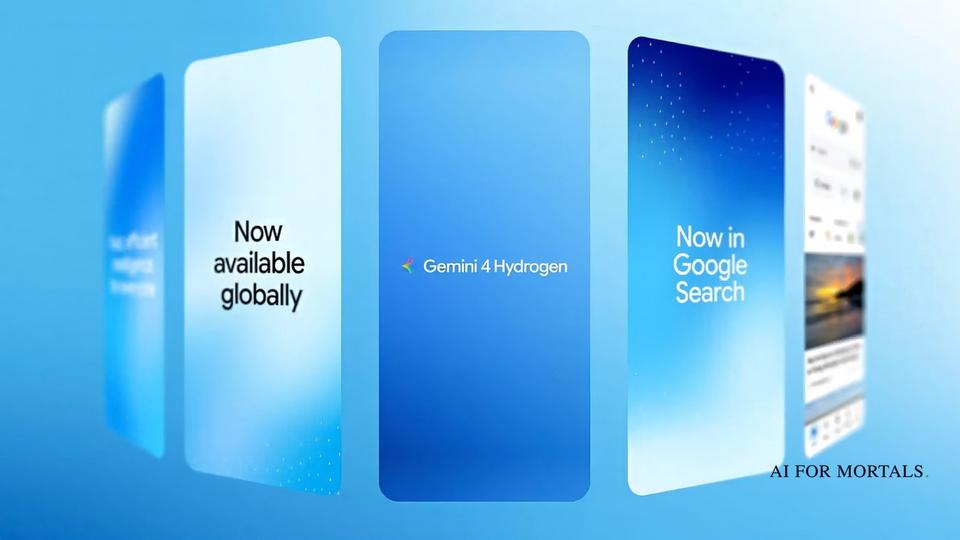
Google released Gemini 4 Hydrogen, its new fast everyday model, and since Thursday it has been rolling out worldwide as the model that writes the AI answers in Google Search, including Google AI Mode, for everyone.
Hydrogen replaces Gemini 3.8 Flash, and Google dropped the "Flash" name with it. It's also rolling out in the Gemini app, where free users get it automatically for some questions and paid subscribers can pick it.
Gemini 4 Hydrogen is here, bringing cutting-edge intelligence to everyone for fast, everyday help. It makes it easier to get things done, following your instructions more closely, calling the right tools, and getting you to a reliable output with less back-and-forth.
Gemini on X, November 12, 2026
What changes in Google AI Mode and Search's AI answers
Google calls Hydrogen "the biggest model upgrade to Search yet." There's nothing to switch on, since it's live for all Search users in every country and in every language AI Mode supports.
According to 9to5Google, Hydrogen is now the default model in AI Mode and handles "your hardest questions" in AI Overviews, the AI summaries at the top of regular results.
Google lists four changes you'll notice:
- Longer, messier questions work. You can ask in one go, with several parts, typos or very specific conditions, and Search tries to answer every part.
- More searches behind each question. Search splits your question into its subtopics and searches all of them at once, so the answer links out to a wider range of sites.
- More visual answers. Expect more images, comparison tables, structured layouts and small custom tools built for your question.
- Better answers in other languages, across every language AI Mode supports.

The way to get the most out of it is to type the whole situation instead of a few keywords. Google's own example question shows the style:
I'm moving to boston for a new job in downtown. I'm 28 and want a neighborhood with a social scene but not too loud on weeknights. suggest some areas I should consider
How to use Gemini 4 Hydrogen in the Gemini app
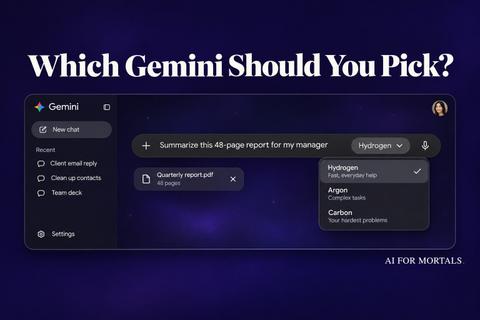
In the Gemini app's model menu, 9to5Google found each model listed by what it's for:
- Quick answers: Gemini 3.5 Flash-Lite
- Everyday help: Gemini 4 Hydrogen
- Detailed research: Gemini 3.1 Pro
- Code & analysis: Gemini 4 Argon
- Most complex work: Gemini 4 Carbon

Free users can't pick Hydrogen themselves. The app's Auto setting, which chooses a model for each question, sends a question to Hydrogen when it decides that's the right model. Paid subscribers can also pick it from the menu.
Which plan gets which model, and how Hydrogen did on seven real jobs against Argon and Carbon, is in our Hydrogen vs Argon vs Carbon test.
Inside the app, Google says Hydrogen sticks more closely to the tone, format and rules you give it, so drafts and rewrites need fewer rounds. It's also better at reaching into your files and apps on its own, pulling from your uploads, Gmail and Google Drive, and Connected Apps like Airtable and Dropbox.
Argon and Carbon stay in the menu. Google pitches them for "deep, long-horizon reasoning on your hardest problems," and Hydrogen for quick, everyday work. Carbon, Google's strongest model, opened to Ultra subscribers only this week.
How Gemini 4 Hydrogen compares with 3.8 Flash, Claude and ChatGPT
Against the model it replaces, Google says Hydrogen finishes tasks 2.5 times faster and makes up facts more than five times less often than Gemini 3.8 Flash.
The independent benchmark firm Artificial Analysis scores Hydrogen 51 on its Intelligence Index at its default setting, four points behind the top scores of Claude Sonnet 5.5 and GPT-6.1 Sol and one ahead of Google's own Gemini 4 Argon. At its highest thinking setting it reaches 54, one point behind them.

On Artificial Analysis's test of hard factual questions, Hydrogen made up an answer 8% of the time, one of the lowest rates the firm has recorded, compared with 43% for Claude Sonnet 5.5 and 52% for GPT-6.1 Sol.
That's what makes this launch bigger than a model swap. The model writing Google's free AI answers for everyone now scores close to the models people pay for in Claude and ChatGPT.
What people are saying about Hydrogen
The busiest launch threads argued about the names. Many people pointed out that nothing in "Hydrogen, Argon, Carbon" tells you which model is the small, fast one, which "Flash" used to do.
Others focused on value. Artificial Analysis found Hydrogen matches Argon's score for about a fifth of Argon's cost per task. Developers, meanwhile, grumbled that what used to be the cheap tier isn't cheap anymore: through Google's API, Hydrogen costs $1.50 per million tokens of input and $7.50 per million of output.
And some free users complained that they can't choose Hydrogen at all, since Auto decides for them.



Comments
Sign in to join the conversation.