Meta's Muse Spark Open Runs on Linked Mac Studios
Meta released Muse Spark Open, a Muse model anyone can download and run on their own computers, and worked with Apple so it runs on a few Mac Studios cabled together.

Meta released Muse Spark Open on October 15, a model from its Muse family that anyone can download and run on their own computers. Meta built it for coding and for long jobs an AI works through on its own, and it can take in images, video and audio as well as text.
Meta also worked with Apple to make it run on a desk, on two to four top-end Mac Studios, Apple's most powerful desktop computers, cabled together. Apple updated MLX, its free software for running AI on Macs, so one model can be split across several of them.
That setup runs into the tens of thousands of dollars, so most people who try it will pay to use it through a service like OpenRouter, which rents out access to many AI models.
What you get when Meta gives a model away
An open model means Meta publishes the files that make up the model, and anyone can download them from Hugging Face, Amazon, Google Cloud or Microsoft and run them on machines they control.
Running it yourself means nothing you type leaves your own computers. Once the model is downloaded, "Meta has no control or visibility" over how it's used, Meta's AI chief Alexandr Wang told Axios. You can also train it further on your own material, and nobody can switch it off or swap it for a different version.
You don't get Meta's best, though. Muse Spark Open is weaker than Muse Wonder, the model Meta announced on Monday for its Muse app. "These aren't the most capable models that we've developed or released," Wang told CNBC.
Meta pitches it as America's answer to the strong open models coming out of China, the ones Washington has talked about pushing out of US companies. "Most of the world's AI will run on open models," Wang told Bloomberg. "They should be American."
What it takes to run it on your own desk
The model is huge. At full size its files take up about 1.5 terabytes. The version Apple ran on Macs is compressed to about 493GB, and the whole model has to sit in memory while it works, which is still too much for one Mac Studio.
Mac Studios can do this because their memory is shared between the main chip and the graphics chip, up to 512GB in each M5 Ultra Mac Studio. "Two Mac Studios behave like one supercomputer with a terabyte of unified memory," Meta writes in its announcement.
For each word it writes, the model uses about a twentieth of itself, so it needs the memory of a giant model but runs closer to the speed of a much smaller one.
Meta's recommended setup is two M5 Ultra Mac Studios with 512GB of memory each. That version of the Mac Studio goes on sale in late October, and Apple hasn't given a price. The other route is four of the 256GB models, which come to about $38,000, Engadget estimates.
Memory is the expensive part of any computer this year, and it's the reason Apple raised Mac and iPad prices back in June.
Apple's research post explains how MLX splits the model. The simple way gives each Mac half of the model: the first Mac does its half of the work on every word, then hands the result to the second Mac over Thunderbolt cables.
The faster way gives every Mac a slice of each part of the model, so all of them work on every word at once, which takes far more back-and-forth between the machines. Apple links each pair of Macs with two Thunderbolt cables to speed that traffic up.
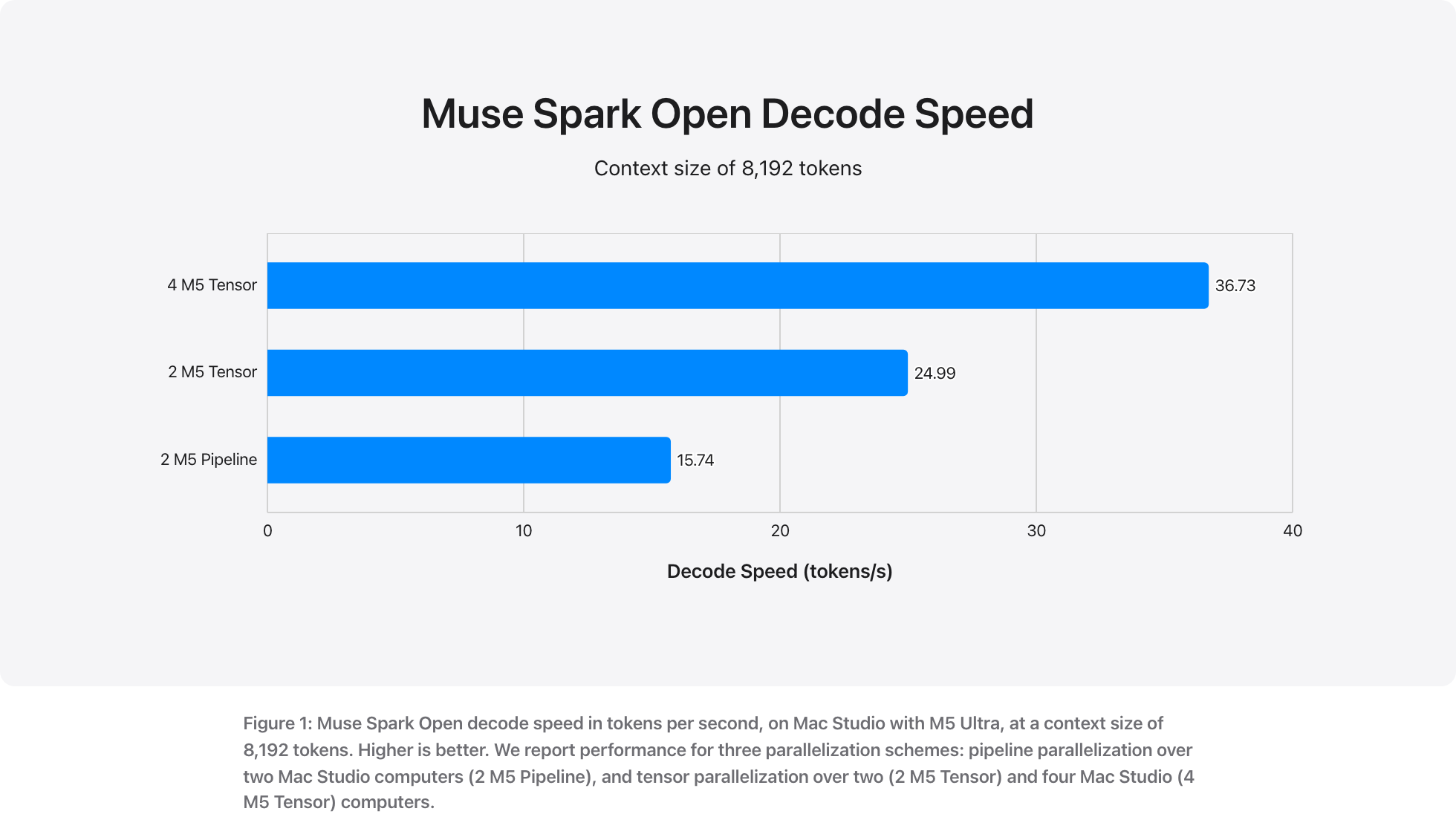
With the faster method, Apple measured about 25 tokens a second on two Macs and about 37 on four (a token is a word or a piece of one), which Apple says is well above average reading speed. The simpler split managed about 16 on two Macs. Those are Apple's own measurements.
There's a smaller option too. Hugging Face got a heavily compressed version running on a single older Mac Studio with 512GB of memory, at about 18 tokens a second, according to its setup guide.
What Meta says it can do, and where its own tests put it behind
Meta tested it running entirely on Macs inside Muse Code, its coding agent. In one job it shipped bug fixes and new features to an open-source iPhone app for the social network Mastodon. In another it ran DaVinci Resolve, the video editor, going through footage frame by frame to find the best moments and crop them for vertical video.
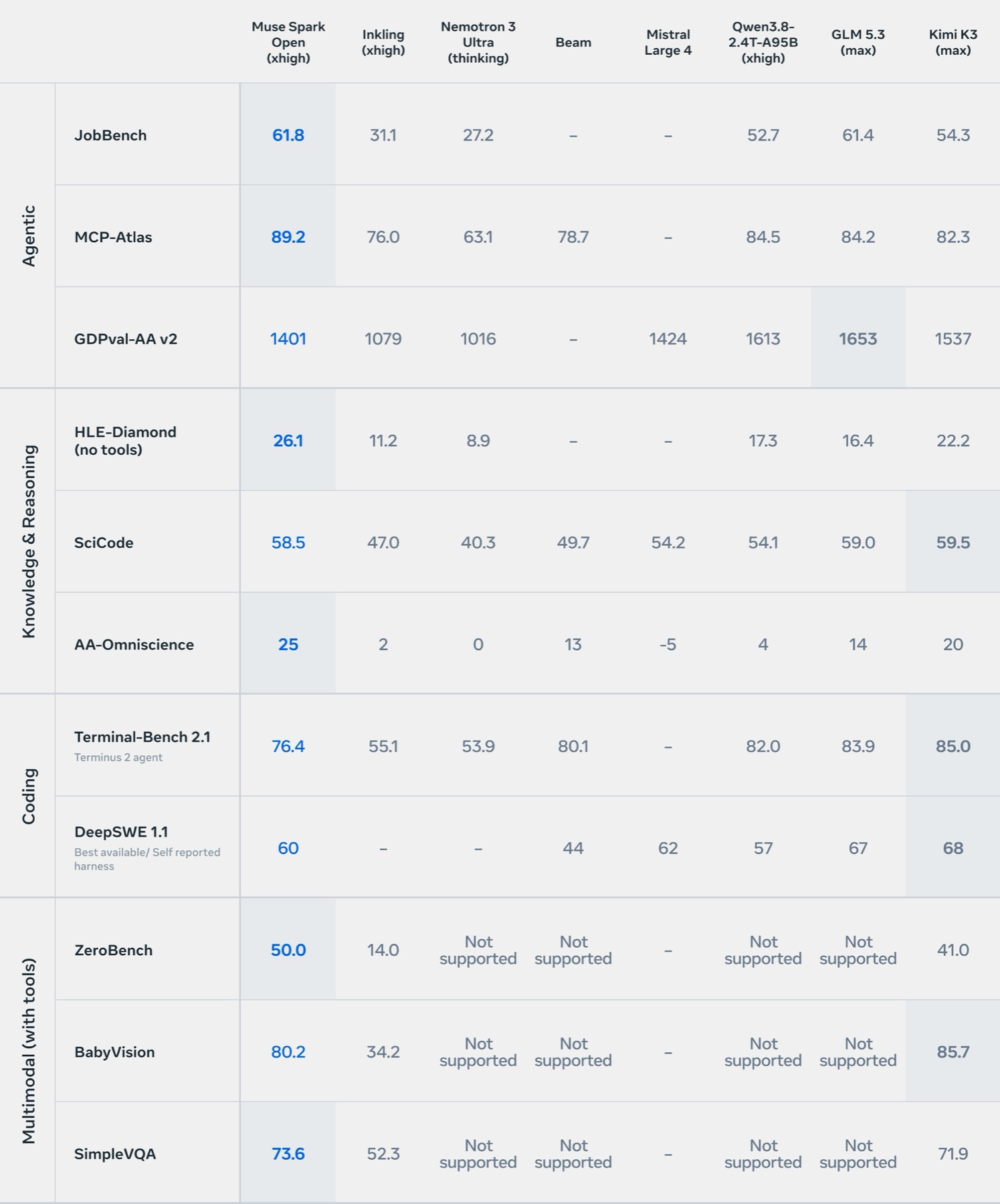
Meta calls it "the most capable US open-weight model to date." Its own test table puts it ahead of China's Kimi K3 and GLM 5.3 on several tests of agent work and reasoning, and behind both of them on its two coding tests.
No Mac Studios? You can rent it by the word
Without the hardware, you can use it through services that run it for you, including OpenRouter, Together AI, Fireworks, Groq and Baseten. On OpenRouter it costs $1.25 for every million tokens you send and $4.25 for every million it writes back, the same rate Meta has charged for its Muse Spark models since Muse Spark 1.1 in July.
Renting gives up the privacy part, since your prompts go to that company's servers.
Meta's license lets most people and companies use it for free, including inside their own products, as long as those products show "Built with Muse Spark Open" somewhere. A company making more than $20 million a year that wants to rent the model out to others needs a separate deal with Meta first, and military uses are banned.
Why Apple helped a company it has fought for years
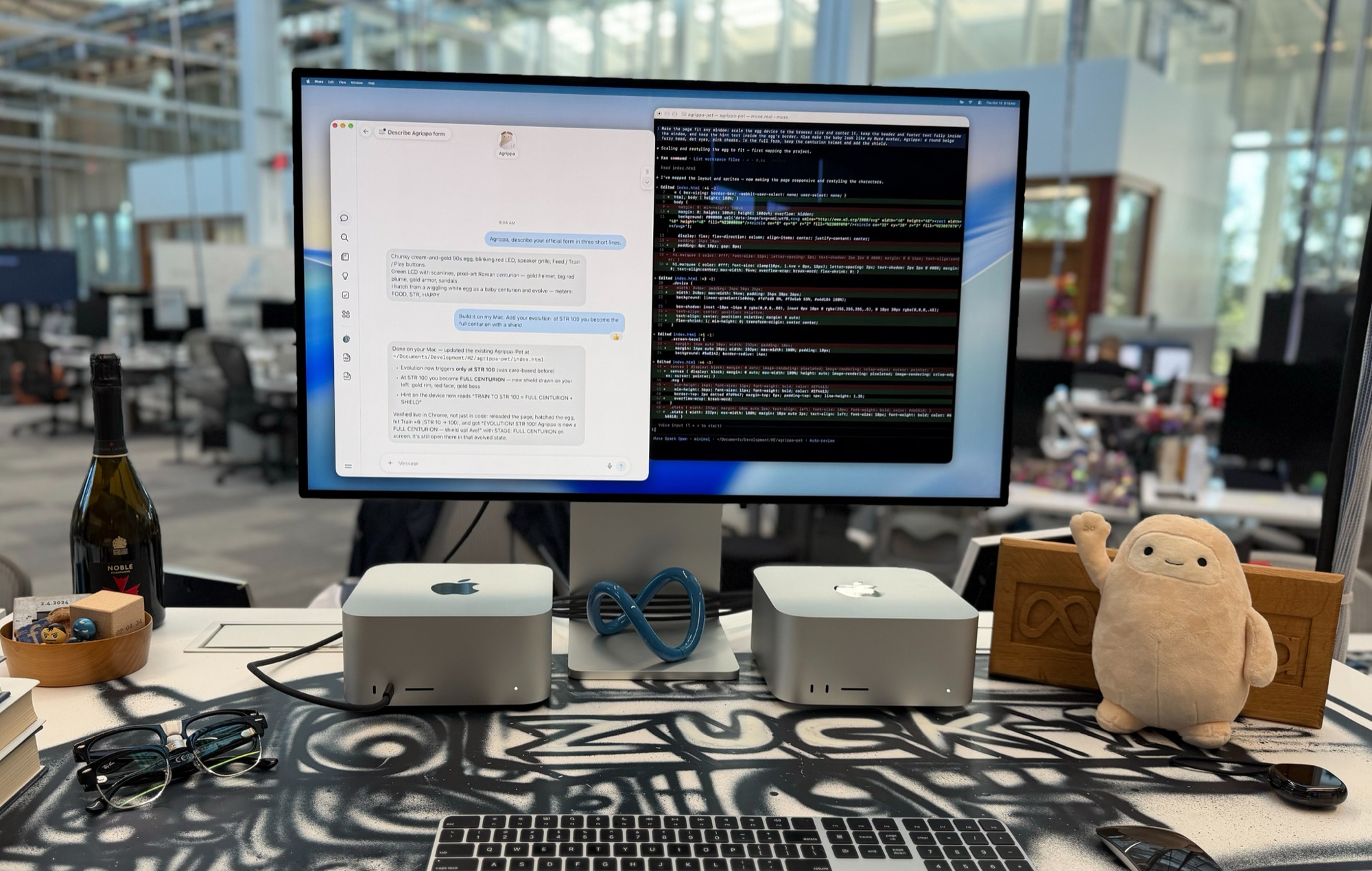
Zuckerberg posted a photo of Muse Spark Open running on two Mac Studios and thanked Apple CEO John Ternus. Ternus replied, "Mac Studio keeps pushing the boundaries of on-device AI!"
The two companies haven't announced a partnership since 2017, and the relationship hit bottom in 2021, when Apple started letting iPhone owners stop apps like Facebook from tracking them. Meta estimated that change would cost it $10 billion in revenue in 2022.
Axios reported that the two sides worked on this for several months, with Daniel Gross, a former Apple executive now at Meta, bringing them together. "We're excited for mommy and daddy to be playing nice again," Wang told Axios.
Neither company would say whether more is coming. This doesn't put Meta's models inside Apple Intelligence, the AI features built into iPhones and Macs.
I put Muse Wonder, Meta's stronger model, up against Claude Opus 5.5, Claude Fable 5.1 and GPT-6 Astra this week on four jobs: rebuilding an award-winning website, making an ad campaign with motion graphics, building an iPhone app and building a 3D simulation. It came last on every one, so a weaker open version won't change what I use.
But Apple's part in this did surprise me, given how long the two companies have been fighting. To me it says Apple wants the Mac to be the computer people run big AI models on, even a rival's.
Sources
- Meta: Introducing Muse Spark Open
- Apple Machine Learning Research: Local and distributed LLM inference with MLX on Mac Studio
- Hugging Face: Welcome Muse Spark Open
- Muse Model License
- Bloomberg: Meta releases open AI model while keeping its best tech closed
- Axios: Apple and Meta bury the hatchet, for AI
- CNBC: Apple and Meta team up to make Muse AI model run on Mac computers
- Engadget: Meta built a huge open-weight AI model for Macs
- OpenRouter: Muse Spark Open pricing

Comments
Sign in to join the conversation.