AI News Explained in Plain English: What OpenAI, Google, Anthropic and China's Labs Just Changed, and What It Means for You
This fall's biggest AI stories from OpenAI, Google, Anthropic and China's labs, each told as what changed, who gets it and what it costs, with its full explainer linked.

On this page
- What is happening in AI news right now?
- OpenAI: GPT-6.1 Terra and the 28 days of upgrades
- Google and Anthropic: Gemini 4 Argon's price, Claude's new rules and the Max lawsuit
- China's giant open models: Qwen3.8 and GLM 5.2
- What are the rules for using AI?
- Microsoft, Meta, Apple and xAI: where to see what each one shipped
- How to follow AI news without the hype
AI news explained in plain English means each story is told as what changed, who gets it, what it costs and what to do about it. As of November 28, 2026, three stories touch what people pay for and how they use AI. OpenAI released GPT-6.1 Terra on October 26 for paid ChatGPT plans (not Free or Go). Google's API price for Gemini 4 Argon rises from $2 to $4 per million input tokens on December 1, and Anthropic's new rules for Claude took effect November 12.
Each story below links to its full explainer, with the date and the source for every price and plan.
Last checked November 28, 2026: the prices, plans and dates on this page, against OpenAI's, Google's and Anthropic's own pages, linked where each one appears.
What is happening in AI news right now?
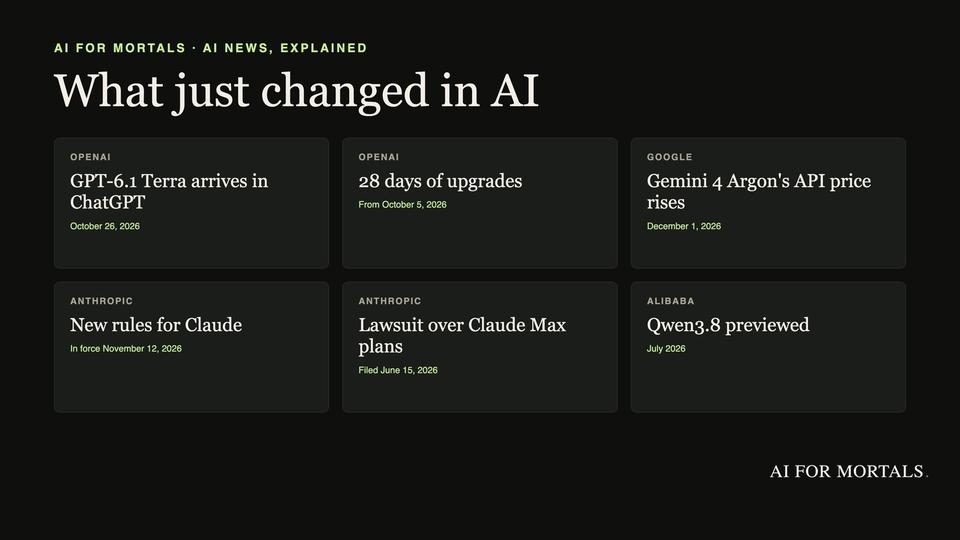
This fall's AI news comes down to cheaper models from OpenAI, a price rise from Google, new rules and a lawsuit at Anthropic, and ever bigger open models from China. The table puts the six stories side by side, with a link to the full explainer for each.
| Story | Date | Who it affects | What it costs | Full explainer |
|---|---|---|---|---|
| OpenAI releases GPT-6.1 Terra | October 26, 2026 | ChatGPT Plus, Pro, Business, Enterprise and Edu (not Free or Go) | 25 credits per million input tokens and 125 per million output, half of GPT-6.1 Sol's | What GPT-6.1 Terra changes on your ChatGPT plan |
| OpenAI promises 28 days of upgrades | Day one: October 5, 2026 | People using ChatGPT Work and Codex | No price change; Ultrafast is on the $500 Pro plan and some Enterprise and Edu workspaces, and Pro $200 now gets it for GPT-6.2 Sol in Codex | OpenAI's 28 days of ChatGPT and Codex upgrades |
| Gemini 4 Argon's API price rises | Pat's review published October 14; new price December 1, 2026 | Anyone paying for Argon through Google's API | $2 per million input tokens and $10 per million output through November 30, then $4 and $20 | Pat's Gemini 4 Argon review and build costs |
| Anthropic's updated usage policy | Published October 8; in force November 12, 2026 | Everyone using Claude, and teams using it for decisions about people | No price change | Anthropic's new rule against abusing Claude |
| Lawsuit over Claude Max plans | Filed June 15, 2026 | Buyers of Max 5x ($100 a month) and Max 20x ($200 a month) since April 2024 | The suit seeks refunds; its claims are untested in court | The lawsuit over Anthropic's $200 Claude Max plan |
| Alibaba previews Qwen3.8 | July 2026 | Developers on Alibaba's cloud; open weights promised later | Preview only, through Alibaba's cloud | Alibaba's Qwen3.8 preview |
Dates and plans come from each explainer and, where noted below, the company's own page, checked November 28, 2026.
OpenAI: GPT-6.1 Terra and the 28 days of upgrades
OpenAI's two moves this fall both stretch what a paid ChatGPT plan covers: GPT-6.1 Terra, a cheaper model for everyday computer work, and a promise of one upgrade a day for 28 days.
Terra came out on October 26 in ChatGPT Work and Codex, the parts of ChatGPT that carry out multi-step tasks and write code. According to OpenAI's Terra announcement, it handles jobs like drafting proposals, reading technical drawings and filling out forms. Plus, Pro, Business, Enterprise and Edu plans get it, and Free and Go plans don't.
The main change for subscribers is how far a plan goes. OpenAI's pricing and usage page estimates that a Plus plan covers 35 to 285 Terra messages every five hours, against 15 to 160 for GPT-6.1 Sol and 5 to 45 for GPT-6 Astra. Once that allowance runs out, extra usage is paid in credits, and Terra costs 25 credits per million input tokens and 125 per million output, half of Sol's 50 and 250. (Tokens are the small chunks of text a model reads and writes.)
OpenAI also says Terra finishes computer tasks over three times faster than Sol and Astra. That is OpenAI's own figure, and Pat hasn't tested Terra yet.
The 28-day promise came from Tibo Sottiaux, who runs ChatGPT and Codex at OpenAI. He said his team would ship one clear improvement to ChatGPT or Codex every day for 28 days, or ship a full usage reset on any day it couldn't. On day one, GPT-6 Astra and GPT-6.1 Sol got about 50% faster at their default speed. On day one, Ultrafast, a much quicker mode, was limited to the $500 Pro plan and some Enterprise and Edu workspaces. OpenAI's Work and Codex help page now also gives Pro $200 Ultrafast for GPT-6.2 Sol in Codex.
OpenAI has kept shipping since. It introduced GPT-6.2 Astra and GPT-6.2 Sol on November 17, and its pricing page lists both for Plus, Pro, Business, Enterprise and Edu in ChatGPT Work and Codex.
Google and Anthropic: Gemini 4 Argon's price, Claude's new rules and the Max lawsuit
Gemini 4 Argon was the cheapest model in Pat's build test and came last in every round, and its API price doubles on December 1. Anthropic's new Claude rules took effect on November 12, and a lawsuit over its Max plans hasn't been tested in court.
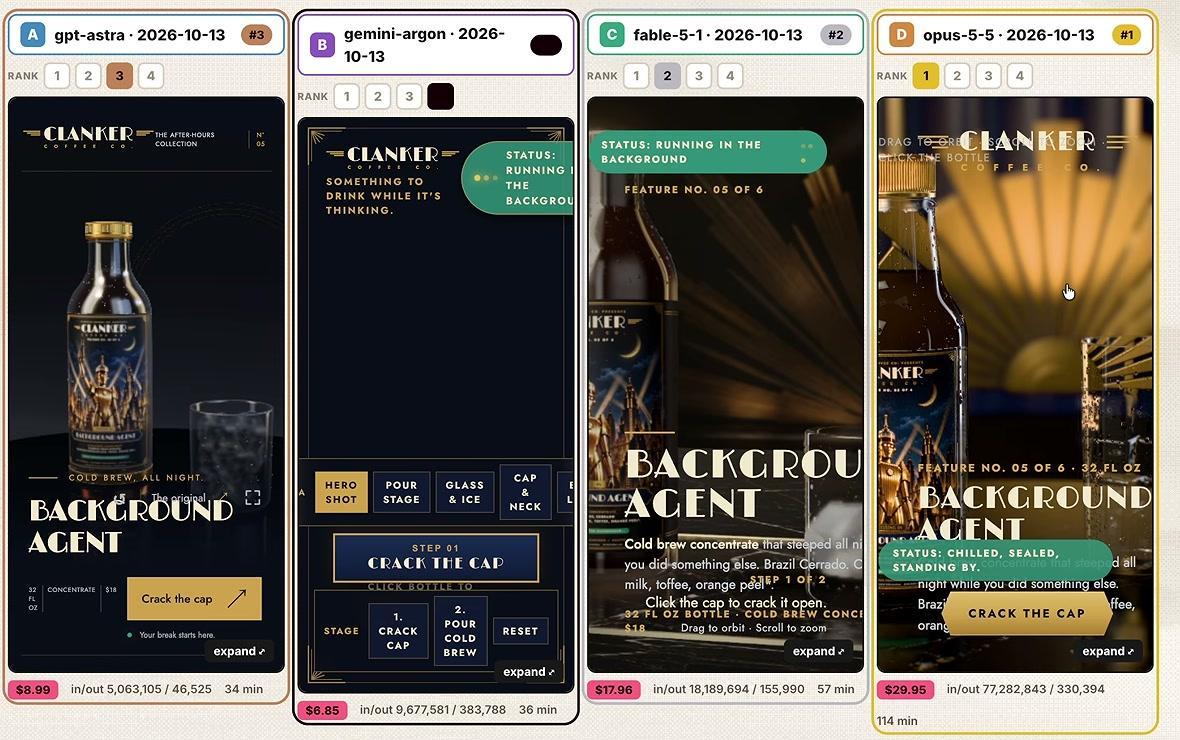
Pat gave Argon, Opus 5.5, Fable 5.1 and GPT-6 Astra the same four hard builds: a photoreal 3D product bottle, a product launch video, a car soccer game and a rebuild of a 3D-heavy website. He judged every round blind, and Argon ranked last in all four while Opus 5.5 ranked first in all four.
| Model | Cost for all four builds | Total build time | Blind rank |
|---|---|---|---|
| Gemini 4 Argon | $39.54 | 247 min | Last in all four |
| Opus 5.5 | $189.04 | 715 min | First in all four |
| Fable 5.1 | $203.08 | 548 min | Second or third |
| GPT-6 Astra | $409.96 | 670 min | Second or third |
Costs are API-equivalent: the token counts each build used, priced at each model's published rates. From Pat's Gemini 4 Argon review, published October 14, 2026.
Argon's low cost was partly its introductory price. Google's API pricing page lists Argon at $2 per million input tokens and $10 per million output through November 30, 2026, then $4 and $20 starting December 1. Argon has no free tier in the API.
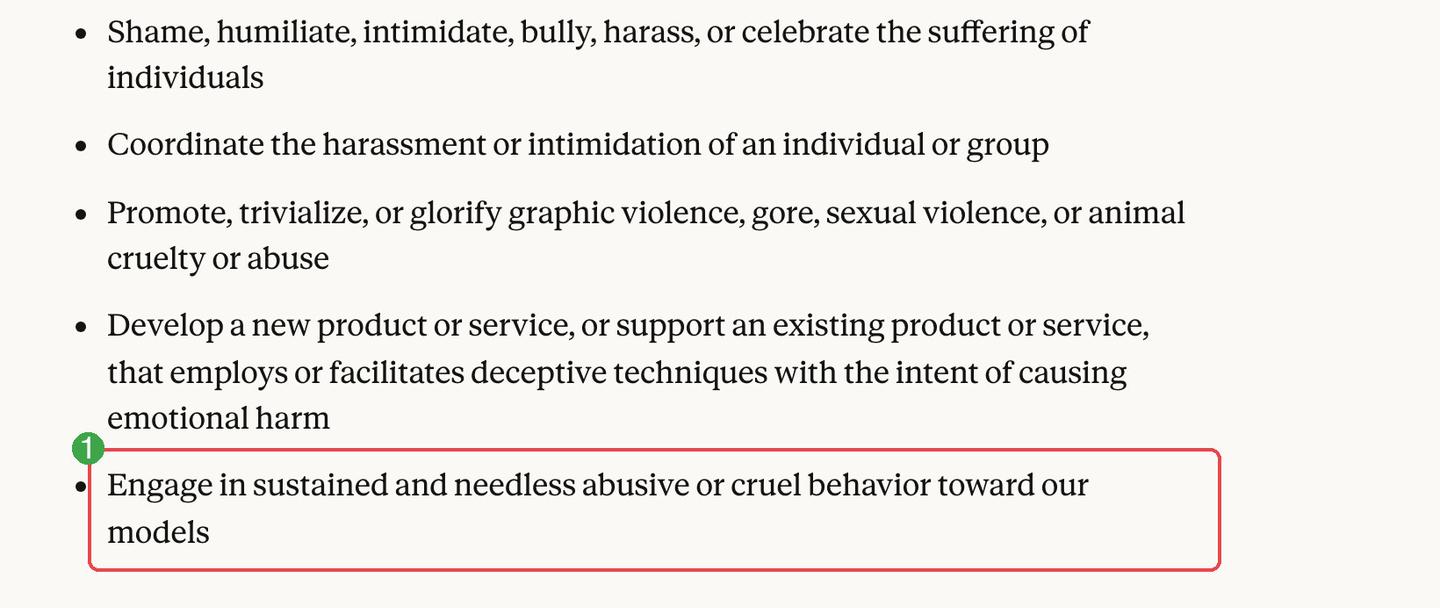
Anthropic published its updated usage policy on October 8, and the policy took effect November 12. The new line bans "sustained and needless abusive or cruel behavior" toward Claude, and Anthropic says it applies only in extreme cases of repeated cruelty with no purpose, and that everyday frustration and pushback don't count. Claude has been able to end abusive conversations since August 2025, and Anthropic says that stays the main way the rule is enforced.
The rule with more day-to-day reach is the human check. When Claude's recommendations can affect someone's health, legal rights, money, job or access to essential services, a qualified person has to be able to review and change them, and the person affected has to be told AI was used. Anthropic says those requirements aren't new, and the update spells out which recommendations they cover.
A federal suit filed in California by customer Karl Kahn alleges that Anthropic's Max plans, Max 5x at $100 a month and Max 20x at $200 a month, deliver far less usage than marketed. It asks for class status covering buyers since April 2024. Anthropic declined to comment, and none of the claims have been tested in court.
China's giant open models: Qwen3.8 and GLM 5.2
China's labs keep announcing very large open models, the kind whose files anyone can download and run, though the newest, Alibaba's Qwen3.8, is so far only a preview.
Alibaba previewed Qwen3.8 at the World AI Conference in Shanghai. It has 2.4 trillion parameters, the internal settings a model adjusts as it learns. Only Qwen3.8-Max-Preview is available, through Alibaba's cloud, and the open-weight version is "coming soon" with no date. Kimi K3, announced two days earlier by Moonshot, has 2.8 trillion.
Alibaba says Qwen3.8 trails only Anthropic's Fable 5. That is Alibaba's claim, with no independent test behind it.
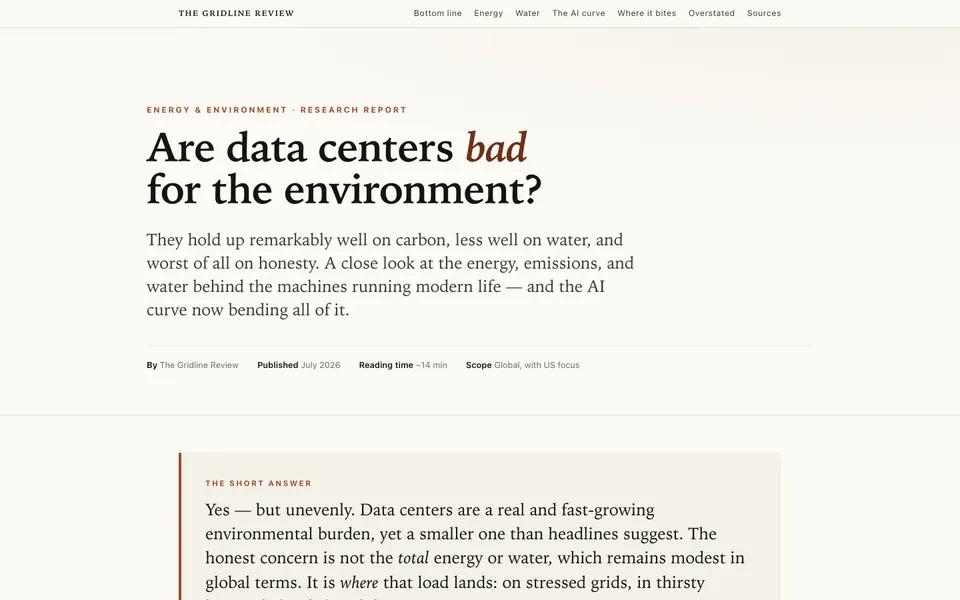
GLM 5.2 is one Pat did test. He gave GLM 5.2 and Kimi K3 the same six build jobs, and one was a research report: whether data centers are bad for the environment, with a focus on water use, delivered as one designed web page with its own charts and a source for every number. GLM 5.2's report is live on AI for Mortals as a working build.
What are the rules for using AI?
The rules depend on where you are and which AI tool you use. The EU AI Act is law in the EU, international frameworks such as the OECD's and UNESCO's are voluntary, and each AI company sets its own usage policy, like Anthropic's new one for Claude.
The OECD's framework has five values-based principles, and UNESCO's has four core values and ten principles. Ideas that show up across them include fairness, transparency and accountability. Neither is binding.
The EU AI Act entered into force on August 1, 2024 and applies in stages. Chatbots fall under its transparency rules, which apply from August 2026: people should be told when they are talking to a machine, and AI-generated content has to be identifiable.
Company policies are the rules most people meet first. Anthropic's usage policy, for example, requires any consumer chatbot or AI agent built on Claude that talks directly with outside users to tell them they are dealing with AI, at least at the start of each chat or in the product itself. Its human-check rule for decisions about people's health, money, jobs or legal rights is in the section above.
Microsoft, Meta, Apple and xAI: where to see what each one shipped
Each of the four has an AI for Mortals company page that lists its AI products and a dated timeline of everything it shipped, newest first.
Microsoft's company page tracks what Microsoft shipped in AI, from Copilot to its own MAI models. The newest entries include the MAI models it released on November 17, among them MAI Code 2 and MAI Image 2.7.
Meta's page lists what Meta shipped in AI across Llama, the Meta AI assistant and the Muse models. One recent entry is Muse Spark Open, an open-weight model for coding released October 15.
For Apple, the page collects Apple Intelligence and Siri AI releases, with Siri AI still in beta. On November 9 Apple introduced a one-time $49.99 Intelligence Usage Pack for people who hit the usage limit on features that run on cloud models from OpenAI or Google.
xAI's Grok and Grok Bot timeline has its newest entry on November 20, when Grok Bot connected to Intuit QuickBooks to answer questions about cash flow and draft invoices and payment reminders for you to approve.
How to follow AI news without the hype
Read every AI story for four things: what changed, who gets it, what it costs, and whether anyone outside the company has tested it.
The last one does the most work. OpenAI's speed figure for Terra and Alibaba's ranking for Qwen3.8 are the companies' own numbers, while Argon's last-place finish comes from Pat running the same builds on four models and judging them blind. A vendor's claim and a side-by-side test answer different questions, and every story on this page says which one it is reporting.
Prices and plans change fastest, so check the date next to them. Argon's API price doubles between November 30 and December 1, which is why every price here carries the date it was checked.
Pat's own posts publish the prompts behind what he built, so a reader can try the same thing. His YouTube thumbnail downloader is one example: ChatGPT drafted the spec, and Cursor wrote and fixed the code. The AI for Mortals blog lists every story newest first.
AI for Mortals is also a free newsletter, sent every weekday, with the practical AI updates of the day and exactly what to do with them. The signup box is at the bottom of this page.
Sources
- OpenAI: Introducing GPT-6.1 Terra
- OpenAI: Codex and ChatGPT Work pricing and usage limits (checked November 28, 2026)
- OpenAI: Introducing GPT-6.2 Astra and Sol
- OpenAI Help Center: ChatGPT Work and Codex (checked November 28, 2026)
- Google AI for Developers: Gemini API pricing (checked November 28, 2026)
- Anthropic: 2026 Usage Policy update
- Anthropic: Usage Policy
- AI for Mortals: the GLM 5.2 research report build
- AI for Mortals: GLM 5.2 vs Kimi K3, six build jobs
- AI for Mortals: AI ethics explained, and the rules that govern AI
- AI for Mortals: how Pat built a thumbnail downloader with ChatGPT and Cursor
- AI for Mortals: every story, newest first


Comments
Sign in to join the conversation.